Track your progress, take practice exams, and study the flashcards in the app.
6.3 The 40 Highest-Yield Facts
- Recall the numeric limits and thresholds that appear most often on the UAG test
- Distinguish the numbers that are commonly confused with one another
- Use the cram sheet as a final review in the 24 hours before the exam
This is the page to read on the morning of your exam. Forty facts, chosen because they appear more often than anything else on the UAG test. Nothing here is new - you have met all of it in Modules 1 through 5. What follows is compression, not instruction.
Use it three ways. Two days out, read it slowly and stop at anything that does not feel automatic, then go back to the lesson that covers it. The night before, read it once and go to bed early. The morning of, read it once in the parking lot and then put it away, because you cannot bring it inside.
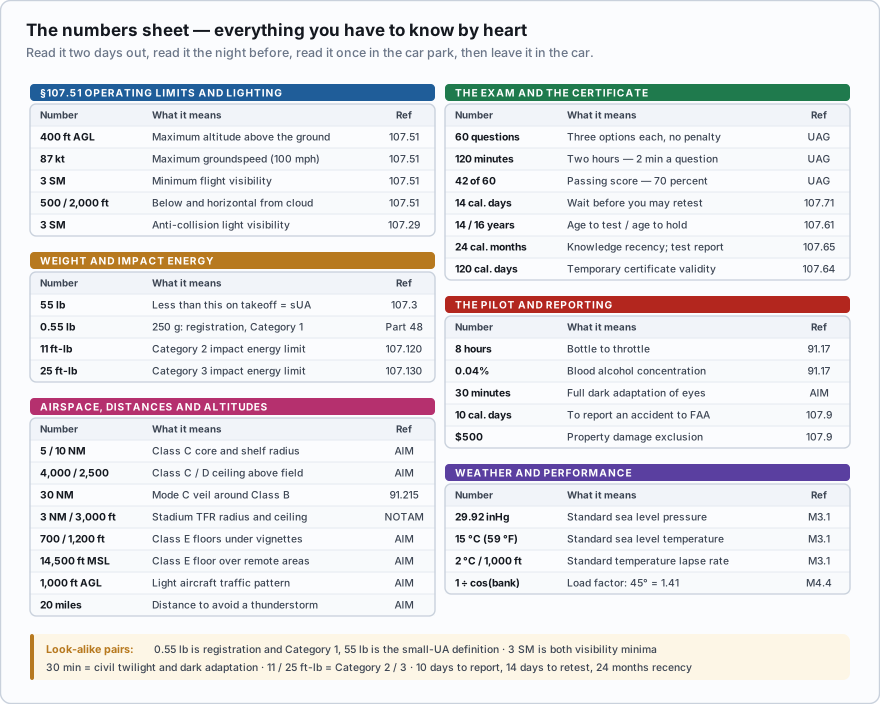
Facts 1 to 20 — the aircraft, the pilot, and the limits
| # | The number | What it means |
|---|---|---|
| 1 | 400 ft AGL | Maximum altitude under 107.51(b) - or 400 ft above a structure's uppermost limit, if you stay within a 400 ft radius of that structure |
| 2 | 87 knots (100 mph) | Maximum groundspeed, 107.51(a) |
| 3 | 3 statute miles | Minimum flight visibility, as observed from the location of the control station, 107.51(c) |
| 4 | 500 ft below / 2,000 ft horizontal | Minimum distance from clouds, from the control station, 107.51(d) |
| 5 | Less than 55 pounds | Definition of a small unmanned aircraft, on takeoff, including everything on board or otherwise attached, 107.3 |
| 6 | 0.55 lb (250 g) | Category 1 operations over people, and the recreational registration threshold. Under Part 107 every aircraft is registered regardless of weight (§48.15, §107.13) |
| 7 | 11 ft-lb / 25 ft-lb | Category 2 and Category 3 impact kinetic energy limits |
| 8 | Category 4 | The only operations-over-people category requiring an airworthiness certificate issued under Part 21 |
| 9 | 3 statute miles | Distance at which anti-collision lighting must be visible at night and during civil twilight, 107.29. It may be dimmed in the interest of safety, never extinguished |
| 10 | 30 minutes | Civil twilight - before official sunrise and after official sunset, except in Alaska |
| 11 | 30 minutes | Time for the eyes to fully adapt to darkness |
| 12 | 8 hours / 0.04% | Bottle to throttle, and the blood alcohol concentration limit, 107.27 through 91.17. Note 0.04% is half the usual 0.08% state driving limit |
| 13 | 12 to 24 hours | The FAA's *recommended* interval between drinking and flying - guidance, not regulation |
| 14 | 10 calendar days | Deadline to report a qualifying safety event to the FAA, 107.9 |
| 15 | $500 | The property damage exclusion: report unless repair cost is $500 or less, or fair market value is $500 or less. It is not a $500 trigger |
| 16 | 24 calendar months | Aeronautical knowledge recency, 107.65 - and the validity period of the Airman Knowledge Test Report |
| 17 | 14 calendar days | Wait before you may reapply for the knowledge test after failing it, 107.71 |
| 18 | 16 years old | Minimum age to hold a remote pilot certificate. You may take the test at 14 |
| 19 | 42 of 60 in 120 minutes | Passing score, 70%, three options per question, no penalty for guessing |
| 20 | 120 calendar days | Maximum validity of a temporary remote pilot certificate, 107.64 |
An aircraft weighs 0.52 lb ready to fly and you are using it for a paid roof inspection. Which statement is correct?
- It must be registered, because the 0.55 lb exemption applies only to recreational flights
- It does not require registration, because it weighs less than 0.55 lb
- It is not a small unmanned aircraft, so Part 107 does not apply to it
Answer: A. The 0.55-pound exemption in §48.15 has two conditions: the aircraft must weigh 0.55 lb or less and be operated exclusively under the recreational exception. A paid inspection fails the second, so the aircraft must be registered. The weight still matters for a different rule - at 0.52 lb it may qualify for Category 1 operations over people if it has no exposed rotating parts that could lacerate skin.
Facts 21 to 40 — airspace, weather, flight, and operations
| # | The number | What it means |
|---|---|---|
| 21 | One aircraft | 107.35 - no person may act as remote PIC, manipulate the controls, or serve as visual observer for more than one unmanned aircraft at a time |
| 22 | Sparsely populated area | The only place you may operate from a moving land or water-borne vehicle, 107.25 - and never from a moving aircraft, and never carrying another person's property for compensation or hire |
| 23 | 5 NM and 10 NM | Class C: 5 NM inner core, 10 NM shelf, plus a 20 NM outer area that is not charted |
| 24 | 30 NM | The Mode C veil around the primary airport of Class B airspace |
| 25 | 3 NM / 3,000 ft AGL | Stadium TFR - 1 hour before to 1 hour after an event at a stadium seating 30,000 or more, per standing NOTAM. Note it is 3,000 ft, not the 2,500 ft in the text of 91.145 |
| 26 | 20 miles | Distance by which to avoid a thunderstorm - and the entire cell, not the visible cloud |
| 27 | Class B, C, D, and Class E surface areas | The airspace requiring prior ATC authorization, 107.41. Class E at 700 or 1,200 ft AGL needs no authorization |
| 28 | 50 ft | UAS Facility Map grid increments - 150, 250 and 350 are real values. A 0 ft grid is not a no-fly zone; it means no automatic LAANC approval |
| 29 | 29.92 inHg, 15 °C, 2 °C per 1,000 ft | Standard atmosphere: sea level pressure, sea level temperature, and the standard temperature lapse rate |
| 30 | BKN, OVC, or VV | The sky conditions that constitute a ceiling. FEW and SCT are not ceilings |
| 31 | True north | METAR and TAF winds are referenced to true north. Tower, ATIS, and AWOS spoken winds are magnetic |
| 32 | Load factor = 1 ÷ cos(bank) | 30° = 1.15, 45° = 1.41, 60° = 2.0. Depends only on bank angle, not on weight or speed |
| 33 | Critical angle of attack | A stall occurs when it is exceeded - at any airspeed and any attitude. Roughly 16 to 20 degrees |
| 34 | Pilot's Operating Handbook or UAS flight manual | Where CG limits and loading instructions come from. Not the AIM, not the Weight and Balance Handbook |
| 35 | The remote pilot in command | Responsible for determining performance, for the condition for safe operation before each flight, for the preflight inspection - and is the final authority as to the operation, 107.19 |
| 36 | Remote ID since 16 March 2024 | Three compliance paths: standard remote ID, a broadcast module, or operating entirely within a FRIA. The serial number goes on the Certificate of Aircraft Registration |
| 37 | 1,000 / 1,500 / 500 ft AGL | Traffic pattern altitude: light aircraft / large and turbine aircraft / helicopters. Patterns are left turns unless RP is charted |
| 38 | 122.9 and 122.95 | MULTICOM, used where there is no tower, FSS, or UNICOM / UNICOM at an airport that has a tower or FSS |
| 39 | 10 miles | Distance from an airport at which pilots begin monitoring and self-announcing on CTAF |
| 40 | Five hazardous attitudes | Anti-authority, impulsivity, invulnerability, macho, and resignation - each with its own specific antidote |
The pairs people mix up
- 0.55 lb is the Category 1 weight limit, and the recreational registration threshold. Under Part 107 there is no weight floor for registration. 55 lb is the upper bound of the definition of a small unmanned aircraft
- 3 statute miles is both the minimum flight visibility and the anti-collision light visibility. Same number, two unrelated rules
- 30 minutes is both civil twilight and full dark adaptation. Again, same number, unrelated rules
- 24 calendar months is recency *and* test report validity. 14 calendar days is the retest wait. 10 calendar days is the safety event report deadline
- 11 ft-lb is Category 2, 25 ft-lb is Category 3. The higher energy is the higher-numbered category
- 87 knots is groundspeed, not airspeed. 400 feet is AGL, not MSL
- Condition for safe operation - the standard for a Part 107 aircraft. There is no airworthiness certificate and no required maintenance program, except for Category 4
- Knows or has reason to know - the test in 107.15(b) for continuing flight, and in 107.17 for a disqualifying medical condition
- Directly responsible for and the final authority as to the operation - the remote PIC, 107.19
- In the interest of safety - the condition under which anti-collision lighting may be dimmed
- Everything that is on board or otherwise attached - the 55 lb weighing rule
- Yielding the right of way means the small unmanned aircraft may not pass over, under, or ahead of another aircraft unless well clear
- Recurrency is a free online course, ALC-677, not a retest at a testing center. The certificate itself never expires
- The notify-any-airport-within-5-miles rule is obsolete for Part 107. What you need is ATC authorization in controlled airspace
- A 0-foot UAS Facility Map grid is not a no-fly zone. It means no automatic LAANC approval; you request further coordination
- Night operations need no waiver - anti-collision lighting and post-6-April-2021 training are the requirements
- Part 108, the beyond-visual-line-of-sight rule, is proposed and is not law. BVLOS today requires a 107.31 waiver or a 44807 exemption
Do not treat this sheet as a substitute for the modules. It is a compression of material you have already learned, and compression only works if the original is there to decompress into. A student who reads only this page will recognize the numbers and still miss the application questions - and application questions, particularly in Operations, are where most of the exam lives.
Your drone strikes a parked car. The repair estimate is $430 and the car is worth $9,000. What must you do?
- Report to the FAA within 10 calendar days
- Nothing - the repair cost does not exceed $500, so the report is excluded
- Report to the NTSB within 10 calendar days
Answer: B. Section 107.9 requires a report unless the cost of repair does not exceed $500, or the fair market value does not exceed $500 in the event of total loss. Repair is $430, so the exclusion applies. Note the structure: $500 is an exclusion, not a trigger. Separately, if anyone had suffered a serious injury or died, 49 CFR Part 830 would require immediate notification to the NTSB as well — that is a second obligation, not a substitute for the FAA report.
Which of these requires prior ATC authorization for a Part 107 operation at 300 feet AGL?
- Class E airspace with a floor of 700 ft AGL
- Class G airspace beneath a Class E shelf
- The surface area of Class E airspace designated for an airport
Answer: C. Section 107.41 requires authorization in Class B, C, and D, and within the lateral boundaries of the surface area of Class E designated for an airport. Class E with a 700 or 1,200 ft AGL floor requires nothing - at 300 feet you are in Class G underneath it anyway.
Beyond the test: about half of this sheet is operationally useful for the rest of your flying career - the 107.51 limits, the reporting thresholds, the alcohol rules, the airspace authorizations. The other half you will never think about again after the exam. Do not feel bad about that. Every certificated pilot carries a set of numbers that existed only to be tested.
- Forty facts carry a disproportionate share of the UAG test, and nearly all of them are numbers
- The four 107.51 limits - 400 ft AGL, 87 knots, 3 statute miles, 500 below and 2,000 horizontal - are the most reliably tested set on the exam
- Watch the look-alike pairs: 0.55 lb and 55 lb, 10 days and 14 days and 24 months, 11 ft-lb and 25 ft-lb
- The $500 property damage figure is an exclusion from the reporting requirement, not a trigger for it
- Class E at 700 or 1,200 ft AGL needs no authorization; only Class E surface areas do
- Recurrency is a free online course every 24 calendar months, and the certificate itself never expires
- Read the sheet two days out, the night before, and once in the parking lot - then leave it in the car