Track your progress, take practice exams, and study the flashcards in the app.
6.2 Test Day
- Describe the testing center environment and the check-in process
- Apply a pacing strategy that leaves time for the figure-based questions
- Use a repeatable method for attacking a chart question under time pressure
Test day is far less dramatic than it feels beforehand. You arrive, you hand over identification, you lock your belongings in a cubby, you sit at a computer in a quiet room for somewhere between forty and ninety minutes, and you find out your score immediately. This lesson removes the remaining surprises.
What the center is like
Most testing centers are small - a reception desk and a room with somewhere between four and twenty computer stations, often with dividers. There will be other people taking entirely different exams. It is quiet, it is usually cold, and it is lit like an office. Some centers offer noise-canceling earmuffs; take them if you are offered them.
At check-in the proctor verifies your identification and FTN, takes your photograph, may take a palm or signature scan, and asks you to empty your pockets into a locker. You are then walked to a station, given scratch material, and started. A countdown timer runs in the corner of the screen for the full 120 minutes.
| Bring | Leave in the locker |
|---|---|
| Your government identification (and a second document if needed) | Phone, smart watch, fitness tracker, earbuds |
| Your FTN written down | Notes, books, printed cram sheets, this course |
| A simple non-programmable calculator, if your center permits one | Programmable or graphing calculators, anything with stored text |
| Glasses, if you wear them - the charts are small | Bags, jackets with pockets, food and drink |
| Nothing else | Hats other than religious headwear |
How the supplement works
When a question references a figure, it names it - Figure 20, area 3, for instance. You open the printed FAA-CT-8080-2H booklet to that numbered plate and find the small numbered box on the chart marking the area of interest. The booklet is shared across several airman tests, so most plates are irrelevant to you and you will flip past a lot of instrument approach material to find sectional excerpts.
Two things make this easier. First, having handled the booklet before - download it free from faa.gov and open it at home. Second, remembering that the paper plate is the authoritative image. The on-screen version may be small or may not be there at all; work from the paper.
A question refers you to Figure 21. Where do you find it?
- In a printed supplement booklet handed to you at the testing center
- In a PDF you download to your phone before the test
- On screen only, alongside the question
Answer: A. FAA-CT-8080-2H, the Airman Knowledge Testing Supplement, is a printed booklet provided at the testing center. You cannot bring your own copy and you cannot use a phone. You can and should download it beforehand to practice with at home.
Pacing — two minutes a question, unevenly spent
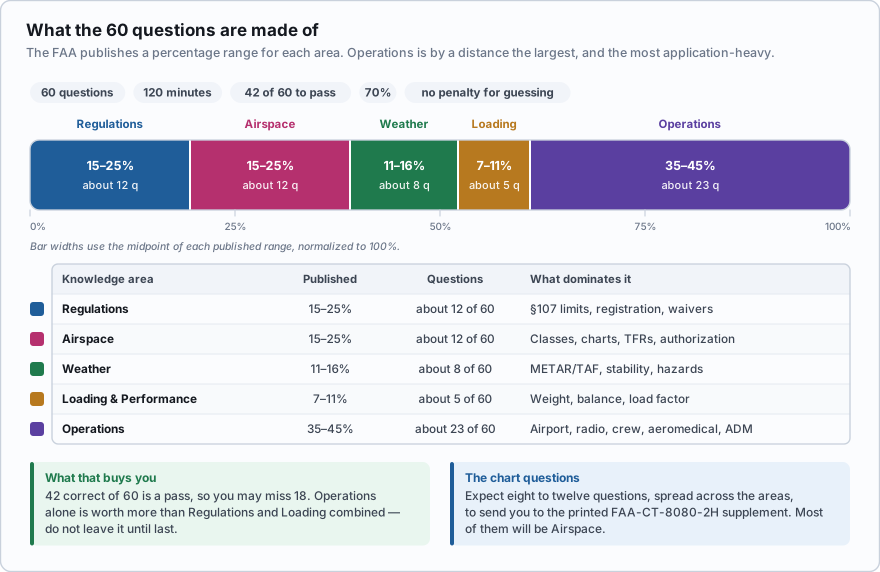
You have 120 minutes for 60 questions, which averages two minutes each. That average is misleading in a useful way. Most questions are pure recall and take fifteen to thirty seconds. The eight to twelve figure questions take two to four minutes. If you move quickly through the recall items, you buy yourself an enormous cushion for the charts and a full review pass.
Work in two passes. On the first pass, answer everything you know immediately and flag anything that needs a chart, needs arithmetic, or needs thought. Do not sit and struggle on question 7 while forty easy points wait at question 40. On the second pass, work through the flagged items with the time you have banked.
| Elapsed | You should be at about | If you are behind |
|---|---|---|
| 20 minutes | Question 25 on the first pass | Stop deliberating. Flag and move |
| 40 minutes | First pass complete, roughly 12 flagged | Answer every remaining question with your best guess, then flag it |
| 75 minutes | Flagged chart questions finished | Prioritize the flagged items you can definitely solve; guess the rest |
| 100 minutes | Review pass under way | Skip the review; make sure nothing is blank |
| 115 minutes | Every question answered, nothing blank | Fill every blank with a guess right now |
One caution on the review pass. Change an answer only if you can articulate the specific reason it is wrong - you misread the bank angle, you used the wrong airspace class, you missed the word not in the stem. Changing an answer on a vague feeling that the other one looks nicer costs more people points than it gains.
How to attack a chart question
- Read the question before you look at the chart. Know exactly what you are hunting for - a frequency, a floor altitude, an airport name, a hazard. Otherwise you will read the whole chart and answer nothing.
- Find the figure and the numbered area box. These are small. Put a finger on it and keep it there.
- Identify the airspace and the features around your point before you start decoding anything. Which color boundaries are you inside? Which airport is nearest?
- Decode only what the question asked for. A sectional excerpt contains hundreds of facts and you need one.
- Check your answer against the options. If your reading does not match any option, you decoded the wrong element or the wrong area. Go back to step 2 rather than forcing your answer into the closest option.
- Sanity-check the units. MSL or AGL, statute or nautical, feet or hundreds of feet. A large share of wrong chart answers are the right number in the wrong unit.
- Never leave a question blank. There is no penalty for a wrong answer, so a blank is a guaranteed zero
- Work in two passes: answer what you know, flag the rest, then return
- Read the question before the chart
- If your chart answer matches none of the three options, you decoded the wrong thing - go back rather than force a fit
- Change an answer on review only when you can name the specific error you made
The most expensive habit on this test is finishing early and leaving. You paid $175 and you have 120 minutes. If you complete the first pass in 45 minutes, use the remaining hour. Reread every question stem hunting for the word not, except, or minimum. Re-verify every chart answer. Nobody has ever been given points back for handing the exam in with an hour on the clock.
You have 20 minutes left and four chart questions flagged. What is the best use of that time?
- Work the flagged questions carefully in order, leaving any you cannot finish
- Put a provisional answer on all four immediately, then work them properly with whatever time remains
- Skip the charts and re-check the recall questions instead
Answer: B. Answer first, refine second. Once every question has something in it, you can no longer be hurt by running out of time - the worst case becomes a guess rather than a zero. Then work the flagged items properly and improve on the guesses you can.
The moment you click submit
You get your score on screen straight away. If you passed, the proctor issues your Airman Knowledge Test Report with your score and an exam identification number, and the result also posts to the FAA system, usually within about 48 hours. Go to lesson 6.5 and file the application - most people do it the same evening.
If you did not pass, the report lists the ACS knowledge codes for every question you missed. That is not a consolation prize, it is a precise study list. Bring those codes into the weak-area engine in this course, drill exactly them, and rebook after the required 14 calendar days. People who fail once and study the codes usually pass comfortably the second time.
- Bring identification and your FTN; everything else goes in a locker. The center supplies scratch material and the supplement
- Figures come from the printed FAA-CT-8080-2H booklet; download it free beforehand and practice with the real plates
- Work in two passes: answer what you know, flag what needs a chart or arithmetic, then return with the time you banked
- For chart questions: read the question first, find the numbered area, decode only what is asked, and sanity-check the units
- Never leave a question blank - there is no penalty for guessing
- Do not finish early and leave; use the full 120 minutes to hunt for not, except, and minimum in the stems
- You get your score immediately; a failing report lists the exact ACS codes you missed, and you may retest after 14 calendar days