Track your progress, take practice exams, and study the flashcards in the app.
5.9 Aeronautical Decision-Making & the Five Hazardous Attitudes
- Explain the accident chain and name the methodology that prevents the final link
- Apply the DECIDE model, the 3P loop and the PAVE checklist to a real job
- Identify each of the five hazardous attitudes and state its exact FAA antidote
- Assess a hazard using a likelihood-by-severity risk matrix before you fly
Most people arrive at this lesson expecting the soft part of the course. It is not. Aeronautical decision-making is one of the most heavily tested subjects on the entire exam, and the FAA writes the questions with very specific answers in mind. There is a right name for each hazardous attitude, a right wording for each antidote, and a right answer to the accident-chain question. Learn those exactly and you bank several points.
It also happens to be true. Drone airframes rarely break. Pilots fly them into wires, past the battery reserve, into weather that was forecast, and over people because a client asked. Those are decisions, and decisions can be trained.
What ADM is
Aeronautical decision-making (ADM) is a systematic approach to the mental process a pilot uses to consistently determine the best course of action in response to a given set of circumstances. The key word is *systematic*. ADM is not judgment, instinct, or experience. It is a procedure you run — the same way you run a preflight — so that a tired pilot on a bad day still reaches a defensible decision.
The accident chain
Accidents are almost never one mistake. A series of events, and the decisions made in response to them, form a chain that leads to the outcome. The FAA's point, repeated everywhere in its safety literature, is that breaking any single link stops the accident. The chain has to be complete to kill you.
The PHAK illustrates it with a pilot who was interrupted during a checklist, skipped an item, took off anyway, and later misdiagnosed the engine problem that resulted. No single blunder — a cascade. And as the handbook notes, most pilots have made those same mistakes and got away with them because of extra margin, a good warning system, a sharp crew member, or plain luck.
You take a roof inspection with a hard deadline (link one). You skip the site survey because you have flown in that neighborhood before (two). The homeowner asks for shots of the back fence line as you arrive, which was not in the plan (three). You are now starting the last battery at 22 percent margin instead of 35 (four). The wind picks up out of the west (five). You decide to get one more orbit rather than land and swap (six). The aircraft does not make it back over the trees. Break any one of those six and this is a story about a normal Tuesday.
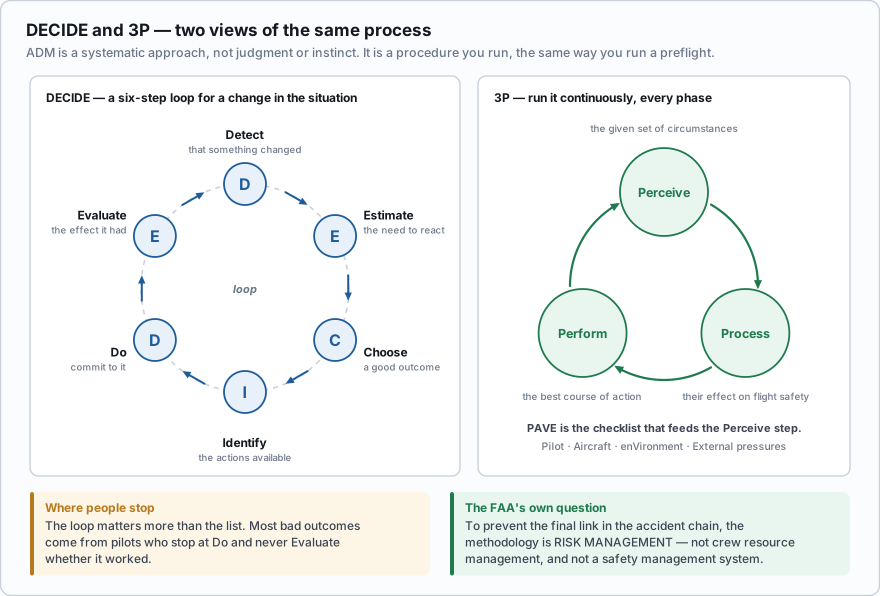
The FAA asks this directly: to prevent the final link in the accident chain, a remote pilot must consider which methodology? The answer is risk management.
On the accident-chain question, the two wrong answers are crew resource management and safety management system — and both sound plausible, because both are real FAA concepts you will study in this module. CRM is about using your team and your resources. An SMS is an organization-level framework. Risk management is the specific methodology of identifying a hazard, assessing it, and mitigating it before it becomes the last link. That is the answer the FAA wants.
The DECIDE model
DECIDE is a six-step loop for handling a change in the situation. Learn the six words in order — the acronym is the memory hook and the FAA uses it as written.
- Detect the fact that a change has occurred. The wind swung. The client walked into the landing zone. The picture went blocky.
- Estimate the need to react to that change. Does this matter? How much, and how soon?
- Choose a desirable outcome for the flight. Decide what a good result looks like from where you now are — not from where you planned to be.
- Identify actions that will get you to that outcome. Usually there are three or four, not one.
- Do the action. Commit.
- Evaluate the effect of the action — then start again at Detect.
The loop matters more than the list. Most bad outcomes come from pilots who stop at Do and never evaluate whether it worked.
The 3P model and PAVE
The 3P model is DECIDE compressed into something you can run continuously in your head: Perceive the given set of circumstances, Process their effect on flight safety, Perform the best course of action. Repeat. Perceive, Process, Perform.
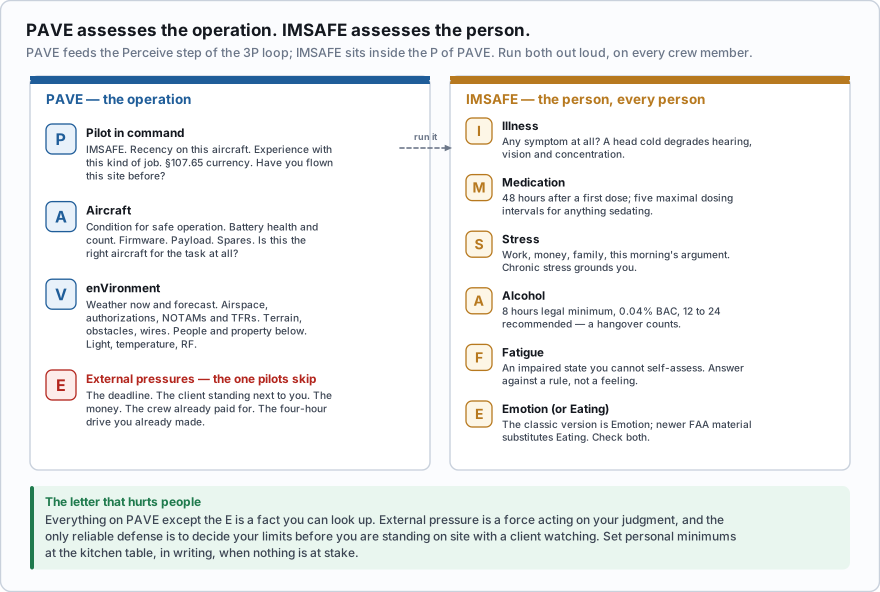
PAVE is the checklist that feeds the Perceive step. It sorts every hazard in an operation into four bins, so nothing gets missed because you were thinking about weather and forgot about yourself.
| Letter | Element | What you are actually checking |
|---|---|---|
| P | Pilot in command | IMSAFE. Recency on this aircraft. Experience with this kind of job. §107.65 currency. Have you flown this site before? |
| A | Aircraft | Condition for safe operation. Battery health and count. Firmware. Payload. Spares. Is this the right aircraft for this task at all? |
| V | enVironment | Weather now and forecast. Airspace, authorizations, NOTAMs and TFRs. Terrain, obstacles, wires. People and property below. Light, temperature, RF environment. |
| E | External pressures | The deadline. The client standing next to you. The money. The crew already paid for. The four-hour drive you already made. The sunk cost of being set up. |
External pressures is the one pilots skip, and it is the one that hurts them. Everything else on the list is a fact you can look up. External pressure is a force acting on your judgment, and the only reliable defense is to decide your limits before you are standing on site with a client watching. Set personal minimums at the kitchen table, in writing, when nothing is at stake.
Which element of the PAVE checklist covers a client's insistence that you finish today because the crew is only on site once?
- enVironment, because site conditions include the people present
- External pressures
- Pilot in command, because it affects your stress level
Answer: B. External pressures is the E in PAVE, and it covers deadlines, client demands, financial incentives, and sunk costs — anything pushing you toward a flight you would not otherwise make. It is the element most often left out of a risk assessment and the one most often present in accidents.
The five hazardous attitudes
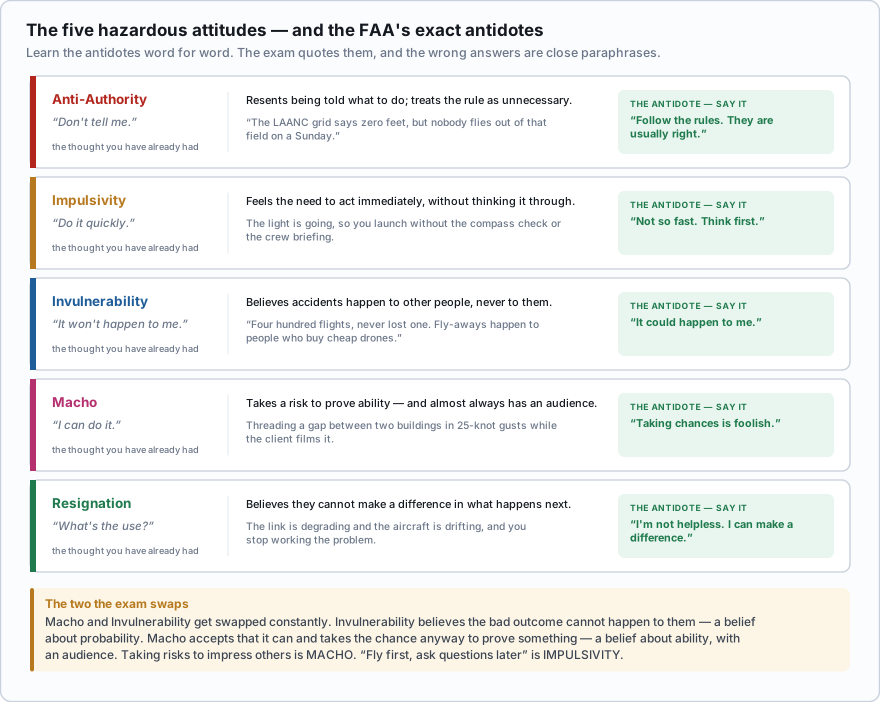
The FAA identifies five attitudes that are hazardous to safe flight. Every pilot has some of them, some of the time — they are not character flaws, they are predictable failure modes of a normal mind under pressure. The method has two steps: recognize the attitude in the thought you have already had, then say the antidote.
Learn the antidotes word for word. The exam quotes them, and the wrong answers are close paraphrases.
| Attitude | The thought | The antidote (exact) | On a job site |
|---|---|---|---|
| Anti-Authority | “Don't tell me.” | “Follow the rules. They are usually right.” | “The LAANC grid says zero feet, but nobody's flying out of that field on a Sunday.” “Airspace authorization is pure bureaucracy.” |
| Impulsivity | “Do it quickly.” | “Not so fast. Think first.” | The light is going, so you launch without the compass check or the crew briefing. Doing the first thing that comes to mind, immediately. |
| Invulnerability | “It won't happen to me.” | “It could happen to me.” | “Fly-aways happen to people who buy cheap drones.” “Four hundred flights, never lost one.” |
| Macho | “I can do it.” | “Taking chances is foolish.” | Launching in 25-knot gusts because the other operator would not. Threading a gap between two buildings while the client films you doing it. |
| Resignation | “What's the use?” | “I'm not helpless. I can make a difference.” | The link is degrading and the aircraft is drifting, and you stop working the problem: “if it goes, it goes.” |
Two of these appear in the FAA's own published sample questions, and it is worth knowing exactly which is which.
- Taking risks in order to impress others is Macho. The distinguishing feature is the audience and the proving. Not invulnerability — that pilot does not think anything bad can happen at all; the macho pilot knows it can and does it anyway to demonstrate skill.
- A manager telling you to “fly first, ask questions later,” and you complying, is Impulsivity. Acting immediately without thinking it through. The FAA lists “machismo” as one of the distractors on this question, so read carefully — the trigger phrase is *do it now*, not *watch me*.
Macho and Invulnerability get swapped constantly. Sort them by what the pilot believes. Invulnerability believes the bad outcome cannot happen *to them* — it is a belief about probability. Macho accepts that the bad outcome is possible and takes the chance anyway, usually to prove something — it is a belief about their own ability, and it almost always has an audience.
Saying the antidote out loud feels ridiculous the first few times. Do it anyway. Naming the attitude is what interrupts it, and the interruption is the whole point.
A remote pilot flies an aggressive low pass over a construction site while the client's crew watches from the trailer. Which hazardous attitude is this, and what is its antidote?
- Invulnerability — “It could happen to me.”
- Macho — “Taking chances is foolish.”
- Impulsivity — “Not so fast. Think first.”
Answer: B. Taking a risk in order to impress others is the textbook definition of the Macho attitude, and the FAA's exact antidote is “Taking chances is foolish.” Invulnerability is the belief that an accident cannot happen to you; Impulsivity is acting without thinking rather than performing for an audience.
Hazard, risk, and the matrix
Two words that get used interchangeably in ordinary speech mean different things here, and the distinction is testable.
- A hazard is a real or perceived condition, event, or circumstance that a pilot encounters. A nicked propeller. A 200-foot crane. A crowd at the far end of the parking lot.
- Risk is the assessment of that hazard — how likely it is to cause harm, and how bad the harm would be.
The same hazard produces a different risk for different pilots. The PHAK's example is two pilots looking at the same nicked propeller: the experienced one judges the risk low because they understand how stress distributes through the blade, the inexperienced one judges it high because they have read about catastrophic failure. Both are doing risk assessment. They differ in knowledge, and one of them is right.
Risk management turns that judgment into a procedure: identify the hazard, assess likelihood and severity, mitigate, then reassess. The tool is a matrix with likelihood down one axis and severity across the other.
| Source | Likelihood | Severity | Result |
|---|---|---|---|
| PHAK Chapter 2 (4 × 4) | Probable · Occasional · Remote · Improbable | Catastrophic · Critical · Marginal · Negligible | Low · Medium · Serious · High |
| AC 107-2A Appendix A (FAA SMS 5 × 5) | Frequent · Probable · Occasional · Remote · Improbable | Catastrophic · Hazardous · Major · Minor · No Safety Effect | Low · Medium · High · Avoid |
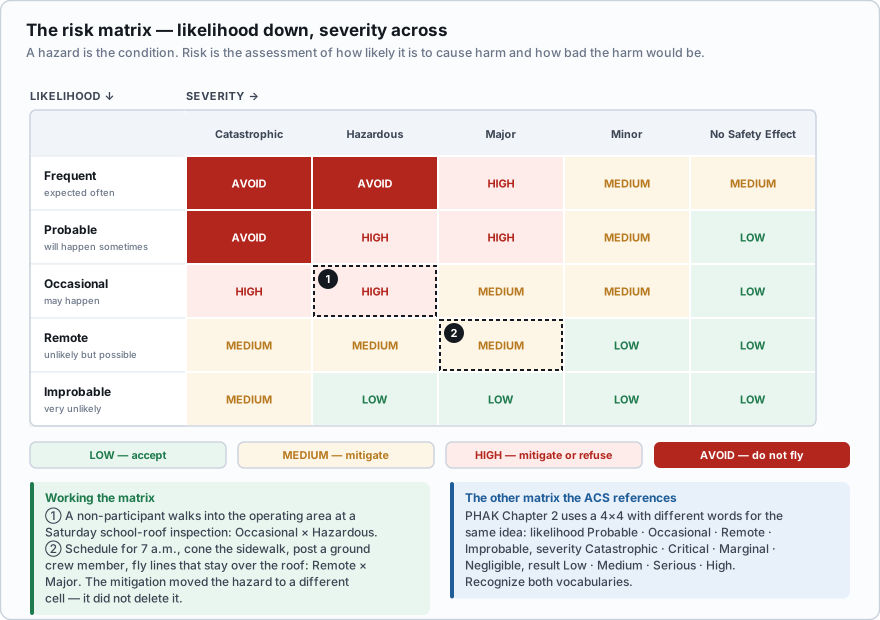
Roof inspection on a two-story school, Saturday morning, school closed. Hazard: a non-participant walks into the operating area. Likelihood before mitigation — Occasional; it is a public sidewalk. Severity — Critical; a 4-pound aircraft descending onto a person. That lands in the red. Mitigations: schedule for 7 a.m., cone the sidewalk and post a ground crew member, plan flight lines that keep the aircraft over the roof and never over the walk, and set an abort criterion that anyone entering the cordon stops the flight. Likelihood drops to Remote and the exposure severity drops because the aircraft is no longer over people. Now it is acceptable. Note what happened: the mitigation moved the hazard to a different cell. It did not delete the hazard. The sidewalk is still there.
Task management and workload
Effective workload management means planning, prioritizing and sequencing tasks so that the essential ones get done and you never saturate. It matters because the honest task list for a solo remote pilot is impossible: fly the aircraft, keep it in unaided sight, scan for manned traffic, watch the ground for people arriving, monitor battery and link, compose the shot, talk to the client, and watch the clock.
That is more than one person can do well, which is the real argument for a visual observer and a separate payload operator. When you cannot add people, you shed tasks.
- Recognize saturation. You stop scanning. You stop hearing the radio. You miss the low-battery warning. You realize you have been staring at the screen and could not say where the aircraft is in the sky.
- Move work earlier. Anything you can decide on the ground — flight lines, altitudes, abort criteria, camera settings — is work you are not doing while flying.
- Use written checklists. A checklist is memory you do not have to spend.
- Shed the non-essential in the moment. “I'll answer that when we're down” is a complete sentence.
- Unload deliberately. Bring the aircraft to a stable hover in clear air and take stock. Ten seconds of doing nothing buys back the capacity to do the next thing right.
- Prioritize: fly the aircraft first. Everything else is negotiable, including the shot the client is paying for.
Automation complacency
Your aircraft flies itself better than you do in calm air. That is precisely the problem. Automation lowers workload, low workload lowers engagement, and low engagement lowers the odds you notice the one thing the automation does not handle.
- Obstacle avoidance does not see thin wires, catenary spans, guy wires, chain-link, glass, water, netting, or thin branches — and it typically disables itself entirely in sport mode. It also sees nothing outside the sensors' field of view.
- Return-to-home is a program, not a rescue. It climbs to a preset altitude and flies a straight line to a recorded point, through whatever is in between. If the RTH altitude is below the tree you launched behind, RTH will fly into the tree.
- Waypoint missions execute exactly what you programmed, including the part you programmed wrong.
- Stay in the loop. At any moment you should be able to say what the automation is doing and what it will do next, and be ready to take manual control. Practice manual and attitude modes in an empty field, on purpose, before you need them.
- To prevent the final link in the accident chain, the methodology is RISK MANAGEMENT. Not CRM, not SMS.
- DECIDE: Detect · Estimate · Choose · Identify · Do · Evaluate — and it is a loop.
- 3P: Perceive · Process · Perform. PAVE: Pilot · Aircraft · enVironment · External pressures.
- The antidotes, verbatim: Anti-Authority → “Follow the rules. They are usually right.” · Impulsivity → “Not so fast. Think first.” · Invulnerability → “It could happen to me.” · Macho → “Taking chances is foolish.” · Resignation → “I'm not helpless. I can make a difference.”
- Taking risks to impress others = Macho. “Fly first, ask questions later” = Impulsivity.
- A hazard is the condition; risk is the assessment of its likelihood and severity. Mitigation moves a hazard to a different cell in the matrix — it does not remove it.
Write your personal minimums down and give a copy to whoever books your work: maximum wind, minimum ceiling and visibility, minimum temperature, maximum on-site hours, and the conditions under which you will not fly at all. A written limit is much harder for a client — or for you — to argue with at 4 p.m. on a Friday than a feeling.
- ADM is a systematic process, not a personality trait; accidents come from chains of events and decisions, and breaking any one link stops the accident
- The FAA's tested answer for preventing the final link in the accident chain is risk management
- DECIDE — Detect, Estimate, Choose, Identify, Do, Evaluate — is a loop; the 3P cycle is Perceive, Process, Perform
- PAVE sorts hazards into Pilot, Aircraft, enVironment and External pressures, and external pressure is the element pilots most often skip
- Learn the five hazardous attitudes and their exact antidotes verbatim; risks taken to impress others are Macho, and “fly first, ask questions later” is Impulsivity
- A hazard is a condition; risk is the assessment of its likelihood and severity, plotted on the PHAK 4×4 or the AC 107-2A 5×5 matrix
- Manage workload by moving decisions earlier, using checklists, shedding non-essential tasks, and flying the aircraft first — and never trust automation to see wires