Track your progress, take practice exams, and study the flashcards in the app.
5.10 Crew Resource Management & Situational Awareness
- Define CRM for an sUAS crew and state which phases of the operation it applies to
- Run a crew briefing and use closed-loop communication and standard callouts
- Recognize the warning signs of lost situational awareness and rebuild it
- Meet the §107.33 visual observer communication requirement and manage client pressure
Crew resource management was invented because of a specific, terrible pattern: perfectly good aircraft flown into the ground by crews of qualified professionals who had all the information they needed and did not use each other. The first officer knew. Nobody asked. The pattern repeats on drone jobs at a smaller scale and with less paperwork.
What CRM is
The PHAK defines it as training “focused on the effective use of all available resources: human resources, hardware, and information supporting ADM to facilitate crew cooperation and improve decision-making.” AC 107-2A ¶5.3 says the same thing for drones: “CRM is a component of ADM, in which the pilot of a small unmanned aircraft makes effective use of all available resources: human resources, hardware, and information.”
In one line: ADM is how one person decides. CRM is how a team decides. And note the word *resources* — it is broader than people. Your resources include the manufacturer's manual, the Chart Supplement, LAANC, the aircraft's own telemetry, the client's knowledge of their own site, the facility security officer, the airport manager's phone number, and your checklist. Flying single-pilot does not exempt you; the FAA calls that single-pilot resource management, and it is the same discipline with a shorter roster.
The tested item: all phases
One of the FAA's published sample questions asks: when adapting CRM concepts to the operation of a small UA, CRM must be integrated into what? The answer is all phases of the operation — not the flight portion only, and not the communications only.
This is not merely a test fact. The decisions that determine whether a flight is safe are made during planning, the site survey, the briefing, setup, and teardown. By the time the props are spinning, most of your risk is already fixed. And the single most dangerous moment on many jobs is the walk back to the truck with a hot battery in one hand while the client asks about the invoice.
Who is on the crew
- Remote pilot in command. Final authority and responsibility for the operation under §107.19. Not necessarily the person holding the controller.
- Person manipulating the flight controls. May be someone else, including an uncertificated person, provided the remote PIC is directly supervising and has the ability to immediately take direct control of the aircraft.
- Visual observer. Designated by the remote PIC. No certificate required, no independent authority. Their job is to see.
- Payload or camera operator. Flies the gimbal, not the aircraft. Hiring one removes an enormous amount of workload from the pilot and is the cheapest safety improvement available on a film or inspection job.
- Ground crew and safety personnel. Perimeter control, keeping non-participants out, watching the approaches nobody else is watching.
- The client. Not crew — but present, influential, and part of your risk picture. Manage them deliberately rather than accidentally.
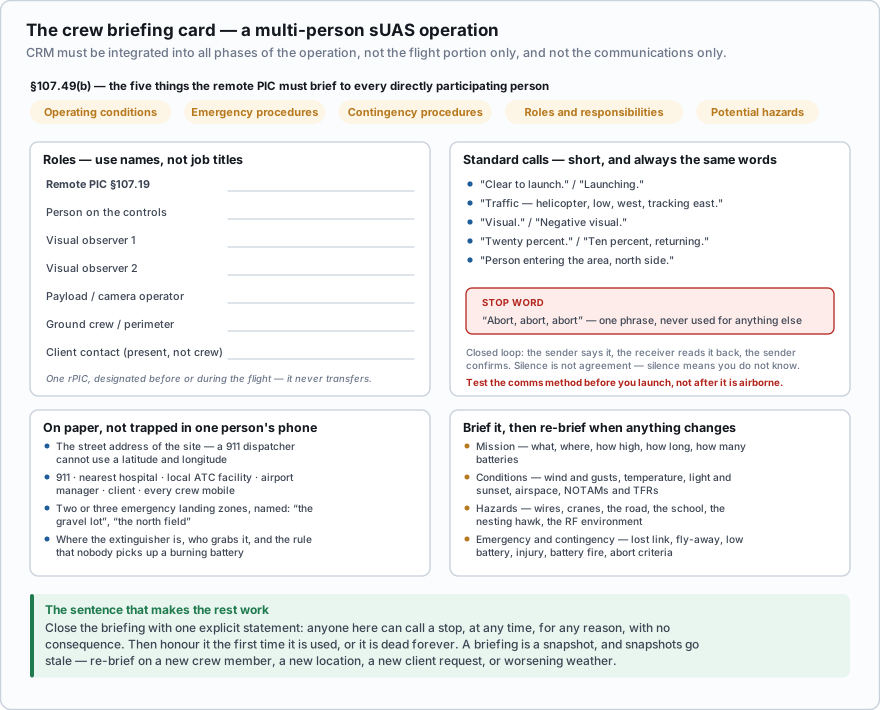
The crew briefing
The briefing is not a courtesy. It is a regulation, and it has five named contents.
Prior to flight, the remote pilot in command must ensure that all persons directly participating in the small unmanned aircraft operation are informed about the operating conditions, emergency procedures, contingency procedures, roles and responsibilities, and potential hazards.
Memorize those five. A briefing that actually works looks like this:
- Who is who — remote PIC, person on the controls, visual observers, payload, ground crew. Use names, not job titles.
- The mission — what we are flying, where, how high, how long, how many batteries, what the shots or the data products are.
- Operating conditions — weather now and expected, wind and gusts, temperature, light and sunset time, airspace class, authorization in hand, NOTAMs and TFRs checked.
- Potential hazards — wires, towers, cranes, trees, the road, the school across the street, the nesting hawk, the RF environment, the crowd expected at three o'clock.
- Roles and responsibilities — who watches which sector, who talks to the client, who calls traffic, who handles the perimeter.
- Emergency procedures — lost link, fly-away, low battery, injury, battery fire. Where the extinguisher is, where the first aid kit is, who calls 911 and what street address they give.
- Contingency procedures — the alternate landing zone, the abort criteria, what happens if a non-participant enters the area.
- Communication — what we are using (voice, radio, headset, hand signals), the standard calls, and the stop word.
- Questions, and one explicit statement: anyone here can call a stop, at any time, for any reason, with no consequence. Then honor it the first time it is used, or it is dead forever.
Re-brief whenever something material changes: a new crew member, a new location, a new client request, worsening weather. A briefing is a snapshot, and snapshots go stale.
Which of these is one of the five items §107.49(b) requires the remote PIC to brief to all directly participating persons?
- The aircraft's registration number and the remote PIC's certificate number
- Contingency procedures
- The client's contact information and billing arrangements
Answer: B. §107.49(b) names exactly five: operating conditions, emergency procedures, contingency procedures, roles and responsibilities, and potential hazards. Registration and certificate numbers must be available for inspection under §107.7 and §107.13, but they are not part of the required crew briefing.
Communication that works
Standard callouts. Short, unambiguous, and always the same words. The point of standardization is that a phrase means one thing even when the person hearing it is busy.
- “Clear to launch.” / “Launching.”
- “Traffic — helicopter, low, west, tracking east.” Position, type, altitude, direction. Not “something's up there.”
- “Visual.” / “Negative visual.” — the observer reporting whether they actually have the aircraft.
- “Twenty percent.” / “Ten percent, returning.”
- “Person entering the area, north side.”
- A stop call — “Abort, abort, abort,” or whatever you choose. Pick one phrase and never use it for anything else.
Closed-loop communication is the second habit. The sender says it, the receiver reads it back, the sender confirms. “Descend to one hundred feet.” “Descending to one hundred.” “That's correct.” It feels stilted for about a day, and then it becomes the thing that catches the misunderstanding that would otherwise have become an accident. Silence is not agreement. Silence means you do not know.
Hearing or speech impairment does not disqualify a crew member. AC 107-2A accepts alternative methods such as sign language, provided the crew has the constant ability to understand one another.
The visual observer and §107.33
If a visual observer is used: (a) the remote PIC, the person manipulating the flight controls, and the visual observer must maintain effective communication with each other at all times; (b) the remote PIC must ensure that the visual observer is able to see the unmanned aircraft in the manner specified in §107.31; and (c) all three must coordinate to scan the airspace where the aircraft is operating for any potential collision hazard, and to maintain awareness of the position of the aircraft through direct visual observation.
- Effective communication at all times is the operative phrase. AC 107-2A ¶5.9.2.2 says the crew “must work out a method of effective communication that does not create a distraction,” and that such a means “entails the constant ability to understand one another.”
- Test the method before you launch. Unaided voice works across a parking lot on a quiet day and nowhere else. Beyond that, use two-way radios or a headset intercom — and confirm they work as part of your §107.49 preflight, not after the aircraft is airborne.
- The VO must see the aircraft the way §107.31 requires — unaided vision, corrective lenses permitted. No binoculars, no telephoto screens, no FPV goggles.
- A visual observer does not extend your legal range. Visual line of sight is still required. The VO helps you satisfy it; the VO does not let you evade it.
- One person, one aircraft. §107.35 prohibits any person from operating more than one small unmanned aircraft at a time, and no number of observers changes that.
Situational awareness
The PHAK defines situational awareness as “the accurate perception and understanding of all the factors and conditions within the five fundamental risk elements... that comprise any given aviation situation.” For a drone crew, that means holding a live, accurate mental model of: where the aircraft is and what it is doing, what is in the air around it, what is on the ground under it, how much battery and link you have left, what the weather is doing, and what the plan is for the next two minutes.
Knowing where the icon is on the screen is not situational awareness. It is one input, and it is the input most likely to be wrong.
The warning signs you have lost it
- Fixation. You are locked onto one thing — the shot, a warning message, the screen — and everything else has gone quiet.
- Ambiguity. Two sources disagree. The map says one thing, your eyes say another, the observer says a third. Ambiguity is a red flag, not a rounding error.
- Confusion, or an unexplained feeling that something is wrong. Take it seriously. It usually means part of you noticed something the rest of you has not caught up to.
- Failure to meet planned targets. You should have been done in twelve minutes and you are at eighteen. You should be at 40 percent and you are at 25.
- Undocumented or unbriefed procedure. You are doing something nobody planned and nobody discussed.
- Nobody flying the aircraft. Everyone is heads-down on the screen, or arguing, or dealing with the client, and no one is actually flying.
- Unresolved discrepancies and unanswered calls. A question was asked and nobody answered it, and the operation continued anyway.
- The standard obstacles: fatigue, stress, work overload, distraction, and an accumulation of small problems none of which was worth stopping for.
Rebuilding it
- Fly the aircraft. Stabilize it — hover in clear air, climb to a known-safe altitude, or land. A stable aircraft buys you time, and time is what you have lost.
- Say it out loud. “I've lost the picture.” Naming it recruits your crew instead of hiding the problem from them.
- Go back to what you know for certain — position, altitude, battery, home point, wind direction, where the sun is.
- Resolve the ambiguity with the most reliable source, which is almost always your own eyes on the actual aircraft.
- Reduce workload. Stop the shot. Stop the conversation. Hand the camera to someone else.
- Rebuild the plan from where you actually are, not from where you meant to be.
- If you cannot rebuild it, land. Landing is always available and it is always cheap.
Mid-flight, your visual observer reports the aircraft is north of the building while your screen shows it south. What is the correct first action?
- Trust the telemetry, since GPS position is more precise than a human estimate
- Stop the task, stabilize the aircraft, and resolve the disagreement by direct visual observation before continuing
- Initiate return-to-home immediately and sort it out after landing
Answer: B. A disagreement between two sources is a classic signal of degraded situational awareness, and continuing while it is unresolved is how the chain builds. Stabilize first, then resolve with the most reliable source — direct visual contact. Blind RTH is risky when you do not know where the aircraft actually is, because RTH flies a straight line through whatever is in the way.
External pressure from the client
The client is paying, is frequently standing next to you, and usually has no idea what is unsafe. “Can you get one more?” “The last guy flew here.” “We only have the crane on site today.” None of that is malice. All of it is pressure.
- Set the limits in writing before the job — wind, ceiling, visibility, temperature, airspace constraints — and state plainly that you will not fly outside them. Expectations set in a contract cost nothing to enforce; expectations set on site cost you the job.
- Give the client a role. Someone with a job is much less likely to lobby.
- Offer an alternative instead of a flat no. “Not that angle, but I can give you this one from the north side, or we come back Thursday morning when the wind is down.”
- Say the actual reason. “That is inside the approach corridor for runway 27 and I don't have authorization for it” is far more persuasive than “it's not safe.”
- Price the return trip into the contract so that scrubbing costs you less and therefore pressures you less. This is a business fix for a safety problem, and it works.
- Remember §107.19. You are the remote pilot in command. You are directly responsible for, and are the final authority as to, the operation of the small unmanned aircraft system. The client's deadline is not a defense in an enforcement action.
Two CRM traps on the exam. First, CRM applies to all phases of the operation — an answer limiting it to the flight portion, or to communications, is wrong. Second, CRM is not only for multi-person crews. A solo remote pilot still manages resources: information, hardware, checklists, weather sources, ATC, and the people on site who are not formally crew.
Safety culture and standard operating procedures
One of the FAA's sample questions describes a news station whose drone team has had repeated near misses and two accidents, and asks what would improve the safety culture. The answer: recognize hazardous attitudes and develop standard operating procedures that emphasize safety. Not a policy allowing no more than five crashes in six months. Not “no changes are needed.”
That answer is correct for a reason worth understanding. Repeated events across different pilots and different aircraft is a systems problem, not a personnel problem. Setting a tolerable crash rate normalizes the crashes. The fix is written procedure plus honest self-assessment of the attitudes driving the behavior.
- What an sUAS SOP set contains: standard checklists, company and personal minimums, a briefing template, standard callouts, an approved-sites file with known hazards, maintenance and battery logs, a non-punitive incident reporting process, and a required post-job debrief.
- Non-punitive reporting is the load-bearing part. If reporting a near miss gets someone yelled at, you will stop hearing about near misses. They will not stop happening — you will only stop finding out, until one of them is an accident.
- Debrief every job in three questions: what went as planned, what did not, and what changes next time. Five minutes at the truck. Write down the answer to the third one.
- CRM must be integrated into ALL PHASES of the operation — this is a published FAA sample question, and the wrong answers are “the flight portion only” and “the communications only.”
- CRM is the effective use of all available resources: human resources, hardware, and information.
- §107.49(b) briefing, five items: operating conditions, emergency procedures, contingency procedures, roles and responsibilities, potential hazards.
- §107.33 requires effective communication at all times among the remote PIC, the person on the controls, and the visual observer — and the VO must be able to see the aircraft unaided under §107.31.
- Warning signs of lost situational awareness: fixation, ambiguity, confusion, failure to meet planned targets, unbriefed procedure, and nobody flying the aircraft.
- A team with repeated accidents fixes it by recognizing hazardous attitudes and developing SOPs that emphasize safety — not by setting an acceptable crash rate.
Give every crew member, including the newest ground assistant, explicit authority to stop the operation — and then engineer the first use of it. Ask someone to call a stop during a training flight and thank them publicly for it. The authority is worthless until the crew has watched you honor it once.
- CRM is the effective use of all available resources — human, hardware and information — and it must be integrated into all phases of the operation, not just the flight
- An sUAS crew may include the remote PIC, a person manipulating the controls, visual observers, a payload operator and ground crew; the client is not crew but is part of the risk picture
- §107.49(b) requires briefing operating conditions, emergency procedures, contingency procedures, roles and responsibilities, and potential hazards
- Use standard callouts and closed-loop communication, and give every crew member explicit authority to call a stop
- §107.33 requires effective communication at all times with a visual observer, who must see the aircraft unaided as §107.31 specifies — a VO does not extend your legal range
- Signs of lost situational awareness include fixation, ambiguity, confusion, missed targets, unbriefed procedure, and nobody flying the aircraft; rebuild by stabilizing, naming it, and landing if needed
- Repeated accidents are a systems problem: the fix is recognizing hazardous attitudes and developing standard operating procedures that emphasize safety