Track your progress, take practice exams, and study the flashcards in the app.
5.7 Lithium Battery Safety
- Explain thermal runaway — what triggers it, how it propagates, and why smothering does not stop it
- Identify the warning signs that a lithium pack must be retired from service
- Apply safe charging, storage, in-flight, transport and disposal practices to a working fleet
The most dangerous thing in your kit is not the aircraft. It is the bag of batteries in the back of the truck. A modern drone pack stores an enormous amount of energy in a very light package, and the chemistry that makes that possible is the same chemistry that makes it burn. The ACS breaks lithium batteries into four sub-elements — transport, charging, usage, and fire risk — so this is heavily tested. It is also the part of the course most likely to save your truck.
Why lithium polymer is different
A lithium polymer (LiPo) pack is a stack of lithium-ion cells in a soft foil pouch. Each cell sits at 3.7 volts nominal, 4.2 volts fully charged, and should not be taken below about 3.0 volts under load. Packs are named by cell count in series — a 4S pack is four cells, so 14.8 V nominal and 16.8 V full. Three features matter for safety: the electrolyte is a flammable organic liquid, not the water-based chemistry of an alkaline or lead-acid battery; anode and cathode are kept apart by a separator only tens of microns thick; and the pouch has no rigid case, so a puncture goes straight into the cell stack. Damage a AA battery would shrug off destroys a LiPo.
Thermal runaway
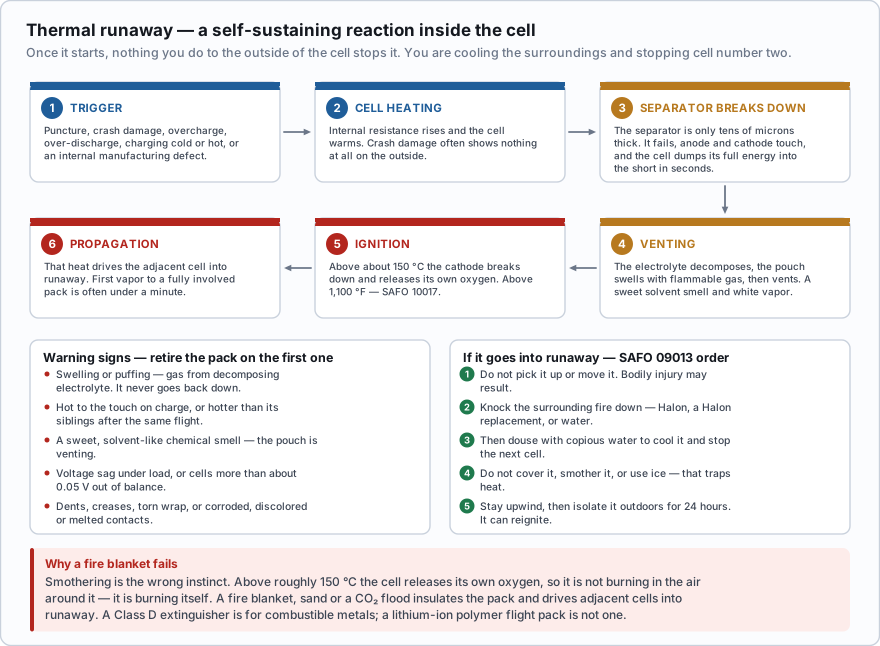
Thermal runaway is a self-sustaining reaction inside a cell in which heat generates more heat. Once it starts, nothing you do to the outside of the cell stops it. The chain runs like this:
- The separator fails — from physical damage, an internal defect, overcharging, or simple overheating.
- Anode and cathode touch. The cell discharges its full energy into that internal short in seconds.
- Cell temperature climbs fast. The electrolyte decomposes and the pouch swells with flammable gas, then vents.
- Above roughly 150 °C the cathode material itself begins to break down and release oxygen.
- The cell now supplies its own fuel and its own oxidizer. It is no longer burning in the air around it — it is burning itself.
That fifth step is the whole reason lithium fires behave the way they do. Smothering works by cutting off atmospheric oxygen, and a cell in runaway does not need atmospheric oxygen. A fire blanket, a bucket of sand, or a CO₂ flood will do nothing to the reaction inside the cell.
SAFO 10017 gives the numbers: a battery in thermal runaway can reach above 1,100 °F, exceeding the ignition temperature of most Class A materials and close to the 1,220 °F melting point of aluminum. SAFO 09013 describes the propagation: “Once one cell in a battery pack goes into thermal runaway, it produces enough heat to cause adjacent cells to go into thermal runaway,” and “the resulting fire can flare repeatedly as each cell ruptures and releases its contents.” From the first wisp of white vapor to full involvement of a six-cell pack is often under a minute. You do not get a long warning. You get seconds, and whatever plan you made in advance.
What causes it
- Physical damage or puncture — a crash, a hard landing, a drop onto concrete, a pack compressed in an overpacked case, a screwdriver loose in the battery bin. Internal damage is often invisible from outside.
- Over-discharge — taking cells below roughly 3.0 V under load, or letting a pack self-discharge below that in storage. It causes copper dissolution that can short the cell on the next charge.
- Overcharge — pushing a cell above 4.2 V, which plates metallic lithium and generates gas.
- Charging a cold pack. Charging below freezing plates metallic lithium on the anode. The plating is permanent and can grow through the separator.
- Charging a hot pack, including one straight off a flight.
- Charging unattended — the single most common reason a lithium fire becomes a structure fire.
- A damaged, miswired, or wrong-chemistry charger, or the wrong cell count selected.
- Internal manufacturing defects — a stray metal particle sitting against the separator. You cannot inspect for this. It is why you charge in containment even when everything looks fine.
Why will covering a lithium battery in thermal runaway with a fire blanket fail to stop it?
- Fire blankets are not rated for the temperatures involved
- The reaction releases its own oxygen, so removing outside air does not stop it — and covering the pack traps heat, which drives adjacent cells into runaway
- The blanket will melt and feed the fire with additional fuel
Answer: B. Above about 150 °C the cathode material decomposes and releases oxygen inside the cell, so the reaction is self-sustaining. SAFO 09013 warns explicitly not to cover the device or use ice, because insulating it increases the likelihood that additional cells reach thermal runaway.
Warning signs — retire the pack
A pack almost always tells you before it fails. Learn the signs and act on the first one.
- Swelling or puffing. Gas from decomposing electrolyte. Not reversible, and it does not go back down. Even slight puffing means the pack is finished.
- Heat — hot to the touch during charging, or noticeably hotter than its siblings after a flight of the same length and workload.
- Unusual smell — a sweet, solvent-like chemical odor means the pouch is venting.
- Voltage sag under load — the pack drops much further than it used to when you pull power. Rising internal resistance.
- Physical damage — dents, creases, torn wrap, cell separation, a soft spot. Corroded, discolored, loose or melted contacts, or scorch marks on the connector.
- Cells drifting out of balance — a pack that will not balance to within roughly 0.05 V across cells — or a pack that self-discharges noticeably while sitting.
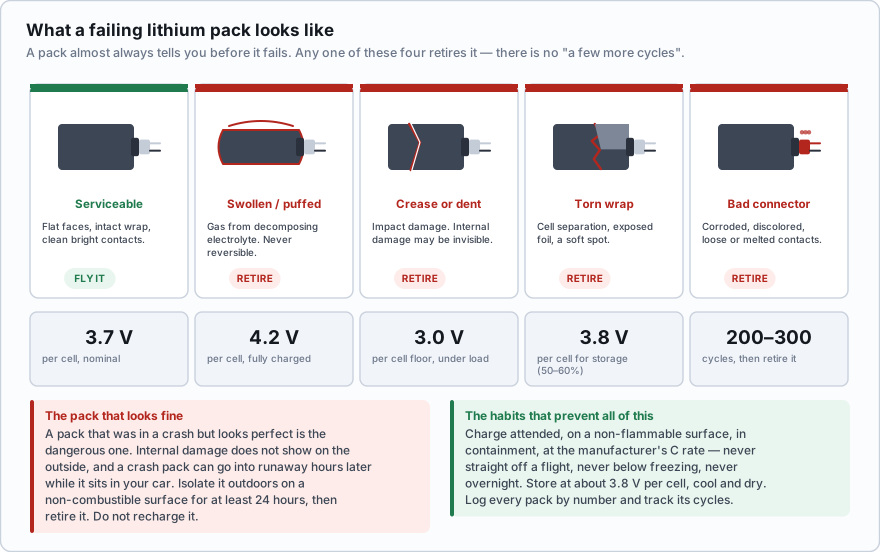
Two traps live here. First: “it is only slightly puffed, I will get a few more cycles out of it.” Puffing is chemical damage that has already happened; the pack is closer to runaway than it has ever been. Second: a pack that was in a crash but looks perfect. Internal damage does not show on the outside, and a crash pack can go into runaway hours later while it sits in your car. Isolate a crash-involved pack outdoors on a non-combustible surface for at least 24 hours, then retire it. Do not recharge it.
Safe charging
- Attended. Always. Not “in the next room,” not overnight. If you cannot watch it, do not start it.
- On a non-flammable surface — bare concrete, a metal tray, ceramic tile. Not carpet, not a plywood bench, not the truck seat.
- In containment — a LiPo charging bag, a vented steel ammo can, or a metal box. Containment will not put out a runaway; it keeps the flare and debris from reaching everything else.
- At the correct C rate. 1C is a charge current numerically equal to the pack capacity — a 5,000 mAh pack at 1C charges at 5 amps. Higher rates generate heat. Use the manufacturer's rate, and less on an older pack.
- Correct cell count and chemistry selected, with the balance lead connected. A 6S pack charged on a 4S profile is a fire.
- Never straight off a flight — let the pack return to roughly ambient temperature, typically 20 to 30 minutes. Never below freezing. Never in a hot car or direct sun.
- Take the pack off the charger when it finishes, and inspect the charger itself — cord, plug, leads, fan — as carefully as you inspect the pack.
- Put a smoke detector and a fire extinguisher in the charging area. Both are cheap. Neither matters until the day it does.
Storage
A pack stored at full charge ages fast and puffs early. The storage target is roughly 3.8 volts per cell — about 50 to 60 percent — which is where the chemistry is most stable. Most smart drone packs self-discharge to storage level after a set number of idle days; know what that setting is and confirm it is doing what you think.
- Store cool and dry, at room temperature or below, in a fireproof container or a dedicated metal cabinet, away from combustibles and not stacked on the charger.
- Do not store fully charged for long periods, and do not store fully depleted either — a pack that self-discharges below about 3.0 V per cell in storage is scrap.
- Log every pack. Number each one and track cycles, capacity, and date in service. Retire at roughly 200 to 300 cycles, or at the first sign of puffing, whichever comes first.
Safe usage in flight
- Respect the low-voltage warning. It is not a suggestion and it is not conservative padding. Start back when it appears.
- Land with reserve. Plan to be on the ground with 20 to 30 percent remaining. The last 20 percent is where voltage sag is worst, and a gust or a climb there can drop the pack under the cutoff and the aircraft descends on its own.
- Never run a pack flat. Over-discharge damages cells permanently even when nothing dramatic happens.
- Derate for cold, wind and payload. A cold pack has higher internal resistance and delivers less; a headwind home costs more than you planned; heavy payload and high density altitude sag voltage faster.
- §107.49(d) requires you to ensure there is enough available power for the aircraft to operate for the intended operational time. Reserve planning is a legal obligation, not merely good practice.
You have landed after an 18-minute inspection flight in 95 °F heat. The pack is warm. What is the correct action before putting it on the charger?
- Charge immediately at a reduced rate so the pack is ready for the next flight
- Let the pack cool to roughly ambient temperature — typically 20 to 30 minutes — before charging
- Put the warm pack in a cooler with ice to bring the temperature down quickly
Answer: B. Charging a hot pack adds heat on top of heat and is a recognized cause of thermal runaway. Cool it passively to about ambient first. Ice is never used on lithium batteries — SAFO 09013 warns that ice insulates and increases the chance of adjacent cells reaching runaway.
Fires — what actually works
SAFO 09013 was written for cabin crews dealing with a burning laptop, but the physics is identical on your tailgate. The FAA's sequence is:
- Extinguish the fire with a Halon, Halon-replacement, or water extinguisher.
- Then douse the device with water or other non-alcoholic liquids to cool it and prevent additional battery cells from reaching thermal runaway.
And two prohibitions, worth quoting exactly: “Do not attempt to pick up and move a smoking or burning device! Bodily injury may result.” And: “Do not cover the device or use ice to cool the device. Ice or other materials insulate the device, increasing the likelihood that additional battery cells will reach thermal runaway.”
Read that priority order carefully, because it is the tested idea. You are not trying to extinguish the cell in runaway — you cannot. You are cooling the surroundings and stopping cell number two from joining cell number one.
| Option | What it does |
|---|---|
| Copious water | The practical field answer. Cools the pack and its surroundings and prevents propagation. Water on a lithium-ion pack is correct, not dangerous — these are not combustible-metal fires. |
| Class ABC dry chemical | Knocks down the surrounding fire — grass, case, truck bed liner. Will not stop the runaway. Worth carrying; not a solution on its own. |
| Halon or Halon replacement | SAFO 09013's first-choice knockdown agent. SAFO 10017 notes Halon 1301 suppresses lithium-ion fires but does not eliminate the risk. |
| Class D extinguisher | Designed for combustible-metal fires — magnesium, sodium, lithium metal. A lithium-ion polymer flight pack is not one, and a Class D agent will not stop the runaway. |
| Fire blanket alone | Wrong. It covers and insulates, exactly what SAFO 09013 warns against. Trapped heat drives adjacent cells into runaway. Sand, CO₂ and other smothering agents fail for the same reason. |
| Non-combustible containment | A metal bucket, an ammo can, or a cleared patch of dirt where the pack can burn out with nothing to spread to. With water, this is the realistic field plan. |
Afterward, leave it alone. A vented pack can reignite hours later — isolate it outdoors on a non-combustible surface for at least 24 hours before disposal. Stay upwind: burning electrolyte produces hydrogen fluoride and other irritants.
Transport
On the ground, keep packs in a fireproof bag or hard case with terminals protected, never loose in a bin where a wrench can bridge the contacts, and never in a closed car in the sun. In the air, the rules are federal and specific.
Spare lithium batteries must be carried in carry-on baggage only, and each spare battery must be individually protected so as to prevent short circuits. A lithium ion battery's watt-hour rating must not exceed 100 Wh; with operator approval, 101–160 Wh is allowed, and no more than two spares in that range may be carried per person.
| Battery | Carry-on | Checked baggage | Quantity |
|---|---|---|---|
| Lithium ion up to 100 Wh (spare) | Yes | No — never | No set limit for personal use |
| Lithium ion 101–160 Wh (spare) | Yes, with airline approval | No | Two spares maximum per person |
| Lithium ion over 160 Wh | Not permitted | Not permitted | Must move as regulated cargo |
| Lithium metal (non-rechargeable) | Yes, up to 2 g lithium content | No (spares) | 2–8 g only with approval, portable medical devices |
| Battery installed in a device | Yes, and preferred | Permitted if protected from accidental activation | — |
- Short-circuit protection is required, per battery. Original retail packaging, tape over the terminals, a battery case, or each pack in its own bag or pouch. Keep them away from coins, keys, tools and jewelry.
- A gate-checked bag counts as checked baggage. If your roller is taken at the jet bridge, pull every spare battery and power bank out and carry them into the cabin.
- Compute watt-hours and write them on the pack. Wh = volts × amp-hours. A 4S 5,000 mAh pack is 14.8 V × 5.0 Ah = 74 Wh. Most consumer packs sit under 100 Wh; heavy-lift, cinema and agricultural packs frequently do not. Discharge to roughly 30 percent for travel — many airlines now require it.
- Why the rule exists: SAFO 10017 notes a pack in runaway exceeds 1,100 °F, and that Halon 1301 in a Class C cargo compartment does not eliminate the lithium-ion risk and is ineffective against lithium metal. In the cabin a crew member can see it, reach it, and douse it. In the belly, nobody can.
Disposal and recycling
- Never in household trash and never in a curbside recycling bin. Compactor trucks crush packs and start fires in them regularly.
- Discharge first. Run a controlled discharge on the charger if the pack is safe to connect. For a damaged pack you will not put on a charger, submerge it in salt water outdoors in a ventilated place for a couple of weeks, then confirm it reads near zero volts.
- Tape the leads, then take it to a battery recycling drop-off — Call2Recycle collection points, many hardware and electronics retailers, and municipal household hazardous waste days.
- Log the retirement and the reason. Two failures traced to one production batch is information you want.
You are flying to a job and carrying four spare 74 Wh drone batteries. Where do they go?
- Checked baggage, with the terminals taped
- Carry-on baggage, each individually protected against short circuit
- Either, as long as each is under 100 Wh
Answer: B. Spare lithium batteries are prohibited from checked baggage entirely, including bags checked at the gate. They go in carry-on, individually protected — original packaging, taped terminals, or a separate bag or pouch for each. At 74 Wh they are under the 100 Wh threshold, so no airline approval and no quantity limit applies.
- Thermal runaway is self-sustaining. The cell generates its own heat and releases its own oxygen, so smothering does not stop it.
- SAFO 09013 sequence: extinguish with Halon, Halon replacement, or water — then douse with water or other non-alcoholic liquid to cool the device and prevent additional cells from reaching thermal runaway. Do not pick it up. Do not cover it or use ice.
- Swelling is terminal. A puffed pack never goes back in service.
- Charge attended, on a non-flammable surface, in containment, at the correct C rate — never cold, never straight off a flight, never overnight.
- Storage charge is about 3.8 V per cell. Long-term storage at full charge destroys packs.
- Spare lithium batteries fly in carry-on baggage only, terminals protected against short circuit. 100 Wh standard limit; 101–160 Wh needs airline approval and is capped at two spares; over 160 Wh is not permitted in passenger baggage.
If you run more than a handful of packs, buy a charger that reports internal resistance per cell and log it. Capacity fades slowly and tells you little; internal resistance climbs measurably before a pack starts sagging in flight, and a cell 30 percent higher than its neighbors is the one that will fail.
None of this is exotic. It is a metal box, a habit of looking at the pack before you plug it in, and the willingness to throw away a $150 battery that is doing something odd. That last one is the whole discipline.
- Thermal runaway is a self-sustaining internal reaction that produces its own heat and releases its own oxygen — it cannot be smothered, and it propagates cell to cell
- SAFO 10017: a pack in runaway exceeds 1,100 °F, near aluminum's 1,220 °F melting point; SAFO 09013: one cell in runaway drives adjacent cells into runaway
- SAFO 09013 response: extinguish with Halon, Halon replacement or water, then douse with water to cool and prevent propagation — never move it, never cover it, never use ice
- Retire a pack at the first sign of swelling, heat, odor, voltage sag, physical damage, corroded contacts, or persistent cell imbalance
- Charge attended, on a non-flammable surface, in containment, at the correct C rate, never cold and never straight off a flight; store at about 3.8 V per cell, cool and dry
- Land with 20–30 percent reserve and respect the low-voltage warning; §107.49(d) makes sufficient power a regulatory requirement
- Spare lithium batteries travel in carry-on baggage only with terminals protected: 100 Wh standard, 101–160 Wh with airline approval and two spares maximum, over 160 Wh not permitted