Track your progress, take practice exams, and study the flashcards in the app.
5.6 Emergency Planning, Lost Link & Fly-Aways
- Apply §107.21 emergency deviation authority and state the reporting obligation that follows it
- Execute a lost-link, fly-away and GPS-loss response, and describe what return-to-home actually does and how it fails
- Build a preflight emergency plan and crew briefing, and apply the §107.9 reporting thresholds
The difference between an incident and an accident is usually what you decided in the first four seconds. Four seconds is not enough time to think, so the decision has to already exist — made on the ground and briefed. This lesson gives you the plan, the failures you will meet, and the reporting that follows.
§107.21 — permission to break the rules
(a) In an in-flight emergency requiring immediate action, the remote pilot in command may deviate from any rule of this part to the extent necessary to meet that emergency. (b) Each remote pilot in command who deviates from a rule under paragraph (a) of this section must, upon request of the Administrator, send a written report of that deviation to the Administrator.
- Any rule of this part. Not a short list — any of them: altitude, groundspeed, visual line of sight, operations over people. If the emergency requires it, you may climb through 400 feet to avoid a helicopter.
- To the extent necessary. The deviation must be proportional and must stop when the emergency does. Climbing to 600 ft to avoid a collision is defensible; staying there to finish the shoot is not.
- Upon request of the Administrator. The report is written and owed only if the FAA asks. Nothing to ATC or the NTSB.
You estimate your small unmanned aircraft climbed above 600 ft AGL to avoid a manned airplane. To whom must you report the deviation?
- Air Traffic Control
- The NTSB
- The FAA, upon its request
Answer: C. Section 107.21(b) requires a written report of an emergency deviation to the Administrator only upon request. Nothing goes to ATC or the NTSB, and no report is filed automatically. This is a published FAA sample question and the wording of the answer matters.
Do not confuse the two reports. §107.21 is the *deviation* report — written, to the FAA, only upon request, no deadline. §107.9 is the *safety event* report — mandatory, within 10 calendar days, for serious injury, any loss of consciousness, or over $500 damage to property other than your aircraft.
The plan you make before you leave the office
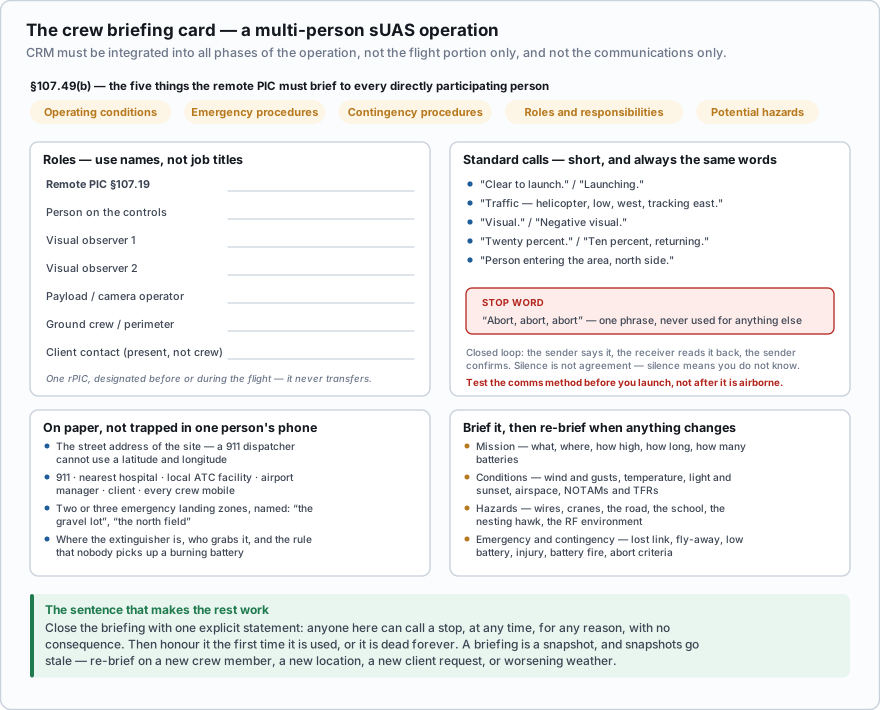
Section 107.49 already requires you to assess the operating environment and brief every participant on operating conditions, emergency and contingency procedures, roles and responsibilities, and hazards. That is the legal floor. Here is what a plan that works contains.
- Site selection. Fly a route home that does not cross a road, a playground, a power line or a crowd.
- Two or three emergency landing zones, chosen before takeoff and known to the crew by name — "the gravel lot," "the north field."
- Wind direction, because a powerless aircraft drifts downwind.
- The street address of the site. A 911 dispatcher cannot use a latitude and longitude.
- Phone numbers on paper: 911, the hospital, the local ATC facility, the airport manager, the client, the crew.
- Fire. Where the extinguisher is, who grabs it, and the rule that nobody picks up a burning battery.
Then the briefing, which is about who calls what. There is exactly one remote pilot in command, designated before or during the flight under §107.19. Assign who is on the controls, which sector each visual observer owns, who handles bystanders and police, and who makes the 911 call. Then agree on one word that means land now.
Lost link
The FAA defines lost link as loss of the command and control link between the control station and the aircraft. Two links run in opposite directions: the uplink carries your commands out, the downlink brings telemetry and video back. A video dropout while the aircraft still answers the sticks is an annoyance; a frozen screen and an unresponsive aircraft is an emergency.
Causes are mechanical: distance; an obstruction between you and the aircraft, including your own body; antenna orientation, because control antennas radiate from their flat faces rather than their tips; congestion on 2.4 or 5.8 GHz; and interference.
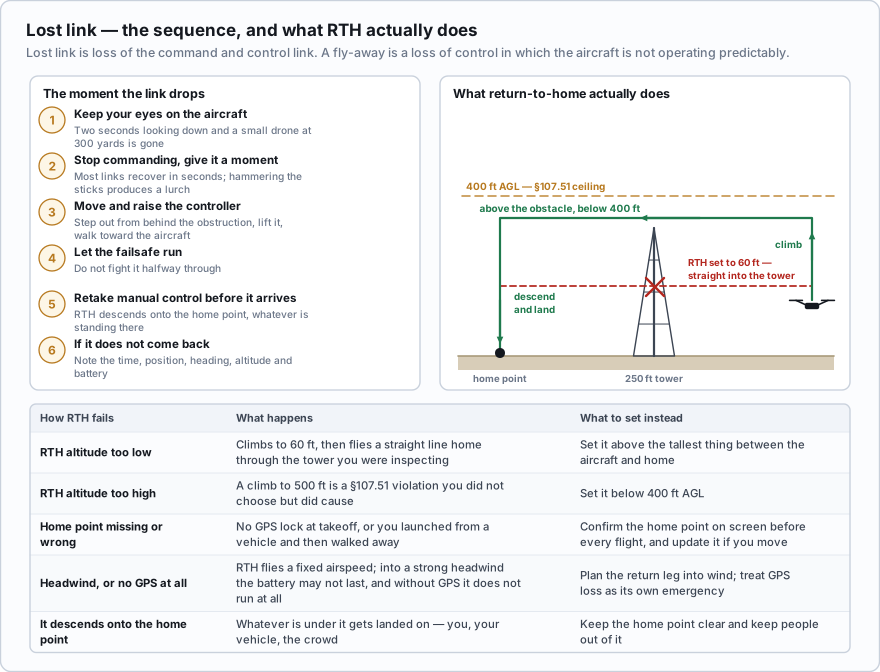
- Keep your eyes on the aircraft. Look down at the controller for two seconds and a small drone at 300 yards is gone for good.
- Stop commanding and give it a moment. Most links recover within seconds, and hammering the sticks during a reconnect produces a lurch you did not want.
- Move and raise the controller. Step out from behind the obstruction, lift the transmitter, walk toward the aircraft. This recovers more links than anything else here.
- Let the failsafe run rather than fighting it halfway through.
- Retake manual control before it gets home.
- If it does not come back, note the time, position, heading, altitude and battery.
What return-to-home actually does — and how it fails
On a typical multirotor, RTH climbs to a preset altitude, flies a straight line to the recorded home point, then descends and lands. Every step has a way to go wrong, and RTH is the feature pilots trust most and understand least.
| Failure | What happens | What to do |
|---|---|---|
| RTH altitude too low | The aircraft climbs to 60 ft, then flies a straight line home through the tower you were inspecting | Set it above the tallest thing between the aircraft and home |
| RTH altitude too high | A climb to 500 ft is a §107.51 violation you did not choose but did cause | Set it below 400 ft AGL |
| Measured from the home point | A ridge between you and the aircraft may sit above the RTH altitude even though the number looks generous | Check the terrain, not just the obstacle |
| Home point never recorded | No GPS lock at takeoff means RTH has nowhere to go | Confirm the home point on screen before every flight |
| Home point in the wrong place | Launching from a vehicle or boat, or walking away after takeoff, leaves home where you were | Update the home point deliberately if you relocate |
| Headwind | RTH flies a fixed airspeed; into a strong headwind the battery may not last | Plan the return leg into wind, not the outbound one |
| Descends onto the home point | Whatever is under it gets landed on — you, your vehicle, the crowd | Keep the home point clear and keep people out of it |
| No GPS | RTH depends on knowing where the aircraft and home are, so it does not run at all | Treat GPS loss as its own emergency, below |
You are inspecting a 250-foot communications tower from 300 ft AGL. What is the correct return-to-home altitude setting for this job?
- 60 ft, so the aircraft comes home quickly and stays below traffic
- An altitude above the tower but below 400 ft AGL, with the home point clear of people and confirmed before takeoff
- 500 ft, to guarantee clearance over everything on the site
Answer: B. RTH flies a straight line home at the set altitude, so it must clear the tallest obstacle between the aircraft and home — a 60 ft setting flies the aircraft into the tower. It must also stay within the 400 ft AGL limit of §107.51, so 500 ft is not available to you. Above the obstacle and below 400 ft is the only correct band, and the home point must be confirmed and clear.
Fly-aways
Flyaway: An interruption or loss of the control link, or when the pilot is unable to effect control of the aircraft and, as a result, the UAS is not operating in a predictable or planned manner.
That definition draws the line. A lost link where RTH runs correctly and the aircraft comes home is not a fly-away. A lost link where it turns for the horizon is, and so is an aircraft that ignores your inputs while the link still shows connected.
Causes cluster around navigation rather than radio: a compass or IMU calibrated near steel, rebar, a car or a magnet; a home point set far away; GPS interference or spoofing; a failsafe set to *hover* rather than return; and firmware faults.
- Write down the facts immediately — time, last position, altitude, heading, battery. You need them for every call.
- Keep trying to regain control. Cycle the controller, try the failsafe, try the app, walk the direction it went.
- Call the nearest ATC facility if the aircraft is near an airport, an approach corridor or controlled airspace. Give position, altitude, heading, endurance and a description; the number is in the Chart Supplement.
- Call local law enforcement — an unexplained drone in somebody's yard becomes a police matter either way.
- Preserve the flight logs, and do not fly that aircraft again until you know why.
- Check the §107.9 thresholds.
No section of Part 107 says "telephone ATC when your aircraft flies away." But §107.19(c) makes you responsible for ensuring the aircraft poses no undue hazard in the event of a loss of control for any reason, and §107.23 makes creating a hazard careless and reckless.
GPS loss
Satellite positioning is what lets a multirotor sit motionless in a 12-knot breeze while you frame a shot. Take it away and the aircraft holds attitude only and drifts with the wind. Most consumer aircraft call this ATTI mode, and the transition is often announced by nothing more than a beep.
| Factor | Detail |
|---|---|
| What you lose | Position hold, waypoint and automated flight, accurate groundspeed, geofencing, and return-to-home. Braking goes lazy — release the stick and the aircraft keeps sliding. |
| Urban canyon | Buildings block satellites and reflect their signals, so the receiver computes a position that is simply wrong. Downtown work between tall buildings is the classic case. |
| Steel and rebar | Bridges, tank farms, metal roofs and reinforced decks corrupt the compass even when GPS is fine; a bad compass with good GPS produces a slow circling drift. |
| Solar activity | Geomagnetic storms and ionospheric disturbance degrade accuracy for hours at a time, worldwide. Many flight apps show a GPS health warning — take it seriously. |
| Deliberate interference | GPS interference testing runs regularly, mostly near military ranges, and is published as a NOTAM. Check them. |
| Simple obstruction | Flying under a bridge deck, inside a partial structure, or beneath dense canopy will do it. |
- Practice ATTI deliberately, in an open field with nothing to hit, before you need it.
- Fly it like a manual aircraft — small inputs, anticipate the drift, lead the aircraft rather than react.
- Keep the nose oriented so you always know which way forward is. Disorientation, not drift, causes the crash.
- Watch the aircraft against a ground reference and stop the drift with the stick, not the screen.
- Descend and work upwind of your landing spot, then let the wind carry you back.
- Land. Do not finish the job.
Midway through a bridge inspection the aircraft loses GPS and switches to attitude mode. What should you expect, and what should you do?
- Position hold and return-to-home stay available, so the mission can continue
- The aircraft holds attitude only and drifts with the wind, and return-to-home is unavailable — fly it manually, get upwind of your landing spot, descend and land
- The aircraft automatically descends to a safe altitude and hovers until GPS returns
Answer: B. Without GPS the aircraft no longer knows where it is, so position hold, waypoint flight and return-to-home all stop working. It holds attitude only and drifts downwind. Fly it manually with small inputs against a ground reference, work upwind of your landing spot, and land rather than finishing the job.
Emergencies over people, and at night
Over people, the plan assumes a total power loss at the worst possible moment — that is the basis of the whole rule set. Category eligibility under Subpart D is the legal permission; the plan is the rest. Choose a path where a dead-stick descent lands on nothing that breathes, control the site, and keep an abort route that avoids the crowd. Sustained flight over an open-air assembly requires Remote ID broadcast.
At night every emergency is harder, because you cannot see what you are about to land on. Survey the site in daylight and mark the obstacles you will not see later. Light the launch and recovery zone. Verify the anti-collision lighting visible for 3 statute miles, which you may dim when safety calls for it. Allow 30 minutes to dark-adapt, and never rely on the aircraft's own lights for visual line of sight.
After the event
§107.9 requires a report to the FAA no later than 10 calendar days after any operation involving serious injury or any loss of consciousness, or damage to property other than the small unmanned aircraft unless the repair cost or fair market value is $500 or less.
Then do the part nobody requires: download the logs, reconstruct the flight, and write down the cause and the change you are making. A fly-away with a known cause is a lesson; one without is an aircraft you cannot trust.
- §107.21: deviate from any rule of Part 107 in an in-flight emergency requiring immediate action; written report to the FAA only upon request.
- §107.9: report within 10 calendar days for serious injury, any loss of consciousness, or over $500 damage to property other than the aircraft.
- Lost link is loss of the command and control link. A fly-away is a loss of control in which the aircraft is not operating in a predictable or planned manner.
- Lost link: eyes on the aircraft, stop commanding, move and raise the antenna, let the failsafe run, retake control before it arrives.
- RTH climbs, flies a straight line home, then descends — and fails on a wrong altitude, a bad home point, headwind, or no GPS.
- GPS loss means no position hold, no RTH, and drift with the wind.
- Night: anti-collision lighting visible for 3 statute miles, 30 minutes to dark-adapt, survey in daylight.
Section 107.9 is the FAA's rule and not the only one. Under 49 CFR Part 830 the NTSB must be notified immediately of an unmanned aircraft occurrence in which any person suffers death or serious injury. If somebody is seriously hurt you owe two reports to two agencies, and the NTSB's clock starts now.
- Section 107.21 lets the remote PIC deviate from any rule of Part 107 in an in-flight emergency requiring immediate action, with a written report to the FAA only upon request
- Emergency planning means chosen landing zones, a known wind direction, the site's street address, phone numbers on paper, one agreed word for land now, and a briefing that assigns every role
- Lost link is loss of the command and control link; the sequence is eyes on the aircraft, stop commanding, move and raise the antenna, let the failsafe run, retake control before it arrives
- Return-to-home climbs, flies a straight line and lands; it fails through a too-low or too-high RTH altitude, an unset or misplaced home point, headwind, obstacles on the direct path, and loss of GPS
- A fly-away is a loss of control in which the aircraft is not operating in a predictable or planned manner; note the facts, keep trying, call ATC and law enforcement, and preserve the logs
- GPS loss removes position hold, waypoint flight and RTH and leaves the aircraft drifting with the wind in attitude-only mode; practice it before you need it, then descend and land
- Operations over people and at night need the plan built around a worst-moment power loss, and §107.9 requires a report within 10 calendar days for serious injury, loss of consciousness, or over $500 of damage to other property