Track your progress, take practice exams, and study the flashcards in the app.
5.2 Talking To (and Listening At) Airports — CTAF, UNICOM, ATIS
- Locate the CTAF, UNICOM, ATIS and automated weather frequency for any airport
- Interpret a manned pilot's self-announce transmission and say where that aircraft is
- State what a remote pilot may and may not do on aviation frequencies, and why
A drone is small, quiet and nearly invisible to a pilot at a mile. You cannot count on being seen. What you can do is know where the traffic is before it arrives, and the cheapest way to know is to listen. This lesson covers who is talking, on what, and what you may say back.
Towered and non-towered
At a towered airport a controller sequences the traffic. Pilots in the Class B, C or D surface area must establish and maintain two-way radio contact with the tower, typically calling about 15 miles out. Somebody is in charge, and the traffic goes where it is told.
At a non-towered airport — the large majority of US airports — there is no controller. Pilots organize themselves by broadcasting their position and intentions on a shared frequency and listening to everyone else. It works because every participant flies the same standard pattern and says the same things at the same points.
That drives your planning. At a towered field the airspace is controlled, you need authorization under §107.41, and the facility knows you exist because you asked. At a non-towered field in Class G you need no authorization — and nobody knows you are there.
CTAF — the frequency everyone shares
The Common Traffic Advisory Frequency is defined by the AIM as a frequency designated for carrying out airport advisory practices at an airport without an operating control tower. It is not a special channel; it is a job. Whichever frequency does that job at a field is that field's CTAF — UNICOM, MULTICOM, Flight Service, or the tower frequency after a part-time tower closes.
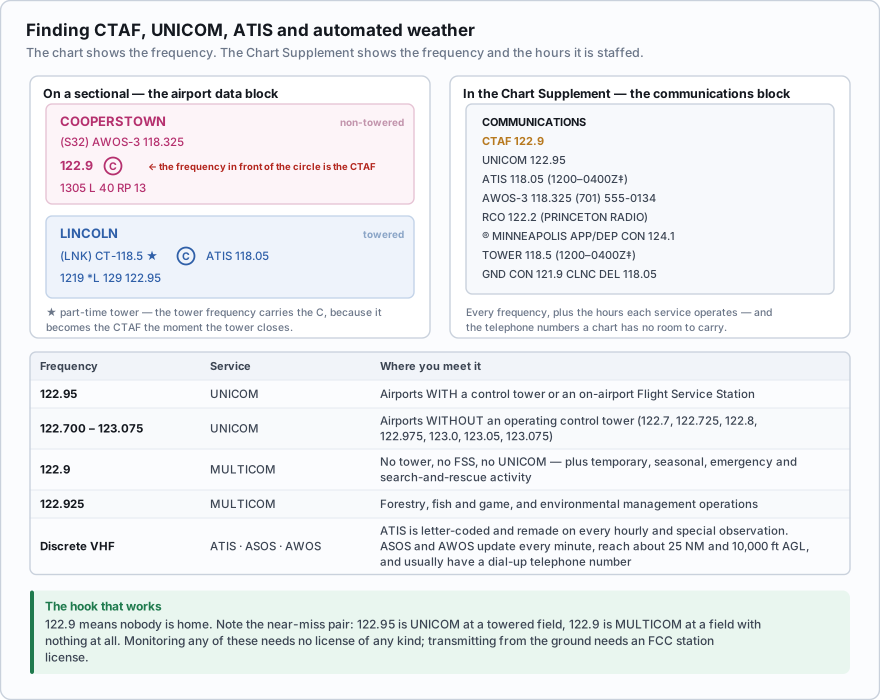
- On a sectional chart, an encircled C is printed immediately after the frequency that serves as the CTAF. Do not guess from the number — find the circle and read the frequency in front of it.
- In the Chart Supplement U.S., the communications block names the CTAF outright, with the hours each service operates.
- On instrument approach and departure charts, it appears in the communications strip.
One wrinkle: at a part-time tower the tower frequency usually carries the encircled C, because when the tower closes it becomes the CTAF. A charted tower frequency does not prove the field is towered right now — the Chart Supplement hours do.
A sectional data block lists 122.7, 122.8 and 135.075, with the encircled C printed immediately after 122.8. Which frequency do you announce on?
- 122.7
- 122.8
- 135.075
Answer: B. The encircled C is printed immediately after whichever frequency serves as the CTAF at that field — here 122.8, which also doubles as the UNICOM. This is the FAA's published Coeur d'Alene sample question: the answer is 122.8, and 122.05 — a Flight Service remote outlet that is not part of the airport data block at all — is the trap. Read the whole box.
UNICOM and MULTICOM
UNICOM is a nongovernment air-to-ground radio station — usually the fixed base operator's desk — that may provide airport information where there is no tower or Flight Service Station. Someone who is not a controller may give you the wind and the runway in use. It issues no clearances and holds no authority. At a non-towered field it is very often also the CTAF.
MULTICOM is the fallback. 122.9 covers temporary, seasonal and emergency activity and search and rescue — and airports with no tower, no Flight Service Station and no UNICOM at all. If a field has nothing, its CTAF is 122.9.
| Frequency | Service | Where |
|---|---|---|
| 122.95 | UNICOM | Airports with a control tower or an on-airport Flight Service Station |
| 122.700, 122.725, 122.800, 122.975, 123.000, 123.050, 123.075 | UNICOM | Airports without an operating control tower |
| 122.9 | MULTICOM | Temporary, seasonal, emergency and search-and-rescue activity, and airports with no tower, no FSS and no UNICOM |
| 122.925 | MULTICOM | Forestry, fish and game, and environmental management operations |
A hook that works: 122.9 means nobody is home. Note the near-miss pair too — 122.95 is UNICOM at a towered field; 122.9 is MULTICOM at a field with nothing.
ATIS — the recorded briefing
Automatic Terminal Information Service is a continuous recorded broadcast of non-control information at busy terminal areas. It keeps routine information off the controller's frequency: one recording, on a loop, tells every pilot the same thing.
- Airport name and the phonetic letter code identifying the recording
- Time of the latest weather observation, in Zulu
- Wind, visibility and obstructions to vision
- Sky condition, temperature, dew point and altimeter setting
- The instrument approach and the runway in use, plus field conditions and pertinent NOTAMs
Each new recording takes the next letter of the phonetic alphabet — Alfa, Bravo, on to Zulu, then back to Alfa. A new recording is made on receipt of any official hourly or special weather observation, and whenever other pertinent data changes. The letter is a version number, and a pilot states it on initial contact to prove they have the current one: "Cessna three four whiskey, information Sierra."
For you, ATIS is a free, current weather report for a field near your job site — and the runway in use line is worth more than the weather, because it tells you which way traffic is flowing and where the approach and departure corridors are today.
ASOS and AWOS
Smaller fields have no ATIS. Instead an automated sensor package generates its own broadcast. ASOS is the Automated Surface Observing System, run by the National Weather Service and the FAA; AWOS is the Automated Weather Observing System, often owned by the airport or the state.
- A 20-to-30 second message updated every minute — far fresher than an hourly METAR.
- Transmitted on a discrete VHF frequency or the voice portion of a nearby navigation aid, receivable to about 25 NM and 10,000 ft AGL.
- Most sites have a dial-up telephone number, so you can call the airport weather from the job site with no radio.
- AWOS-A is altimeter only; AWOS-1 adds wind, temperature, dew point and density altitude; AWOS-2 adds visibility; AWOS-3 adds cloud and ceiling; 3P, 3T, 3PT add precipitation and thunderstorm detection.
- The frequency appears in the data block as AWOS-3 135.075 or ASOS 118.425.
You are planning a job three miles from a small non-towered field. You want the current wind and ceiling but you have no aviation radio. What is the fastest legitimate source?
- Transmit a request on the CTAF from your phone
- Call the airport's AWOS or ASOS dial-up telephone number, listed in the Chart Supplement
- Wait for the next hourly METAR to be published
Answer: B. Most automated weather sites have a telephone dial-up that plays the same one-minute-updated message you would hear on the radio. The number is in the Chart Supplement entry for the airport. It requires no radio and no license.
What self-announcing sounds like
Pilots broadcast in a standard shape: airport name, aircraft type and call sign, position, intentions, airport name again. The name bookends the call because nearby airports often share a CTAF.
- "Cooperstown traffic, Cessna two one four three quebec, ten miles south, inbound, will enter left downwind runway one three, Cooperstown." — ten miles south, joining on the northeast side shortly.
- "...four three quebec, midfield left downwind runway one three..." — alongside the middle of the runway, about 1,000 ft up, northeast of it.
- "...four three quebec, turning base runway one three..." — descending toward the extended centerline.
- "Cooperstown traffic, Queen Air seven one five five bravo, taxiing to runway two six..." — a twin about to depart southwest along the extended centerline.
The AIM's recommended reporting points tell you when to expect to hear something. Inbound: ten miles out, entering downwind, base, final, and leaving the runway. Outbound: before taxiing, and before taxiing onto the runway. Hear the ten-mile call and then silence, and the aircraft is still coming.
What a remote pilot may and may not do on these frequencies
Monitoring is legal, free and genuinely valuable. Receiving a transmission requires no license of any kind, and a receiver tuned to the nearest CTAF warns you about every aircraft that announces. Nothing in Part 107 requires it and nothing prohibits it.
Transmitting is different, and the answer is generally no. Three reasons stack up.
- Your certificate does not authorise it. A remote pilot certificate is an FAA airman certificate. Radio stations are licensed by the FCC, and the two have nothing to do with each other.
- A ground transmitter needs a station license. Under 47 CFR §87.18(a) stations in the aviation service must be licensed. Paragraph (b) licenses *aircraft stations* by rule for domestic flights — but that means a radio carried aboard an aircraft. A transceiver in your hand on the ground is a ground station, and it needs its own FCC authorization.
- You are not a participant in the pattern. The AIM's phraseology is built for aircraft flying the pattern in sequence. Announcing "drone operating two miles north" asks pilots to look for what they will not see, while occupying a frequency they need for each other.
Recreational, commercial, and public drones generally do not require authorization to operate in Class G airspace, nor are UA required to maintain radio communications with other aircraft. The remote PIC must always yield right-of-way to a manned aircraft and not interfere with manned aircraft operations. The FAA encourages remote PICs to use caution when operating in and around the vicinity of airports because their aircraft may be difficult to see or be recognized by pilots of manned aircraft.
You are not required to talk. You are required to yield and to not interfere. Listening helps you do both; talking does neither.
An airspace authorization is not a clearance. A LAANC approval to fly at 200 ft inside Class D does not make you a participant in the traffic pattern and does not oblige anyone to avoid you. On the exam, the wrong answer to "how may a remote pilot operate in Class C airspace" is "monitor the ATC frequency from launch to recovery" — the right answer is prior authorization from the ATC facility having jurisdiction.
- CTAF serves an airport without an operating control tower; on a sectional it is the frequency immediately in front of the encircled C.
- UNICOM has no authority — 122.95 at towered fields; 122.7 to 123.075 at non-towered fields.
- MULTICOM 122.9: no tower, no FSS, no UNICOM — plus temporary, seasonal, emergency and search-and-rescue activity.
- ATIS is identified by a phonetic letter, remade on every hourly and special observation; pilots state the letter on initial contact.
- ASOS and AWOS update every minute, reach about 25 NM and 10,000 ft AGL, and usually have a telephone dial-up.
- Reporting points: 10 miles out, downwind, base, final, clear of the runway; departing, before taxiing and before entering the runway.
- Monitoring needs no license. Transmitting from the ground needs an FCC station license.
If your work genuinely requires coordination with an airport, the tool is the telephone, not the radio. The Chart Supplement lists the airport manager and the ATC facility. A five-minute call the day before buys a point of contact and sometimes a NOTAM published on your behalf.
- Towered airports have a controller and require two-way radio contact from manned pilots; non-towered airports have no controller and the pilots self-organize on a shared frequency
- CTAF is a role, not a fixed frequency; find it by the encircled C in the sectional data block or in the Chart Supplement
- UNICOM is a nongovernment advisory station with no authority — 122.95 at towered fields; MULTICOM 122.9 serves fields with no tower, no FSS and no UNICOM
- ATIS is a recorded loop identified by a phonetic letter, updated on every hourly and special observation; pilots state the letter to prove they have the current version
- ASOS and AWOS update every minute, reach about 25 NM and 10,000 ft AGL, and usually have a telephone number you can call from the job site
- Manned pilots self-announce at ten miles, downwind, base, final and clear of the runway, and before taxiing and before entering the runway
- Remote pilots may monitor freely and are encouraged to; transmitting requires an FCC station license and does not make you a participant in the pattern