Track your progress, take practice exams, and study the flashcards in the app.
5.1 Radio Communications & the Phonetic Alphabet
- Spell any identifier, call sign or ATIS code using the ICAO phonetic alphabet
- State and interpret altitudes, headings, speeds and times the way aviation says them
- Convert local time to Zulu and back for any US time zone, in standard time and in daylight time
You are almost certainly never going to transmit on an aviation radio. So why does the biggest section of the exam open with radio language? Because aviation writes everything the way it says it. The METAR you read before a job, the TFR that blocks your site, the NOTAM about a closed runway, the LAANC authorization window the FAA grants you, and the ATIS recording playing at the field a mile from your roof inspection are all written and spoken in this dialect. Learning to read it costs you one lesson. Not learning it costs you questions all the way through the test.
Why a spelling alphabet exists
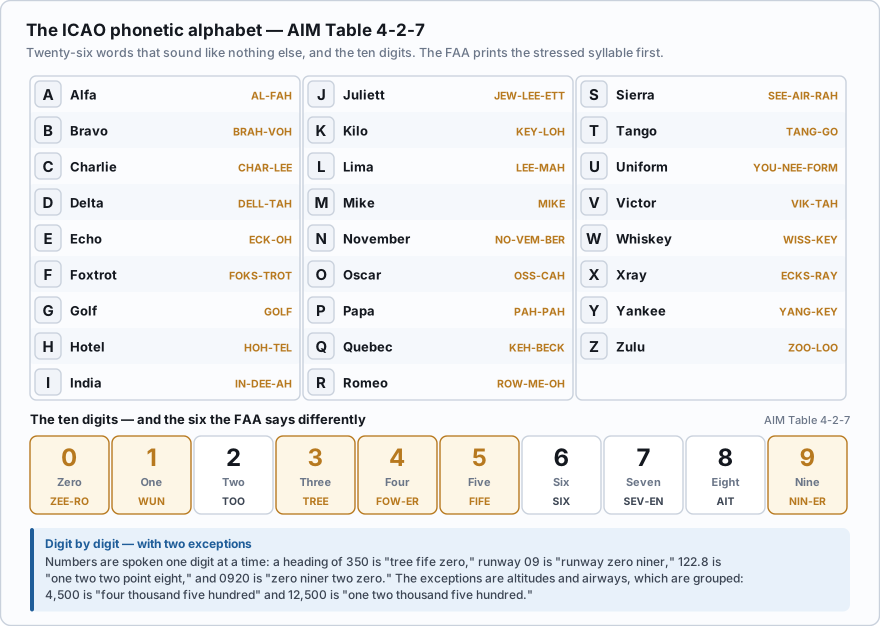
Over a VHF radio channel with engine noise behind it, B, C, D, E, G, P, T, V and Z all sound alike. So does M and N. Aviation solved this by giving every letter a word that sounds like nothing else. It is called the ICAO phonetic alphabet — ICAO is the International Civil Aviation Organization, the UN body that standardizes aviation worldwide — and you will meet it far outside the radio. Taxiways are lettered and spoken phonetically. ATIS recordings are named by a letter. Airspace is Class Bravo, Charlie, Delta. The letters in an aircraft registration number are spoken this way. Learn it once and it stays.
| Letter | Word | Said |
|---|---|---|
| A | Alfa | AL-FAH |
| B | Bravo | BRAH-VOH |
| C | Charlie | CHAR-LEE or SHAR-LEE |
| D | Delta | DELL-TAH |
| E | Echo | ECK-OH |
| F | Foxtrot | FOKS-TROT |
| G | Golf | GOLF |
| H | Hotel | HOH-TEL |
| I | India | IN-DEE-AH |
| J | Juliett | JEW-LEE-ETT |
| K | Kilo | KEY-LOH |
| L | Lima | LEE-MAH |
| M | Mike | MIKE |
| N | November | NO-VEM-BER |
| O | Oscar | OSS-CAH |
| P | Papa | PAH-PAH |
| Q | Quebec | KEH-BECK |
| R | Romeo | ROW-ME-OH |
| S | Sierra | SEE-AIR-RAH |
| T | Tango | TANG-GO |
| U | Uniform | YOU-NEE-FORM or OO-NEE-FORM |
| V | Victor | VIK-TAH |
| W | Whiskey | WISS-KEY |
| X | Xray | ECKS-RAY |
| Y | Yankee | YANG-KEY |
| Z | Zulu | ZOO-LOO |
There is no good mnemonic for twenty-six arbitrary words, and a bad one would slow you down. Say the list out loud three times a day for three days instead. Then start spelling ordinary things with it — your street, your last name, the identifier of the airport nearest your house. It sticks fast that way.
Numbers, and the five that change
Numbers get the same treatment for the same reason. Five of the ten digits are pronounced differently from ordinary English, and those five are the ones the exam likes.
| Digit | Word | Said |
|---|---|---|
| 0 | Zero | ZEE-RO |
| 1 | One | WUN |
| 2 | Two | TOO |
| 3 | Three | TREE |
| 4 | Four | FOW-ER |
| 5 | Five | FIFE |
| 6 | Six | SIX |
| 7 | Seven | SEV-EN |
| 8 | Eight | AIT |
| 9 | Nine | NIN-ER |
Each alteration fixes a real confusion. Tree for three keeps it from being heard as *free*. Fife for five keeps it from being heard as *fire* or *nine*. Niner for nine keeps it from being heard as *five* and from being confused with the German *nein*. Fower for four gives it a second syllable so it cannot be lost. Wun and zee-ro harden the vowels.
A controller says an aircraft is on a heading of "tree fife zero." What heading is that?
- 330 degrees
- 350 degrees
- 035 degrees
Answer: B. Tree is three and fife is five, so the digits are 3, 5, 0 — heading 350. Headings are always spoken digit by digit in three digits, so there is no missing leading zero to worry about.
The digit-by-digit rule and its exceptions
The default is one digit at a time. Ten is *one zero*, not *ten*. The exceptions exist because saying an altitude one digit at a time would take too long and invite errors, so hundreds and thousands get grouped.
| Kind of number | Rule | Example |
|---|---|---|
| Hundreds and thousands up to 9,900 | Group form | 4,500 = four thousand five hundred |
| Above 9,900 | Digits for the thousands, then the word | 10,000 = one zero thousand |
| Altitude below 18,000 ft MSL | As above, spoken in feet | 12,500 = one two thousand five hundred |
| Altitude at or above 18,000 ft | Flight level, digit by digit | FL190 = flight level one niner zero |
| Headings, bearings, wind direction | Three digits, one at a time | 005 = zero zero five |
| Speeds | Digit by digit, then the unit | 250 kt = two five zero knots |
| Runway numbers | Digit by digit | Runway 09 = runway zero niner |
| Frequencies | Digit by digit around the decimal | 122.8 = one two two point eight |
| Time | Four digits, 24-hour clock | 0920 = zero niner two zero |
| Airways and routes | Group form | V12 = Victor twelve |
Note the pattern hiding in there. Anything that could be mistaken for a different quantity — a heading, a speed, a runway, a frequency — is broken into digits. Anything that is unmistakably a big round number — an altitude in thousands of feet — is grouped. A wind report of *two two zero at one five* cannot be confused with anything; a wind report of *two-twenty at fifteen* can.
Call signs and N-numbers
Every civil aircraft registered in the United States carries a registration number beginning with the letter N — the nationality mark assigned to the US. Pilots call it the N-number or the tail number. Your own drone has one too, issued when you registered it, and it is the number you must display on the airframe.
- Full form. N4964A is spoken *November four niner six fower alpha*. Letters phonetic, digits one at a time.
- With the aircraft type. When the pilot states the manufacturer or model, the N is dropped: *Aztec two fower six fower alpha*, *Bonanza six five five golf*, *Cessna one seven two romeo bravo*.
- Abbreviated. After the first exchange, the controller or the pilot may shorten it to the prefix plus the last three characters — *Aztec six fower alpha*. You will hear the short form far more than the long one.
- Airlines and operators with an assigned call sign use a company name plus a flight number in group form: *Delta one twenty-three*, *Cactus forty-two*.
- Commercial operators with no FAA-assigned call sign prefix their normal identification with the phonetic word Tango: *Tango Aztec two fower six fower alpha*.
- Experimental and other special aircraft append the word to the call sign: *Breezy six one tree romeo experimental*.
This matters more than it looks. When you overhear *Skyhawk three four whiskey* you know a Cessna 172 is out there — a light, slow trainer that will fly a 1,000-foot pattern at 90 knots. When you overhear *Lifeguard* or *Medevac* prefixed to a call sign, a medical flight is inbound and it will not be flying a normal pattern. When you overhear a jet call sign, the aircraft is faster, higher on approach, and will be on a longer final than the small stuff. The call sign is free information about who is about to be near your job site.
You hear "Cherokee two eight five golf papa, midfield left downwind." What is the aircraft's registration number?
- N285GP
- N28-5-GP, a Cherokee-specific number
- The registration cannot be determined from that transmission
Answer: A. When a pilot states the aircraft type, the N prefix is dropped from the spoken call sign. Cherokee two eight five golf papa is N285GP. Add the N back to reconstruct the registration.
Zulu time — one clock for the whole world
An airplane can cross three time zones in two hours. If every report, forecast and clearance used local time, half of aviation would be spent asking *whose noon?* So aviation runs on a single worldwide clock: Coordinated Universal Time, abbreviated UTC, which is the local time on the prime meridian at Greenwich, England, with no daylight saving adjustment ever. In speech and on charts it is called Zulu, after the phonetic word for the letter Z that marks it.
The FAA uses Coordinated Universal Time (UTC) for all operations. The term ZULU may be used to denote UTC. Time is stated on a 24-hour clock, spoken digit by digit — 0920 is "zero niner two zero."
You will see Zulu on every product you touch. A METAR stamped 141853Z was observed on the 14th of the month at 1853 UTC. A TAF valid 1412/1518 runs from 1200Z on the 14th to 1800Z on the 15th. A TFR is published with Zulu start and stop times. Your LAANC authorization is granted for a Zulu window. Get the conversion wrong and you fly outside your authorization.
| Time zone | Standard time: add | Daylight time: add |
|---|---|---|
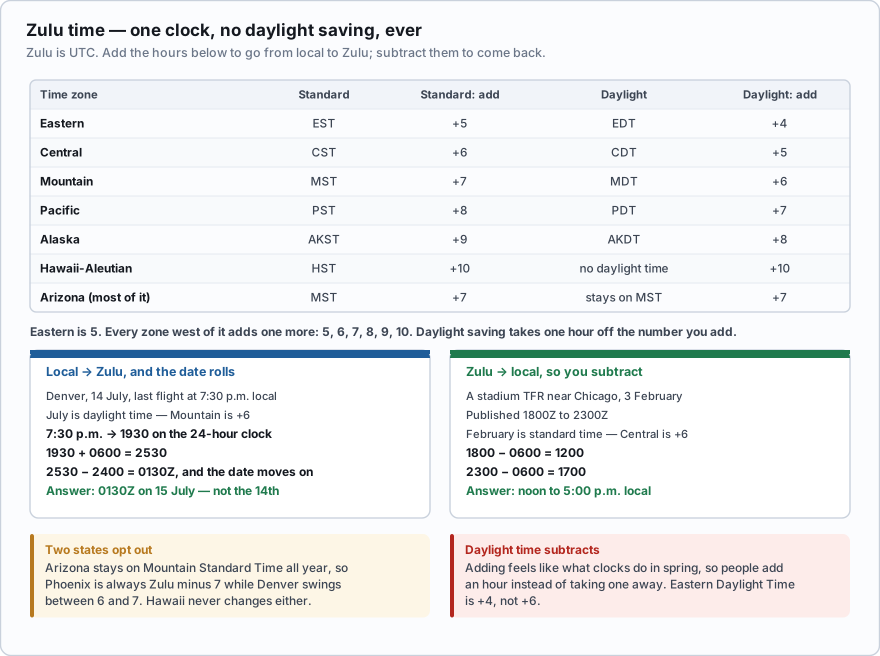
| Eastern (EST / EDT) | 5 hours | 4 hours |
| Central (CST / CDT) | 6 hours | 5 hours |
| Mountain (MST / MDT) | 7 hours | 6 hours |
| Pacific (PST / PDT) | 8 hours | 7 hours |
| Alaska (AKST / AKDT) | 9 hours | 8 hours |
| Hawaii-Aleutian (HST) | 10 hours | no daylight time — always 10 |
The structure is easy once you see it. Eastern is 5, and every zone west of it adds one more: 5, 6, 7, 8, 9, 10. Daylight saving time moves the clock forward one hour locally, so it takes one hour off the number you add. Two states opt out entirely: Hawaii never changes, and Arizona stays on Mountain Standard Time all year, so Phoenix is always Zulu minus 7 while Denver swings between 6 and 7.
Local to Zulu. You are shooting a construction progress set in Denver on 14 July. Your client wants the last flight at 7:30 p.m. local. July is daylight time, so Mountain is +6. Put 7:30 p.m. on the 24-hour clock first — 1930. Then 1930 + 0600 = 2530, which is more than 2400, so subtract 24 hours and roll the date forward: 0130Z on 15 July. Your authorization must cover that Zulu date, not the 14th. Zulu to local. A TFR near a stadium in Chicago on 3 February reads 1800Z to 2300Z. February is standard time, so Central is +6, and going the other way you subtract: 1800 − 0600 = 1200, and 2300 − 0600 = 1700. The TFR runs from noon to 5:00 p.m. local. Note that you subtracted to go from Zulu to local, and added to go from local to Zulu. Getting the direction backwards is the single most common error on this topic.
Two traps live here. First, the date rolls. Any West Coast evening operation is already "tomorrow" in Zulu — 6:00 p.m. PDT on Tuesday is 0100Z Wednesday. If your authorization is written for Tuesday Zulu, it expired at 5:00 p.m. your time. Second, daylight time subtracts. Clocks going forward feels like adding, so people add an hour to the conversion instead of taking one away. Eastern Daylight Time is +4, not +6.
It is 1:00 p.m. Pacific Daylight Time. What time is it in Zulu?
- 2100Z
- 2000Z
- 0500Z
Answer: B. Convert to the 24-hour clock first: 1:00 p.m. is 1300. Pacific Standard Time adds 8 hours; daylight time takes one hour off that, so add 7. 1300 + 0700 = 2000Z.
- The five altered digits: 3 = tree, 4 = fower, 5 = fife, 9 = niner, 0 = zee-ro.
- Headings, bearings, wind directions and runway numbers are spoken digit by digit — 005 is zero zero five.
- Altitudes below 18,000 ft use group form — 12,500 is one two thousand five hundred. Above 9,900 the thousands are spoken as digits.
- N is dropped when the aircraft type is stated. Cherokee two eight five golf papa is N285GP.
- Zulu = UTC, a single clock with no daylight saving, used for every FAA time.
- Add: Eastern 5, Central 6, Mountain 7, Pacific 8, Alaska 9, Hawaii 10. Daylight time subtracts one from each.
- Arizona and Hawaii do not observe daylight time.
The word Zulu does double duty and it confuses people the first time. An ATIS broadcast identified as information Zulu is the twenty-sixth recording of the cycle — the letter Z — and has nothing to do with the time zone. Context sorts it out: a letter names a recording, a four-digit number followed by Z names a time.
That is the language. Next you will hear it used: the frequencies it travels on, who is talking, and what you may and may not say back.
- The ICAO phonetic alphabet exists because letters sound alike on a radio; it is used for taxiways, airspace classes, ATIS codes and the letters in a registration number
- Five digits change: three is tree, four is fower, five is fife, nine is niner, zero is zee-ro
- Numbers are spoken digit by digit except altitudes and hundreds-thousands groups; headings, speeds, runway numbers and frequencies are always digits
- US civil registrations begin with N; the N is dropped when the aircraft type is stated, and the call sign may be abbreviated to the prefix plus the last three characters
- Aviation runs on Zulu time — UTC, the clock at Greenwich, with no daylight saving adjustment ever
- Add 5 for Eastern, 6 Central, 7 Mountain, 8 Pacific, 9 Alaska, 10 Hawaii; subtract one hour from each during daylight time
- Watch the date roll: an evening flight in the western US falls on the next Zulu day