Track your progress, take practice exams, and study the flashcards in the app.
5.11 Physiology, Vision & Fitness for Flight
- Explain how rods, cones, the blind spot and dark adaptation govern what you can actually see
- Apply the segmented scanning technique and off-center viewing, and recognize the night illusions
- Recognize dehydration, heat injury, hyperventilation, stress and fatigue in yourself and your crew
- State the alcohol, drug and medical-condition rules that apply to a remote pilot, and run IMSAFE
Part 107 requires no medical certificate. That does not mean the FAA stopped caring about your body — it means the responsibility moved onto you. §107.31 makes your eyes required equipment on every flight, and §107.17 makes you the person who decides whether you are fit to use them. Area V, Task E carries nine knowledge elements, which is a lot for a subject most courses treat as filler.
How the eye works
Light passes through the cornea and lens and lands on the retina at the back of the eye. The retina holds two kinds of light-sensitive cell, and the difference between them explains almost everything about seeing aircraft.
| Cones | Rods | |
|---|---|---|
| Where | Concentrated toward the center of the field of vision, densest in the fovea | Spread around the periphery of the retina |
| What they do | All color vision and fine detail | Detect movement; provide vision in dim light; no color |
| Light needed | Daylight and bright illumination | Work in very low light once adapted |
| Adaptation | Adapt to darkness quickly but stop working in it | Need approximately 30 minutes for full dark adaptation |
Two consequences follow. In daylight your sharpest vision covers a very small cone of straight-ahead view — roughly a thumbnail at arm's length. Everything else is soft, which is why searching requires moving your eyes rather than staring. At night the arrangement inverts: the center of your vision, being all cones, effectively goes blind.
The blind spot
Where the optic nerve attaches to the retina at the back of each eye there are no light-sensitive cells at all. That patch is a genuine hole in each eye's field of view. Normally the other eye covers it and your brain fills the gap so convincingly you never notice — but with one eye occluded by sun glare, a hat brim, or a monitor hood, an aircraft can sit in that hole and be invisible.
There is a second, different one at night. The night blind spot covers the central 5 to 10 degrees of vision in low light, because that is the cone-only region. At night, looking straight at a dim object makes it disappear.
Scanning — the tested technique
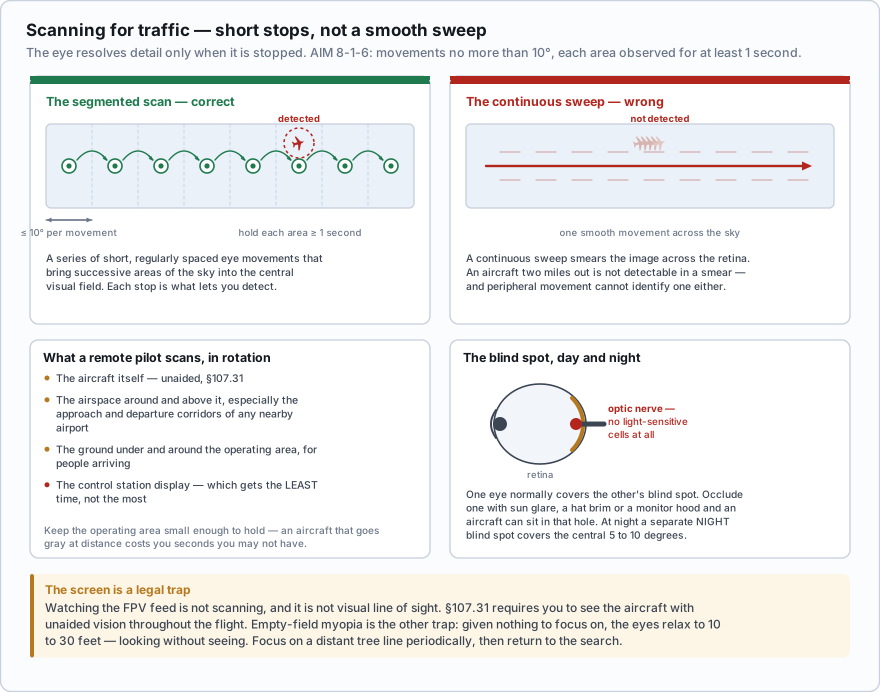
The FAA asks which technique a remote pilot should use to scan for traffic. The answer is to systematically focus on different segments of the sky for short intervals. Not sweeping continuously from right to left. Not relying on movement in peripheral vision.
The reason is mechanical: the eye resolves detail only when it is stopped. A continuous sweep smears the image, and an aircraft two miles out is not detectable in a smear.
- Daytime method (AIM 8-1-6): “a series of short, regularly spaced eye movements that bring successive areas of the sky into the central visual field. Each movement should not exceed 10 degrees, and each area should be observed for at least 1 second to enable detection.”
- Night method: scan in roughly 30-degree segments with about 10 degrees of overlap, holding each stop no longer than 2 to 3 seconds, and use off-center viewing.
- The four things a remote pilot scans, in rotation: the aircraft itself; the airspace around and above it, especially the approach and departure corridors of any nearby airport; the ground under and around the operating area for people arriving; and the control station display. The display gets the least time, not the most.
- Keep the operating area small enough to hold. Your aircraft goes gray at distance, and losing it then reacquiring it costs seconds you may not have.
Watching the FPV feed is not scanning, and it is not visual line of sight. §107.31 requires you to see the aircraft with unaided vision throughout the flight. A screen is a useful instrument and a legal trap: it draws your eyes down at exactly the moment a manned aircraft is closing. Brief a hard split — eyes on the aircraft, glances at the screen — and give the observer the standing job of saying so when you drift from it.
Which technique should a remote pilot use to scan for traffic?
- Continuously sweep the eyes smoothly from right to left across the sky
- Systematically focus on different segments of the sky for short intervals
- Concentrate on detecting relative movement in the peripheral vision
Answer: B. The eye resolves detail only when it stops moving, so effective scanning is a series of short fixations on successive segments. A continuous sweep blurs the image and detects almost nothing. Peripheral vision detects movement but cannot identify or resolve an aircraft, and an aircraft on a collision course shows no relative movement at all.
Night vision
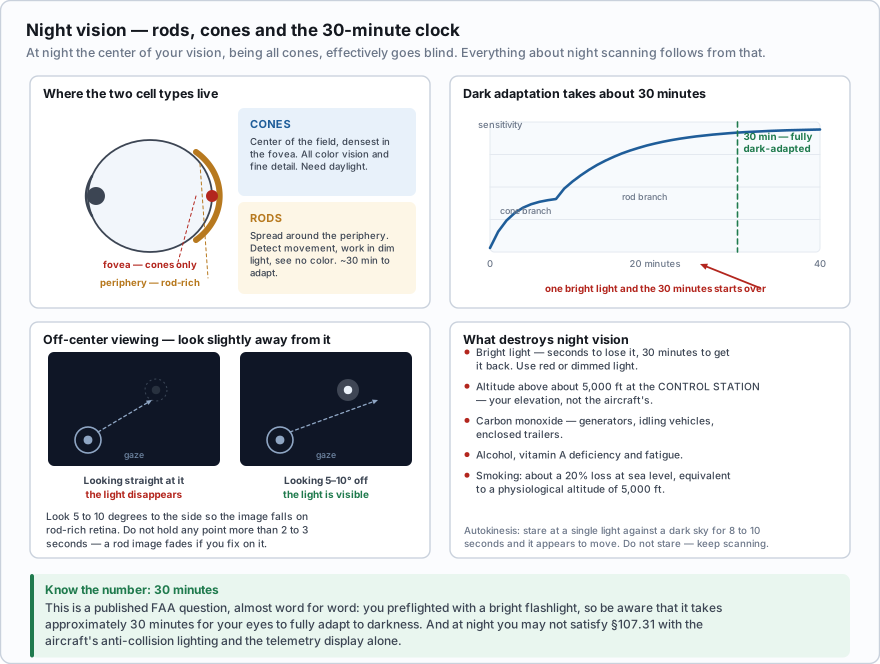
Rods take time to come online. Full dark adaptation takes approximately 30 minutes, and this number is tested — the AIM notes a moderate degree of adaptation in about 20 minutes under dim red light, with complete adaptation requiring at least 30 minutes in darkness. A bright light destroys it in seconds, and then the 30 minutes starts over. That is the exact content of an FAA sample question: you preflighted with a bright flashlight, so be aware that it takes approximately 30 minutes for your eyes to fully adapt to darkness.
- Use red or dimmed light for preflight and paperwork, and turn controller and tablet brightness to minimum. Brief the crew that anyone about to use white light announces it and points it away.
- Off-center viewing is how you see a dim object at night. Look 5 to 10 degrees off to the side — above, below, or either side — so its image falls on rod-rich retina rather than the cone-only center. To see it better, look slightly away from it. It is deeply counterintuitive and has to be practiced before the job that needs it.
- Do not hold any point more than 2 to 3 seconds. A rod image fades if you fix on it; keep moving and keep coming back.
- What degrades night vision: bright light, altitude above about 5,000 feet at the control station (your elevation, not the aircraft's), carbon monoxide, alcohol, vitamin A deficiency, and fatigue.
- Smoking: the FAA's figure is a 20 percent loss of night vision capability at sea level, equivalent to a physiological altitude of 5,000 feet. Of all the self-imposed stressors, cigarette smoking most decreases visual sensitivity at night.
Empty-field myopia
Given nothing to focus on — clear blue sky, a uniform haze layer, a dark night — the eyes relax to a resting focal distance of roughly 10 to 30 feet. You are looking at infinity and focused at arm's length, and aircraft in that field are not seen at all. The FAA's phrase for it is looking without seeing. The fix costs nothing: periodically focus on something real and distant — a tree line, a building edge, a cloud — then return to the search.
Night illusions
- Autokinesis. Stare at a single stationary light against a dark background for 8 to 10 seconds and it appears to move. Your aircraft's anti-collision strobe against a black sky is exactly that setup, and the consequence is chasing a movement that is not happening. Fix: do not stare, keep scanning, and cross-check against a fixed reference such as a tower light.
- False horizon. Sloping cloud, an obscured horizon, a dark landscape spread with ground lights, bright stars, or a shoreline can be mistaken for the true horizon — distorting your judgment of the aircraft's attitude and your own orientation on uneven ground.
- Flicker vertigo. Light flickering between about 4 and 20 cycles per second can produce nausea, dizziness, disorientation and, rarely, seizures. Site sources: your own strobe seen through the propellers, a rotating airport beacon, sun through a spinning rotor, emergency vehicle lights. Fix: change the geometry or look away, and remove an affected crew member from the operation.
- Reversible perspective and the size-distance illusion. At night an aircraft's light can appear to recede when it is in fact approaching. Judge by whether the light is getting brighter (closing) or dimmer, not by apparent size.
- The practical rule: fly a night operation over ground you surveyed in daylight. Every one of these illusions is easier to defeat when you already know what is out there.
Dehydration and heat
Dehydration is a critical loss of water from the body, caused by heat, wind, low humidity, and diuretic beverages — coffee, tea, alcohol, and caffeinated soft drinks.
- The first symptom is FATIGUE. This is the tested item. Not thirst, not headache — fatigue. Progressive symptoms follow: headache, cramps, sleepiness, dizziness, weakness, nausea, tingling in the extremities, and finally extreme thirst.
- Thirst is unreliable. It does not engage until roughly a 1.5-quart deficit, about 2 percent of body weight, and a little moisture in the mouth can switch the signal off while the deficit continues.
- Drink two to four quarts of water every 24 hours, on a schedule rather than on thirst. You cannot catch up — the body absorbs water at only about 1.2 to 1.5 quarts per hour. Under severe heat stress drink about a quart per hour; under moderate heat stress, about a pint per hour.
- Heatstroke is the body's inability to control its temperature. It can mirror dehydration or arrive as sudden collapse, and it is a medical emergency.
Why this is in a drone ACS at all: unlike a pilot in a climate-controlled cockpit, the remote pilot stands outside for the entire operation — often on asphalt, in direct sun, in a high-visibility vest, holding a controller they cannot put down. Multi-hour survey and inspection work in July is the exposure. Mitigate with shade over the control station, crew rotation, a written hydration plan, electrolytes on long days, and heat named explicitly as a stop criterion in the briefing. Cold counts too: numb fingers, reduced battery output, impaired judgment.
What is the first symptom of dehydration a remote pilot is likely to notice?
- Extreme thirst
- Fatigue
- Muscle cramps in the legs
Answer: B. Fatigue is the first symptom of dehydration. Thirst is a late and unreliable indicator — it does not engage until roughly a 1.5-quart deficit, about 2 percent of body weight. Cramps, headache and dizziness come later in the progression. Drink on a schedule, two to four quarts per 24 hours, rather than waiting to feel thirsty.
Hyperventilation
Hyperventilation is an excessive rate and depth of breathing that blows off too much carbon dioxide from the blood. It usually happens subconsciously, under stress or anxiety, which is why people rarely notice they are doing it.
- Symptoms: visual impairment, lightheadedness, dizziness, tingling in the fingers and around the mouth, hot and cold sensations, muscle spasm, a feeling of suffocation, drowsiness, incoordination, disorientation — and eventually unconsciousness, at which point breathing self-corrects.
- Hyperventilation symptoms closely mimic hypoxia, and the two can occur together. That overlap is a favorite exam point.
- Treatment: breathing normally is both the best prevention and the best cure. Consciously slow the rate and depth. Talking out loud or singing works; breathing into a paper bag rebuilds CO₂.
- Where you will meet it: a fly-away, a low-battery warning at maximum range, a crowd walking in, a client watching. The tingling hands arrive exactly when fine stick control matters most. Brief it — if a crew member starts breathing fast during an emergency, name it and slow them down.
Carbon monoxide
Carbon monoxide is a colorless, odorless, tasteless gas produced by every internal combustion engine. It binds to hemoglobin and prevents it carrying oxygen — a form of hypoxia — and small quantities over time are enough. Symptoms are headache, blurred vision, dizziness, drowsiness and loss of muscle power. The drone sources are ordinary: a generator charging batteries, working beside or inside an idling vehicle, gas-powered sUAS exhaust, enclosed trailers, and cigarettes. Get to fresh air, shut down the source, and seek treatment if symptoms persist.
Stress and fatigue
- Stress is the body's response to physical and psychological demands. Acute stress is the immediate fight-or-flight response, which healthy people normally cope with. Chronic stress exceeds a person's ability to cope and causes performance to fall sharply — the FAA states plainly that pilots at that level are not safe and should not exercise their airman privileges.
- Acute fatigue is short-term: strenuous effort, excitement, or lack of sleep. Rest after exertion and 8 hours of sound sleep ordinarily cures it.
- Skill fatigue is a variety of acute fatigue with two effects worth knowing: timing disruption — every task performed as usual but slightly out of sequence, treated as separate components rather than one integrated activity — and disruption of the perceptual field — concentrating on the center of vision and neglecting the periphery. For a remote pilot that is the precise mechanism by which you stop scanning and start staring.
- Chronic fatigue extends over a long period, usually with psychological roots, and is not relieved by diet and rest. It requires a physician. Stress and fatigue together are an extremely hazardous combination.
The tested item: fatigue is best recognized as an impaired state. Not “easily recognized by an experienced pilot,” and not something willpower overcomes. You cannot reliably self-assess fatigue, because the instrument you would assess with is the thing that is impaired — a fatigued pilot rates their own performance generously. That is why you use external limits instead: a maximum on-site hour count, a hard stop time set before you left the house, and a crew member with standing authority to call it.
Alcohol
§107.27 applies §§91.17 and 91.19 to the person manipulating the flight controls, the remote PIC, and the visual observer. The alcohol rules cover your whole crew, not only you.
No person may act or attempt to act as a crewmember of a civil aircraft: within 8 hours after the consumption of any alcoholic beverage; while under the influence of alcohol; while using any drug that affects the person's faculties in any way contrary to safety; or while having an alcohol concentration of 0.04 percent or greater in a blood or breath specimen.
- Those are four independent prohibitions, not one rule described four ways. You can satisfy the 8 hours and still violate the rule by being under the influence.
- 0.04 percent is half the typical 0.08 percent state DUI limit. You can be legally sober to drive and illegally impaired to fly.
- 8 hours is the legal minimum; the FAA recommends 12 to 24 hours between bottle and throttle depending on the amount consumed. Considerable amounts of alcohol can remain in the body for over 16 hours.
- As little as one ounce of liquor, one beer, or four ounces of wine impairs flying skill, and impairment of vision and hearing can occur from a single drink. Judgment and decision-making are affected by even small amounts.
- Alcohol causes histotoxic hypoxia — the cells cannot use the oxygen they have — and one ounce is roughly 2,000 feet of physiological altitude. Impaired pilots also stare at objects and neglect scanning technique, so alcohol attacks precisely the skill this lesson is about, and the residual effects outlast the buzz.
- Nothing speeds elimination. Not coffee, food, exercise or oxygen. There is no way to alleviate a hangover, and a hungover pilot is still impaired.
- Marijuana is an illicit drug under federal law and its use by airmen is prohibited, regardless of state legalization. §91.19 prohibits carriage of narcotics, marijuana, and depressant or stimulant drugs.
Two more sections carry the enforcement. §107.57 makes a conviction under any federal or state narcotics, marijuana, or depressant/stimulant statute grounds for denial of an application for up to 1 year after the date of final conviction, or for suspension or revocation of a remote pilot certificate — and committing an act prohibited by §91.17(a) or §91.19(a) carries the same consequences. §107.59 makes refusing to submit to an alcohol test, or refusing to furnish or authorize release of the results, grounds for denial for up to 1 year, or suspension or revocation. Refusal is not an escape route; it is its own offense.
Medication
No person may manipulate the flight controls of a small unmanned aircraft system or act as a remote pilot in command, visual observer, or direct participant in the operation of the small unmanned aircraft if he or she knows or has reason to know that he or she has a physical or mental condition that would interfere with the safe operation of the small unmanned aircraft system.
Note the breadth — it reaches direct participants, not only the pilot — and note that it is not waivable. This is the section that replaces the medical certificate you do not have to hold.
- Virtually all medications have the potential for adverse side effects in some people, including herbal supplements and energy products.
- Antihistamines are the classic trap. Diphenhydramine (Benadryl) causes drowsiness and has a prolonged half-life, so the impairment outlasts the feeling of being impaired by hours. Decongestants, cough suppressants, sedatives, tranquilizers, muscle relaxants, motion-sickness drugs and anti-diarrheals all impair.
- OTC aspirin, acetaminophen and ibuprofen at correct dosages have minimal side effects and rarely preclude flying. Prescription analgesics — oxycodone, codeine, meperidine, propoxyphene — cause confusion, dizziness, nausea and vision problems, and flying is almost always precluded. Anything that depresses the nervous system also increases susceptibility to hypoxia.
- Two waiting rules to memorize: wait at least 48 hours after the first dose of any new medication, and wait at least five maximal dosing intervals for a medication with sedating or dizziness side effects. A label reading “every 4 to 6 hours” means 5 × 6 = 30 hours.
- The condition can disqualify you even when the drug does not. AC 107-2A's examples: loss of the dexterity needed to operate the control station, blurred vision preventing see-and-avoid vigilance, illness or medication preventing situational awareness — including any medication that cautions against driving or operating heavy machinery — migraine or moderate-to-severe pain, hearing or speech impairment that blocks crew communication, and conditions such as epilepsy that risk sudden incapacitation.
- The safest rule: do not fly as a crew member while taking any medication unless you have confirmed it is acceptable.
IMSAFE and fitness for flight
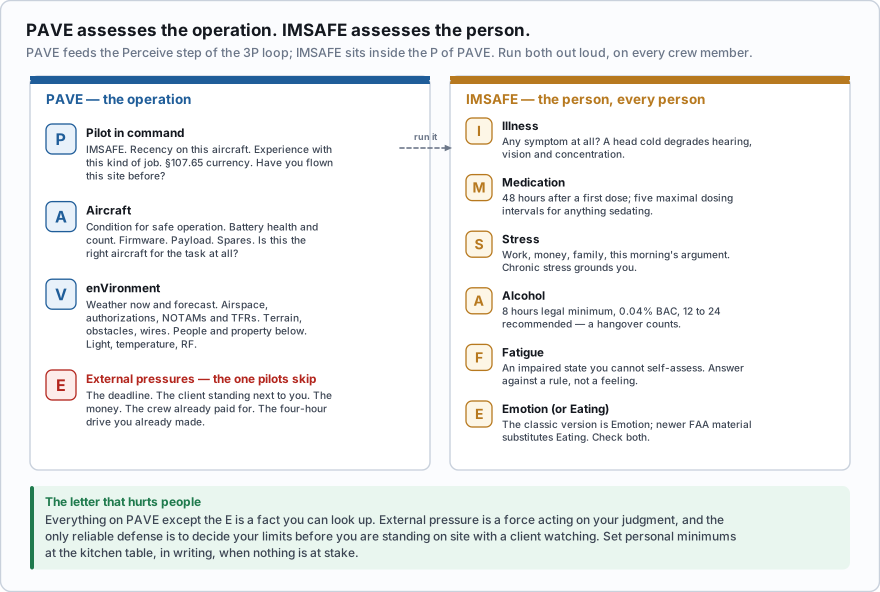
- I — Illness. Any symptom at all? A head cold degrades hearing, vision and concentration.
- M — Medication. Prescription or over the counter, within the last 48 hours or five dosing intervals.
- S — Stress. Work, money, family, the argument this morning. Chronic stress grounds you.
- A — Alcohol. 8 hours legal minimum, 12 to 24 recommended — and a hangover counts as impairment.
- F — Fatigue. Are you fully rested? You cannot self-assess this well, so answer against a rule, not a feeling.
- E — Emotion. The classic PHAK and AIM version is Emotion; newer FAA and industry material substitutes Eating. Know both, and check both.
No medical certificate is required for Part 107, and none of your crew needs one. §107.17 puts the burden on each of them instead, and the remote PIC must ensure the whole crew remains unimpaired throughout the operation, not merely at the start. Beyond IMSAFE: avoid elective medications before a job, eat regular meals, stay hydrated, and sleep before you drive to the site. Standing in the sun for six hours holding a controller is a physical job.
- Cones: center of the retina, color and detail, need light. Rods: periphery, movement and dim light, no color, ~30 minutes to fully dark-adapt — and one bright light resets the clock.
- The blind spot is where the optic nerve attaches to the retina; at night a separate night blind spot covers the central 5–10 degrees. Use off-center viewing, 5 to 10 degrees away from the object.
- Scan by systematically focusing on different segments of the sky for short intervals — not a continuous sweep, not peripheral movement.
- Dehydration's first symptom is fatigue. Thirst is unreliable. Drink 2 to 4 quarts per 24 hours.
- Fatigue is best recognized as an impaired state and cannot be reliably self-assessed.
- Alcohol: 8 hours bottle to throttle, 0.04 percent BAC, and no operation while under the influence — §107.27 applying §91.17, and it covers the visual observer too. §107.59: refusing a test is itself grounds for denial, suspension or revocation.
- 48 hours after a first dose of any new medication; five maximal dosing intervals for anything sedating.
Buy a cheap red headlamp and keep it in the case. It costs less than a propeller and it is the difference between arriving at a night job dark-adapted and spending the first half hour of a paid flight unable to see your own aircraft against the sky.
- Cones sit in the center of the retina and give color and detail in daylight; rods sit in the periphery, see movement and dim light, and need about 30 minutes to fully dark-adapt
- The blind spot is where the optic nerve attaches to the retina; at night the central 5–10 degrees goes blind, so use off-center viewing and never hold a point more than 2–3 seconds
- Scan by systematically focusing on small segments of the sky for short intervals — a continuous sweep detects nothing, and empty-field myopia makes a featureless sky invisible
- Night illusions: autokinesis after 8–10 seconds of staring, false horizon, flicker vertigo at 4–20 cycles per second, and reversible perspective
- Dehydration's first symptom is fatigue and thirst is unreliable — drink 2 to 4 quarts per 24 hours; heatstroke is the body's failure to control temperature and is an emergency
- Hyperventilation mimics hypoxia and is cured by breathing normally; fatigue is best recognized as an impaired state and cannot be reliably self-assessed
- §107.27 applies §91.17 to the remote PIC, the person on the controls and the visual observer: 8 hours bottle to throttle, 0.04 percent BAC, and no operation under the influence; §107.17 bars any impaired direct participant; §107.57 and §107.59 supply the penalties