Track your progress, take practice exams, and study the flashcards in the app.
5.12 Maintenance, Inspection & Preflight (§107.49)
- Distinguish scheduled from unscheduled maintenance and state who may perform maintenance on a Part 107 sUAS
- Recite the §107.49 preflight actions and apply the §107.15 condition-for-safe-operation standard
- Run a complete preflight inspection, including the additions required for night
- Explain the Declaration of Compliance and what a remote pilot must verify before a Category 2 or 3 operation
Part 107 prescribes no maintenance program. There is no annual, no 100-hour inspection, no airworthiness certificate, and no mechanic's signature. 14 CFR Part 43 — the maintenance rule for manned aircraft — does not apply, and Part 21 does not apply either, unless the aircraft will be flown over people under §107.140 as a Category 4 operation. All of that is replaced by a single standard, and everything in this lesson hangs off it: condition for safe operation.
§107.15 — the standard
(a) No person may operate a civil small unmanned aircraft system unless it is in a condition for safe operation. Prior to each flight, the remote pilot in command must check the small unmanned aircraft system to determine whether it is in a condition for safe operation. (b) No person may continue flight of the small unmanned aircraft when he or she knows or has reason to know that the small unmanned aircraft system is no longer in a condition for safe operation.
- The remote PIC makes the determination, before each flight. The FAA asks this directly: responsibility to inspect the sUAS to ensure it is in a safe operating condition rests with the remote pilot in command — not the owner, and not the visual observer.
- Paragraph (b) is a continuing obligation. The duty does not end at takeoff. If you learn mid-flight that the aircraft is no longer safe, continuing is a violation. This is the regulatory basis for “land it when the anomaly appears,” and it means that decision is not a judgment call.
- §107.15 is not waivable.
Scheduled and unscheduled maintenance
AC 107-2A defines sUAS maintenance as scheduled and unscheduled overhaul, repair, inspection, modification, replacement, and system software upgrades of the aircraft and its associated elements. Read that last item again: firmware updates are maintenance. Treat them with the discipline you would give to replacing a motor.
| Scheduled | Unscheduled | |
|---|---|---|
| Trigger | A time-in-service limit — flight hours, cycles, or calendar days | A discrepancy found at preflight or discovered in service |
| Source | The manufacturer's documentation identifying components that need periodic service | Inspection, an anomaly in flight, a hard landing, a product notification |
| Your obligation | Adhere to the manufacturer's recommended schedule to maximize service life and safety | Flight operations should not occur until the issue is corrected — including a required software update |
| If no schedule exists | The owner/operator should establish one, by documenting repairs, modifications, overhauls and replacements and recording component time-in-service | — |
That bottom-left cell is a published FAA sample question. Under what condition should the operator establish a scheduled maintenance protocol? When the manufacturer does not provide a maintenance schedule. Not never, and not only after an accident. You build the schedule out of your own logged data until it tells you what wears out and when.
Who may perform maintenance
- There is no certificate requirement. No A&P mechanic, no repairman certificate, no Part 145 repair station is needed to work on a Part 107 sUAS. The remote PIC or the owner may do it.
- Follow the manufacturer's instructions. The manufacturer may require specific personnel for particular tasks — warranty work, sealed assemblies, calibrations requiring proprietary tooling.
- If the manufacturer cannot or will not do the work, it should be completed by personnel familiar with that specific small UAS and its components, in accordance with the manufacturer's instructions or, in lieu of those, within known industry best practices.
- Some jobs need equipment, tools or training you may not have — motor bearing replacement, ESC firmware flashing, IMU and gimbal calibration, structural bonding, battery pack repair. Send those out.
- If the equipment cannot be restored to a condition for safe operation, replace the component or the aircraft. That is the AC's own answer and it is the exam answer.
Recordkeeping
Part 107 requires no maintenance records and prescribes no format. AC 107-2A treats recordkeeping as a best practice and the ACS tests it as “appropriate record keeping.” Hardcopy or electronic logbook, your choice — but log the whole system, not only the airframe: the aircraft, the control station, launch and recovery equipment, command-and-control link equipment and antennas, the payload, and any other component required for the operation.
- What to record: inspections and findings; maintenance, preventive maintenance and repairs; alterations; component replacements with part and serial numbers; time-in-service by component; defects discovered and the corrective action; deviations from manufacturer specifications; firmware versions with update dates; battery logs per pack (ID, cycles, capacity, internal resistance, storage events, retirement); the date of the last successful preflight check; and flight logs.
- Why it is worth the ten minutes: it produces the maintenance schedule you were told to establish, it tracks component service life, and it documents systemic failures — the way you discover that arm number three keeps cracking.
- §107.7 requires the remote PIC, owner, operator, or person manipulating the controls to present the sUAS and any associated records required to be kept, upon request by the Administrator. Your log is also your first line of defense in an enforcement action or an insurance claim.
Your aircraft's manufacturer publishes no maintenance schedule for the airframe. What should you do?
- Nothing — with no manufacturer schedule, no maintenance program is required
- Establish a scheduled maintenance protocol yourself, documenting work performed and recording component time-in-service
- Request an inspection interval from the FAA before the next flight
Answer: B. AC 107-2A is explicit: when the manufacturer provides no schedule, the operator should establish a scheduled maintenance protocol by documenting repairs, modifications, overhauls and replacements and recording component time-in-service, so a reliable schedule develops over time. The FAA does not issue inspection intervals for Part 107 aircraft.
§107.49 — the preflight action, enumerated
This is the section to know as a list, because the exam asks which items belong in it. Like §107.15, it is not waivable.
Prior to flight, the remote pilot in command must: (a) assess the operating environment, considering risks to persons and property in the immediate vicinity both on the surface and in the air — the assessment must include (1) local weather conditions, (2) local airspace and any flight restrictions, (3) the location of persons and property on the surface, and (4) other ground hazards; (b) ensure that all persons directly participating in the operation are informed about the operating conditions, emergency procedures, contingency procedures, roles and responsibilities, and potential hazards; (c) ensure that all control links between the ground control station and the small unmanned aircraft are working properly; (d) if the small unmanned aircraft is powered, ensure that there is enough available power for the small unmanned aircraft system to operate for the intended operational time; (e) ensure that any object attached or carried by the small unmanned aircraft is secure and does not adversely affect the flight characteristics or controllability of the aircraft; and (f) if the operation will be conducted over human beings under subpart D, ensure that the aircraft meets the requirements of § 107.110, § 107.120(a), § 107.130(a), or § 107.140, as applicable.
Two sub-lists carry most of the questions. The four environment items: local weather, local airspace and flight restrictions, the location of persons and property on the surface, and other ground hazards. The five briefing items: operating conditions, emergency procedures, contingency procedures, roles and responsibilities, and potential hazards.
Students blend the four environment items and the five briefing items into one list of nine and then cannot answer either question. Keep them apart by what each is about. Paragraph (a) is about the world — weather, airspace, people and property on the ground, other ground hazards. Paragraph (b) is about the people — what your crew must be told. If the answer choice names a physical condition, it belongs to (a). If it names something you say to a person, it belongs to (b).
One requirement sits outside §107.49 but belongs in the same breath: if a visual observer is used, §107.33 requires that the VO can see the aircraft as §107.31 specifies and that effective communication is established. Test the radios before you launch, not after.
A complete preflight
AC 107-2A ¶7.3.4 gives a 23-item recommended checklist and Appendix E provides a sample form. 14 CFR Part 43 Appendix D offers a logical way to organize an inspection into subgroups — airframe, flight controls, batteries, engine — but the AC warns it is not comprehensive, because it does not address UAS-specific features such as datalinks or support equipment. Use it as a template, not as the whole program: inspections should be scalable to the aircraft, the program and the operation, and should cover the entire system.
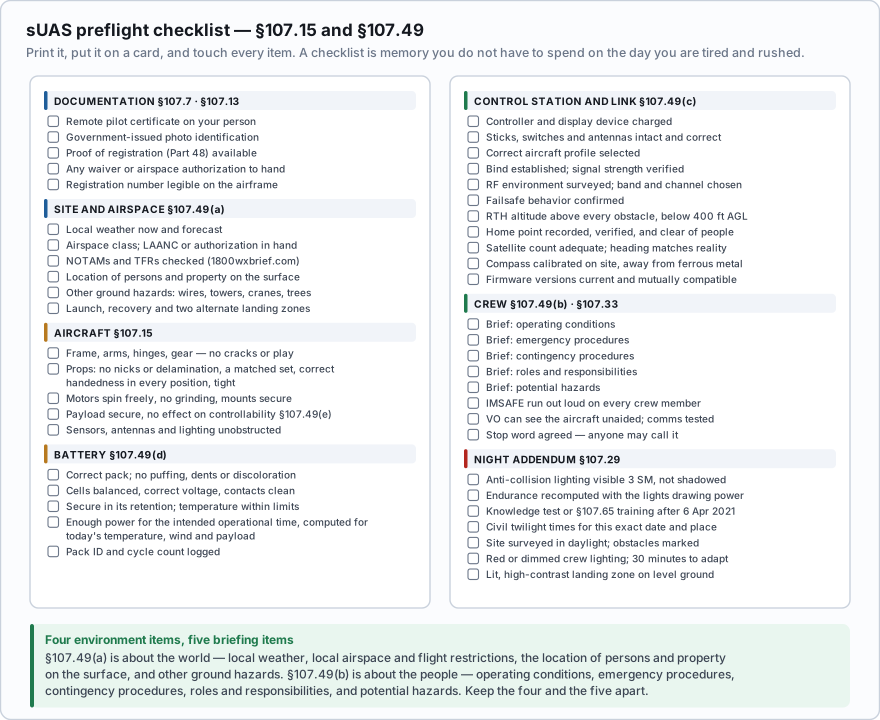
- Documents — remote pilot certificate, government-issued photo ID, proof of registration, and any Certificate of Waiver or airspace authorization available (§107.7, §107.13). Registration marking legible on the exterior.
- Site — weather now and forecast; airspace class and authorization in hand; NOTAMs and TFRs; obstacles, wires and towers; location of persons and property; other ground hazards; launch, recovery and alternate landing zones.
- Structure — frame, arms and booms, folding hinges, landing gear, fasteners, cracks, deformation, previous repair sites; control surfaces, linkages and servos on a fixed wing.
- Propellers and motors — no nicks, cracks, delamination or warping; correct handedness in every position; a matched set; securely fastened. Motors spin freely with no grinding or bearing play, mounts secure and uncracked.
- Battery — correct pack for the mission; no puffing, damage or discoloration; secure in its retention; correct voltage; cells balanced; connector clean; temperature within limits; pack ID logged.
- Control station — charged; sticks and switches free and correct; antennas intact and correctly oriented; display readable; correct aircraft profile selected; failsafe behavior and RTH altitude verified above every obstacle in the area.
- Control links — bind established, signal strength verified, RF environment surveyed, correct control response commanded from the control station, and VO communication tested (§107.49(c), §107.33).
- GPS and compass — adequate satellite count (AC 107-2A says at least four; in practice wait for a strong lock), home point recorded and verified, compass calibrated at the site away from ferrous material.
- Firmware — aircraft, controller, battery and app versions current and mutually compatible. Update in the shop, never in the field, and never on the morning of a paying job.
- Payload — secure, does not adversely affect flight characteristics or controllability (§107.49(e)), does not obstruct sensors or lighting; any drop mechanism safed.
- Power — enough for the intended operational time with reserve (§107.49(d)), computed for today's temperature, wind and payload, not for the brochure.
- Function check — start the propellers and check for imbalance or irregular operation, then a low hover to check stability, drift and vibration before committing to the mission.
- Crew — §107.49(b) briefing complete, IMSAFE run on everyone, VO positioned and communicating.
Use a written checklist, on paper or on a card, and touch each item. The purpose of a checklist is not to teach you the aircraft. It is to work on the day you are tired, rushed, and confident you remember everything.
The night preflight addendum
- Anti-collision lighting. §107.29 requires lighting visible for at least 3 statute miles with a flash rate sufficient to avoid a collision. Verify it functions, verify it is visible from all directions, and verify the airframe, payload or landing gear is not shadowing it.
- Recompute power. AC 107-2A directs the remote PIC to consider whether the anti-collision lights reduce the power available, potentially requiring a reduced duration of operation. Your night endurance is not your daylight endurance.
- Confirm your own currency — the §107.29(a)(1) requirement that the remote PIC completed the initial knowledge test or §107.65 recurrent training after April 6, 2021 — and confirm official sunset, sunrise and civil twilight for that exact location and date.
- Survey the site in daylight first. Find the unlit towers, cranes, wires, antennas and building edges you will not be able to see later. AC 107-2A adds that in almost all cases involving operations at night, the remote PIC may need to restrict the operational area.
- VLOS is still VLOS. You may not rely solely on the aircraft's anti-collision lighting, the ground control station telemetry display, or a combination of the two, to satisfy §107.31.
- Crew lighting and night vision — red or dimmed lights only, white light announced before use, controller and tablet brightness at minimum, roughly 30 minutes allowed for dark adaptation, reflective vests, and a lighted site perimeter.
- A higher-contrast landing site — an illuminated or high-contrast pad on level ground you inspected in daylight, so you can find it and judge height against it. Brief the night illusions before you launch.
You are planning a 25-minute night inspection flight using the same aircraft and battery that gives you 25 minutes in daylight. What does AC 107-2A tell you to consider?
- Nothing changes — battery endurance is unaffected by the time of day
- The anti-collision lighting draws power, which may reduce the available flight duration
- Night flight requires a second battery aboard the aircraft
Answer: B. AC 107-2A directs the remote PIC to consider whether the anti-collision light or lights could reduce the amount of power available, potentially requiring a reduced duration of the operation. §107.49(d) then requires you to ensure enough power for the intended operational time — computed with the lights on, not off.
Mitigating mechanical failures
The ACS asks about mechanical failures of all elements used in sUAS operations, such as the battery and any devices used to operate the sUAS — so think in systems, not airframes.
| Element | Common failure | Mitigation |
|---|---|---|
| Propellers | Nicks, cracks, delamination, imbalance, wrong handedness, in-flight shedding | Inspect every flight, replace as matched sets, never repair a prop, verify rotation after any motor swap |
| Motors and ESCs | Bearing wear, desync, overheating, solder joint failure | Spin check, listen for grinding, check temperature after landing, log hours |
| Airframe | Fatigue cracks at arm roots and folding hinges, loose fasteners | Torque check, inspect joints, full inspection after any hard landing |
| Battery | Puffing, cell imbalance, rising internal resistance, connector wear, voltage sag | Per-pack logs, storage voltage discipline, retire at first puffing, never fly a crash-involved pack |
| Control station | Dead controller, stick drift, cracked screen, damaged antenna, tablet overheating or receiving a call | Charge before every operation, airplane mode where the app allows, shade the device, carry a spare |
| C2 link and antennas | Loose or damaged antenna, wrong orientation, interference | Physical inspection, correct orientation, site RF survey, spare antennas |
| GPS and compass | Interference, poor calibration, low satellite count | Calibrate on site away from metal, verify satellite count and home point |
| Firmware | Incompatible versions, mid-update failure, changed behavior | Update in the shop, test-fly afterward in a safe area, log versions, never update on job day |
The overarching mitigation is unglamorous: a written checklist that gets used, a maintenance log that reveals trends before they become failures, conservative retirement of components, and the discipline to cancel rather than fly a system with a known discrepancy. §107.15(a) makes flying a known-unsafe sUAS a regulatory violation, which takes the decision out of the realm of opinion.
Declaration of Compliance for Category 2 and 3
A declaration of compliance is a record submitted to the FAA certifying that the small unmanned aircraft conforms to the Category 2 or Category 3 requirements of Subpart D. The designer, producer, or modifier submits it — not the remote pilot.
- Category 2 (§107.120(a)): the aircraft will not cause injury to a human being equivalent to or greater than the severity of injury caused by a transfer of 11 foot-pounds of kinetic energy on impact from a rigid object; has no exposed rotating parts that would lacerate human skin; and contains no safety defects. Category 3 (§107.130(a)) applies the same three criteria at 25 foot-pounds.
- Means of compliance (§107.155) must consist of test, analysis, or inspection, and must be accepted by the FAA.
- Three obligations the DOC places on its holder: label the aircraft as eligible for the category — in English, legible, prominent and permanently affixed; provide remote pilot operating instructions; and maintain a product support and notification process to notify the public and the FAA of identified safety defects.
The maintenance obligations that reach you flow out of those three. Before a Category 2 or 3 operation over people:
- Verify the exact make, model and serial number appear on an accepted Declaration of Compliance in the FAA's database at uasdoc.faa.gov.
- Physically confirm the Category 2 or Category 3 label is present on the aircraft.
- Have and follow the manufacturer's remote pilot operating instructions. They are part of the compliance, not a suggestion.
- Watch for and comply with product support notifications. A safety defect notice can remove your aircraft from eligibility overnight.
- Keep the aircraft in its declared configuration. A third-party propeller guard, an added payload, an aftermarket modification, or a repair performed outside the manufacturer's instructions can void the declared compliance. The DOC covers the aircraft as declared — which makes maintaining eligibility a maintenance discipline, not paperwork.
For contrast: Category 4 is the only Part 107 category with a real maintenance regime. It requires an airworthiness certificate issued under Part 21, operation within the approved Flight Manual limitations, and maintenance, preventive maintenance, alterations and inspections performed per the manufacturer's instructions using methods acceptable to the Administrator, with records to match.
- §107.15: the sUAS must be in a condition for safe operation, the remote PIC checks it before each flight, and flight may not continue once the PIC knows or has reason to know it is no longer safe. Not waivable.
- When the manufacturer provides no maintenance schedule, the owner/operator should establish one.
- No certificate is required to maintain a Part 107 sUAS — but the work should follow the manufacturer's instructions and be done by someone familiar with that specific system; if it cannot be restored to a condition for safe operation, replace it.
- §107.49(a) four environment items: local weather · local airspace and flight restrictions · location of persons and property on the surface · other ground hazards.
- §107.49(b) five briefing items: operating conditions · emergency procedures · contingency procedures · roles and responsibilities · potential hazards. Then (c) control links working, (d) enough power, (e) attached objects secure and not affecting controllability, (f) Subpart D compliance if over people.
- Night: anti-collision lighting visible for 3 statute miles, lights reduce available power, survey the site in daylight, and you may not satisfy VLOS with lighting and telemetry alone.
- The Declaration of Compliance is submitted by the designer, producer or modifier — the remote pilot verifies it at uasdoc.faa.gov, checks the label, follows the operating instructions, and keeps the aircraft in its declared configuration.
Photograph your aircraft from six angles the day you buy it and keep the images with the log. When an insurer or the FAA asks whether that arm crack predated the incident, a dated photograph settles in ten seconds an argument that otherwise takes months. The same habit applies to every pack: photograph the label, write the watt-hours on it, and start its log on day one.
- Part 107 has no airworthiness certificate, no Part 43 and no prescribed inspection intervals — the standard is §107.15's condition for safe operation, checked by the remote PIC before each flight and continuing throughout it
- Maintenance includes scheduled and unscheduled overhaul, repair, inspection, modification, replacement and software upgrades; when the manufacturer gives no schedule, the owner should establish one
- No certificate is required to maintain a Part 107 sUAS, but work should follow the manufacturer's instructions and be done by someone familiar with the system — and unrestorable equipment gets replaced
- Records are not mandated but are tested as best practice: log the whole system, including per-pack battery data and firmware versions, and present records to the Administrator on request under §107.7
- §107.49 requires assessing weather, airspace and restrictions, persons and property on the surface, and other ground hazards; briefing five items to all direct participants; verifying control links and power; securing attached objects; and confirming Subpart D eligibility
- Night adds anti-collision lighting visible for 3 statute miles, a power recomputation, currency confirmation, a daylight site survey, a restricted operating area, and a high-contrast landing site
- The Declaration of Compliance is filed by the designer, producer or modifier for Category 2 (11 ft-lb) and Category 3 (25 ft-lb); the remote pilot verifies it, checks the label, follows the operating instructions, and keeps the aircraft in its declared configuration