Track your progress, take practice exams, and study the flashcards in the app.
4.3 What Loading Does to Performance
- List the performance penalties that result from operating an overloaded sUAS
- Calculate the increase in stall speed produced by an increase in weight
- Describe ground effect and its practical consequences for a multirotor
- Recognize vortex ring state and state the correct escape technique
Every ounce you add to an aircraft is paid for somewhere. Lesson 4.2 covered whether the weight is legal and where it sits. This lesson covers what it costs you in the air, plus two low-altitude phenomena - ground effect and vortex ring state - that the exam expects you to know and that will genuinely bite you on a job site.
The cost of overloading
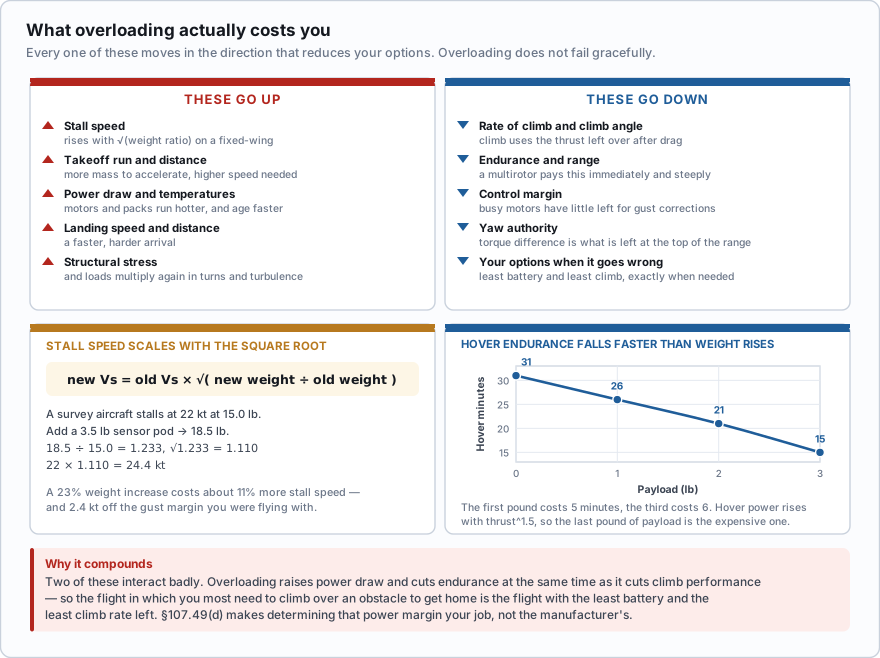
- Higher stall speed (fixed-wing). A heavier wing must produce more lift, so it reaches its critical angle of attack at a higher airspeed. Your margin above the stall shrinks.
- Longer takeoff run and distance. More weight to accelerate, and a higher speed to reach before the wing will fly.
- Reduced rate of climb and reduced climb angle. Climb performance comes from thrust left over after overcoming drag. Add weight and there is less left over.
- Reduced endurance and range. More power is needed to stay airborne, so the battery drains faster. A multirotor pays this immediately and steeply.
- Higher power draw and higher motor and battery temperatures, which shortens component life and increases the risk of a thermal event.
- Reduced control margin. Motors already running near their limit to hold the aircraft up have little left for attitude corrections in gusts.
- Increased structural stress. Arms, mounts, and airframe joints are designed for a maximum weight, and loads multiply in turns and in turbulence.
- Longer landing distance and higher landing speed on a fixed-wing, and a faster, harder arrival on a multirotor.
Two of these interact in an ugly way. Overloading raises power draw and reduces endurance at the same time as it reduces climb performance - so the flight in which you most need to climb over an obstacle to get home is the flight in which you have least battery and least climb rate. Overloading does not fail gracefully.
Stall speed and weight, calculated
For a fixed-wing sUAS, stall speed scales with the square root of the weight ratio. Add weight and stall speed rises, but not proportionally - a 20 percent weight increase produces about a 10 percent stall speed increase. The formula is: new stall speed = old stall speed × √(new weight ÷ old weight).
A fixed-wing survey aircraft stalls at 22 knots at its normal operating weight of 15.0 pounds. You add a 3.5 lb sensor pod for a new contract. Step 1. New weight = 15.0 + 3.5 = 18.5 lb. Step 2. Weight ratio = 18.5 ÷ 15.0 = 1.233. Step 3. Square root of 1.233 = 1.110. Step 4. New stall speed = 22 × 1.110 = 24.4 knots. Reading the result. A 23 percent weight increase raised the stall speed by about 11 percent - roughly 2.4 knots. That sounds small. It is not, because your approach speed, your minimum maneuvering speed, and your margin in a gust all move with it, and your takeoff and landing distances grow at the same time. If you were previously approaching at 28 knots with a 6-knot margin over the stall, you now have 3.6 knots of margin at the same approach speed.
A fixed-wing sUAS has its takeoff weight increased. What happens to stall speed and rate of climb?
- Stall speed increases and rate of climb decreases
- Stall speed decreases and rate of climb increases
- Stall speed is unchanged because the critical angle of attack is unchanged
Answer: A. A heavier wing must generate more lift, so it reaches the critical angle at a higher airspeed - stall speed rises with the square root of the weight ratio. Climb rate falls because less thrust is left over after overcoming the extra drag. The critical angle of attack itself does not change, but the speed at which you arrive there does.
Endurance is not linear either
For a hovering multirotor, the power required rises faster than the weight does - roughly with thrust to the power of one and a half. Doubling the payload does considerably more than double the power penalty of that payload. This is why a manufacturer's payload chart is not a straight line, and why the last kilogram of rated payload costs far more flight time than the first.
A quadcopter's flight manual publishes these hover endurance figures at sea level in still air: | Payload | Hover endurance | |---|---| | 0.0 lb | 31 min | | 1.0 lb | 26 min | | 2.0 lb | 21 min | | 3.0 lb (maximum) | 15 min | Step 1 - note the shape. The first pound costs 5 minutes. The second pound costs another 5. The third costs 6. The curve is steepening, which is the T-to-the-1.5 relationship showing up in the numbers. Step 2 - your mission. You need a 2.4 lb sensor package. Interpolate between the 2.0 lb and 3.0 lb rows: 21 min minus 0.4 × (21 − 15) = 21 − 2.4 = 18.6 minutes. Step 3 - apply the reserve. Never plan to the published number. A standard personal minimum is to land with 25 percent of the battery remaining, so usable endurance is 18.6 × 0.75 = 14.0 minutes. Step 4 - apply the real-world derate. Manufacturer figures are still-air, sea-level, hovering, new battery. With a 12-knot wind, a 900-foot site elevation, a 40-degree-Fahrenheit morning, and packs with 80 cycles on them, planning on 11 to 12 minutes of working time is realistic. The result. A published 31-minute aircraft gives you about 11 minutes of usable work with this payload on this day. Plan the mission around 11, not 31.
The manufacturer's advertised flight time is a best case laboratory figure - no payload, no wind, sea level, moderate temperature, a hover, and a new battery. It is not a lie, but it is not a plan. Students and new pilots both make the same mistake of treating it as a budget. Section 107.49(d) requires you to ensure there is enough power for the intended operational time, and that determination is yours, not the manufacturer's.
Ground effect
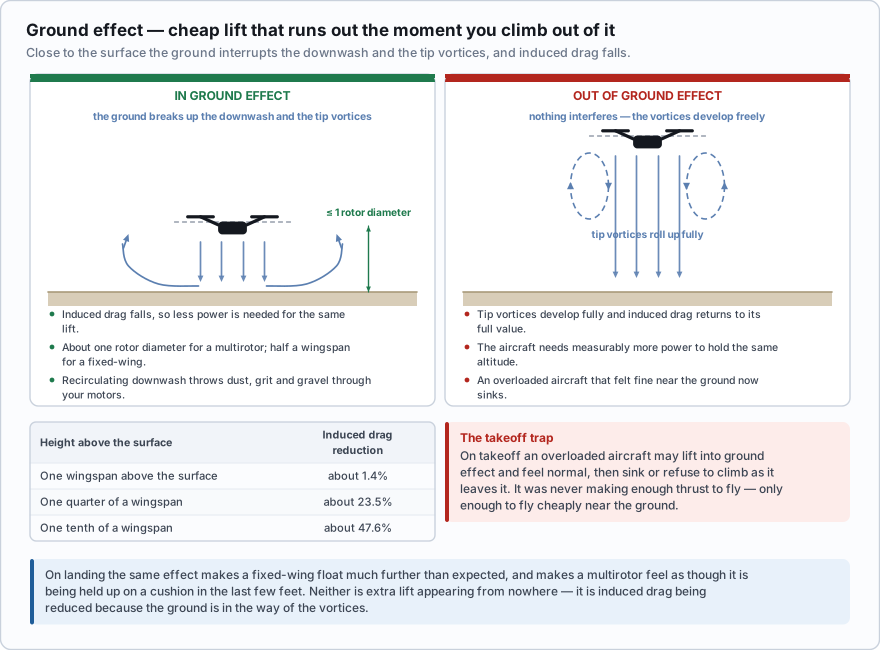
Ground effect is the change in aerodynamic behavior that happens when an aircraft operates close to the surface. The ground physically interrupts the downwash and the tip vortices, which reduces induced drag - the drag that is a by-product of producing lift. Less induced drag means the aircraft needs less power to stay up.
For a fixed-wing, the standard figure to remember is that ground effect becomes significant at less than half the wingspan above the surface, and it grows rapidly closer in. The FAA's own numbers for induced drag reduction are about 1.4 percent at one wingspan, about 23.5 percent at a quarter wingspan, and about 47.6 percent at one tenth of a wingspan. For a multirotor, the practical rule is roughly one rotor diameter above the surface.
The practical consequences run both ways. On takeoff, an overloaded aircraft may lift into ground effect and feel fine, then sink or refuse to climb as it leaves ground effect - it was never producing enough thrust to fly, only enough to fly cheaply near the ground. On landing, a fixed-wing may float far further than expected. And for a multirotor over an uneven or debris-strewn surface, ground effect is also where recirculating downwash picks up dust, gravel, and grit and throws it through your motors.
Vortex ring state
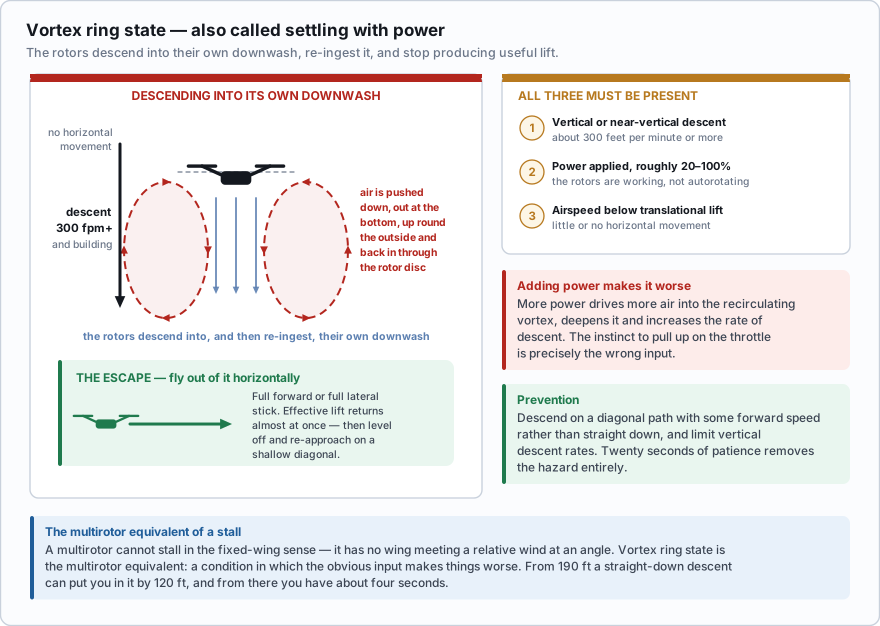
Vortex ring state - also called settling with power - happens when a rotorcraft descends vertically into its own downwash. The air the rotors have pushed down comes back up around the outside of the disc and gets pulled through again, forming a doughnut-shaped recirculating vortex. The rotors are turning at full speed in air that is already moving downward, so they produce far less useful lift. The aircraft develops a high, increasing rate of descent, becomes unresponsive, and may wobble or roll unpredictably.
- Three conditions must be present together for vortex ring state: a vertical or near-vertical descent of about 300 feet per minute or more, power applied in roughly the 20 to 100 percent range, and airspeed below effective translational lift - meaning little or no horizontal movement
- The escape is lateral or forward flight. Move the aircraft sideways or forward out of its own disturbed column of air
- Adding power does not fix it and makes it worse. More power drives more air into the recirculating vortex
- Prevention: descend on a diagonal path rather than straight down, keep some forward speed, and limit vertical descent rates
- A multirotor cannot stall in the fixed-wing sense. Vortex ring state is the multirotor equivalent hazard
The instinct when a drone starts dropping is to pull up on the throttle, and that is precisely the wrong input in vortex ring state. It increases the downwash the rotors are already sitting in, deepens the vortex, and accelerates the descent. The correct response is counterintuitive: fly out of it sideways or forward, and only then arrest the descent. If you have altitude, a small forward stick input recovers you in a second or two. If you triggered it by descending fast onto a landing point from 20 feet, you will not have that second.
You have finished a rooftop inspection at 190 feet AGL and you are behind schedule. You center the aircraft over the landing pad and pull straight down on the descent stick. What the aircraft does. Descent rate builds past 300 feet per minute. There is no horizontal movement, so the rotors stay in their own descending column of air. Power is still applied at roughly 40 percent. All three conditions for vortex ring state are now satisfied. What you see. At about 120 feet the descent rate suddenly increases and the aircraft starts to rock. The screen still shows a normal battery and normal motor status. The wrong response. Full up on the throttle. The descent rate increases further. You now have roughly four seconds and 100 feet. The right response. Full forward or full lateral stick, hold it, and let the aircraft translate out of the disturbed column. Effective lift returns almost immediately, then you level off and re-approach the pad on a shallow diagonal. The prevention. Descend on a diagonal path with forward speed rather than straight down, or limit vertical descent to a slow rate. It costs you twenty seconds and it removes the hazard entirely.
A multirotor in a fast vertical descent begins sinking rapidly and becomes unresponsive. What is the correct recovery?
- Apply maximum power to arrest the descent
- Move the aircraft laterally or forward out of its own downwash
- Cut power to allow the rotors to unload, then restore power
Answer: B. This is vortex ring state. Adding power feeds the recirculating vortex and increases the rate of descent. Cutting power removes what lift you still have. The escape is horizontal - translate out of the disturbed column of air, then arrest the descent once the rotors are working in clean air again.
Beyond the test: density altitude belongs in this conversation even though the exam files it under weather. On a hot day at a high-elevation site, the air is less dense, so the rotors move less mass for the same RPM and the motors must run faster to hover. That consumes the same control margin that overloading consumes, and the two stack. A load that is comfortable at sea level on a cool morning can leave you with no headroom at all at 6,000 feet in the afternoon. Module 3.7 covers density altitude in detail.
- Overloading raises stall speed and takeoff distance, and reduces climb rate, endurance, range, control margin, and structural margin
- Stall speed rises with the square root of the weight ratio - a 23% weight increase costs about 11% more stall speed
- Hover power rises faster than weight, so the last pound of payload costs far more endurance than the first
- Manufacturer endurance figures are still-air, sea-level, no-payload best cases; derate them and add a reserve
- Ground effect reduces induced drag within about half a wingspan, or one rotor diameter, of the surface, and can mask an overload on takeoff
- Vortex ring state needs a vertical descent of about 300 fpm or more, 20 to 100 percent power, and near-zero airspeed. Escape laterally or forward - do not add power