Track your progress, take practice exams, and study the flashcards in the app.
4.2 Weight, Balance & Center of Gravity
- Calculate whether an sUAS meets the 55-pound regulatory limit including everything on board or attached
- Compute a center of gravity position from weights and arms and compare it to published limits
- Describe the effects of a forward and an aft center of gravity on stability and controllability
- Identify where the CG limits for a specific aircraft come from
Weight and balance is two separate questions that get lumped together. Weight asks how much the aircraft weighs and whether that is legal and safe. Balance asks where that weight sits, because the same total weight in the wrong place flies very differently. Both are tested, and both come up in real work the moment you bolt a second camera to something.
Weight and the 55-pound number
A small unmanned aircraft is an unmanned aircraft weighing less than 55 pounds on takeoff, including everything that is on board or otherwise attached to the aircraft.
Read the definition carefully, because the exam does. The 55 pounds is measured on takeoff, and it includes everything on board or otherwise attached - the airframe, the battery, the camera, the gimbal, the propeller guards, the parachute, the spotlight, the delivery payload, the strobe, and the roll of tape you left in the cargo bay. Not the controller, which is on the ground with you. Not your tablet.
It is also less than 55 pounds, not 55 or under. An aircraft that weighs exactly 55.0 pounds on takeoff is not a small unmanned aircraft and cannot be flown under Part 107.
You are rigging a heavy-lift hexacopter for a thermal roof survey. | Item | Weight | |---|---| | Airframe, empty, with motors and props | 31.4 lb | | Flight battery, 2 packs at 6.8 lb each | 13.6 lb | | Gimbal and thermal camera | 4.9 lb | | Visual camera on the secondary mount | 2.1 lb | | Ballistic parachute system | 1.7 lb | | Anti-collision strobe and mount | 0.4 lb | Step 1. Add every item that will be on board or attached at the moment of takeoff: 31.4 + 13.6 + 4.9 + 2.1 + 1.7 + 0.4 = 54.1 lb. Step 2. Compare to the regulatory limit. 54.1 lb is less than 55 lb, so the aircraft is a small unmanned aircraft and the flight may be conducted under Part 107. Step 3. Compare to the manufacturer's maximum takeoff weight, which for this airframe is 52.0 lb. The flight is legal but not airworthy - you are 2.1 lb over the manufacturer's structural and performance limit. The lesson. The 55-pound number is a regulatory ceiling, not a permission. The manufacturer's maximum takeoff weight is almost always lower, and it is the one that determines whether the aircraft will actually fly the mission. Remove the visual camera and you are at 52.0 lb and compliant with both.
- A small unmanned aircraft weighs less than 55 pounds on takeoff, including everything on board or otherwise attached
- The control station, your tablet, and your spare batteries on the ground do not count toward the 55 pounds
- The manufacturer's maximum takeoff weight is usually well below 55 lb and is the limit that governs performance and structure
- 0.55 pounds (250 grams) is a different number entirely: the registration threshold, and the Category 1 operations-over-people limit
Which of these counts toward the 55-pound limit in the definition of a small unmanned aircraft?
- The remote controller and the tablet mounted to it
- A propeller guard set and a parachute installed on the aircraft
- The spare batteries in your vehicle
Answer: B. The limit covers everything on board or otherwise attached to the aircraft on takeoff. Guards and a parachute are attached, so they count. The control station and spare equipment stay on the ground and are not part of the aircraft's takeoff weight.
Balance and the center of gravity
The center of gravity, or CG, is the point at which the aircraft would balance if you could suspend it from a single string. All of the aircraft's weight can be treated as acting through that one point. Where it sits determines how the aircraft handles.
Three terms you need for the arithmetic. The datum is an arbitrary reference point chosen by the manufacturer, from which all distances are measured - often the nose or the leading edge of the wing. An arm is the distance from the datum to an item, measured in inches. A moment is weight multiplied by arm, and it expresses the turning effect that item has about the datum. Add up all the moments, divide by the total weight, and you have the CG position.
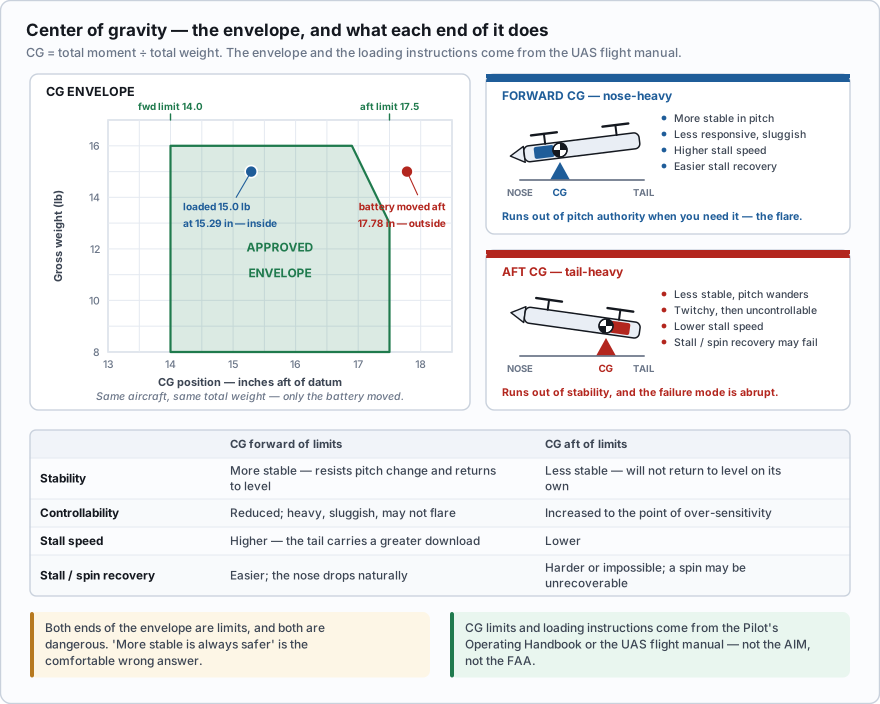
A fixed-wing mapping aircraft has its datum at the nose. Its published CG range is 14.0 to 17.5 inches aft of datum. | Item | Weight (lb) | Arm (in) | Moment (lb-in) | |---|---|---|---| | Airframe empty | 9.2 | 16.0 | 147.2 | | Battery, forward bay | 3.4 | 11.0 | 37.4 | | Mapping camera | 1.8 | 13.5 | 24.3 | | Tail-mounted radio | 0.6 | 34.0 | 20.4 | Step 1. Compute each moment: weight × arm. Those are the right-hand column above. Step 2. Total the weights: 9.2 + 3.4 + 1.8 + 0.6 = 15.0 lb. Step 3. Total the moments: 147.2 + 37.4 + 24.3 + 20.4 = 229.3 lb-in. Step 4. CG = total moment ÷ total weight = 229.3 ÷ 15.0 = 15.29 inches aft of datum. Step 5. Compare to the envelope. 15.29 inches falls between 14.0 and 17.5, so this loading is within limits. Now change one thing. Move the battery from the forward bay to the rear bay at arm 22.0 in. Its moment becomes 3.4 × 22.0 = 74.8, the total moment becomes 266.7, and the CG moves to 266.7 ÷ 15.0 = 17.78 inches - now outside the aft limit. The aircraft weighs exactly the same. Nothing was added. The load is in the wrong place, and it will be twitchy in pitch and difficult to recover from a stall.
What forward and aft CG actually do
| CG forward of limits | CG aft of limits | |
|---|---|---|
| Stability | More stable - the aircraft strongly resists pitch changes and wants to return to level | Less stable - the aircraft does not return to level on its own and pitch wanders |
| Controllability | Reduced - heavy, sluggish pitch response; may not have enough elevator authority to flare or to raise the nose | Increased, to the point of being over-sensitive and eventually uncontrollable |
| Stall speed | Higher - the tail carries a greater download so the wing must produce more lift | Lower |
| Stall and spin recovery | Easier - the nose drops naturally | Harder or impossible - a spin may become unrecoverable |
| Cruise performance | Slightly slower for the same power because of extra trim drag | Slightly faster |
| Overall risk | Runs out of control authority when you need it most | Runs out of stability, and the failure mode is abrupt |
The comfortable but wrong conclusion is more stable is always safer, so keep the CG forward. It is not. A CG too far forward means the aircraft may not have enough pitch authority to flare, to recover from a descent, or to hold the nose up at low speed - and the stall speed is higher, so the moment arrives sooner. Both ends of the envelope are limits, and both are dangerous to exceed. In a stall or spin, an aft CG is the more likely to kill the aircraft, because the recovery may not work at all.
Where CG limits come from
This is a direct exam item and the answer is narrow. The loading instructions and CG limits for a specific aircraft come from the Pilot's Operating Handbook or the UAS flight manual supplied by the manufacturer. Not the AIM. Not the Aircraft Weight and Balance Handbook, which explains the method but contains no limits for your aircraft. Not the FAA. The manufacturer flight-tested that airframe and published the envelope, and that document is the authority.
- CG = total moment ÷ total weight. Moment = weight × arm; arm is measured from the datum
- To ensure CG limits are not exceeded, follow the loading instructions in the Pilot's Operating Handbook or the UAS flight manual
- Forward CG: more stable, less controllable, higher stall speed, easier stall recovery
- Aft CG: less stable, more controllable, lower stall speed, harder or impossible stall and spin recovery
- The same total weight in a different position produces a different CG - moving something is as significant as adding something
Multirotor CG — lateral and vertical, not only fore and aft
A multirotor has no wing and no elevator, so the fixed-wing envelope diagram does not apply directly. But CG still matters enormously, and on a multirotor it matters in three dimensions.
A multirotor wants its CG on the vertical axis through the geometric center of the rotors. Offset it - hang a spotlight off one arm, mount a speaker on one side, fit a camera further outboard than the manufacturer intended - and you have lateral or asymmetric loading. The flight controller compensates automatically and instantly, which is exactly why it is dangerous: the aircraft looks perfectly normal in the hover.
What is actually happening is that the motors on the heavy side are running continuously faster to hold the aircraft level. That has four consequences. Those motors draw more current, so flight time drops. Those motors run hotter, so they wear faster. Those motors are further up their throttle range, so there is less headroom left for control inputs - and when a gust arrives and the controller demands more from an already-busy motor, there may be nothing left to give. And in an aggressive maneuver or a hard turn, the aircraft may be unable to hold attitude at all on the heavy side.
A quadcopter hovers at 58 percent throttle on all four motors with a balanced load, and gives 24 minutes of flight time. You clamp a 0.6 lb spotlight to the end of the right-front arm for a night search. What happens. To stay level, the controller commands the right-front motor up to roughly 71 percent and trims the left-rear motor down to about 46 percent. The aircraft hovers perfectly level and appears normal. Consequence 1 - endurance. The extra weight plus the constant differential raises average current draw. Flight time falls to about 19 to 20 minutes, a loss of roughly 17 percent, most of which comes from the imbalance rather than the 0.6 lb itself. Consequence 2 - control margin. The right-front motor started with 42 percent of throttle in reserve. It now has 29 percent. In a gust that demands a hard roll correction to the left, that motor is the one being asked for more, and it saturates first. Consequence 3 - it gets worse as the battery drains. As voltage sags, every motor needs a higher throttle percentage for the same thrust. The busiest motor hits 100 percent before the others, and at that moment the aircraft can no longer hold attitude. The fix. Mount payloads on the aircraft's centerline wherever possible, and where you cannot, add ballast on the opposite side to restore balance. Yes, ballast costs you flight time - and it costs you far less than a saturated motor.
A camera is mounted well off the centerline of a quadcopter. The aircraft hovers level and looks normal. What is the most significant hidden effect?
- The aircraft's registration weight has changed and must be re-filed
- One motor runs continuously faster, reducing flight time and leaving less control margin for gusts
- The critical angle of attack of the rotors is reduced
Answer: B. The flight controller hides the imbalance by holding one motor faster all flight. That costs endurance and, more importantly, consumes the throttle headroom that the controller needs for attitude corrections. Registration is not weight-dependent above 0.55 lb, and rotors do not have a critical angle of attack in the fixed-wing sense.
- A small unmanned aircraft weighs less than 55 pounds on takeoff, including everything on board or otherwise attached
- The manufacturer's maximum takeoff weight is usually well below 55 lb and is the limit that actually governs performance
- CG = total moment ÷ total weight, where moment = weight × arm measured from the datum
- CG limits come from the Pilot's Operating Handbook or the UAS flight manual - that is the tested answer
- Forward CG means more stability, less controllability, and a higher stall speed; aft CG means less stability, more controllability, and harder stall recovery
- Lateral or asymmetric loading on a multirotor forces one motor to run continuously faster, cutting endurance and eating the control margin needed for gusts