Track your progress, take practice exams, and study the flashcards in the app.
4.1 How Drones Actually Fly — The Four Forces
- Name the four forces acting on an aircraft and describe how they balance on a multirotor and on a fixed-wing sUAS
- Explain how a quadcopter pitches, rolls, and yaws using differential motor speed and reaction torque
- Define angle of attack and explain why a stall can occur at any airspeed and any attitude
This module is the smallest area on the exam - 7 to 11 percent, about five questions - and it is also the cheapest module in the course in points earned per hour of study. There are only four lessons, the physics is shallow, and the same handful of concepts come back again and again. Work through it once properly and those five questions are yours.
Start with why any aircraft stays up. Four forces act on every aircraft in flight, manned or unmanned, winged or rotored. You need the names, the directions, and what happens when they are out of balance.
The four forces
- Lift - the upward force that supports the aircraft. On a fixed-wing it is produced by the wing moving through the air. On a multirotor it is produced by the spinning rotors, and it is usually called thrust because the rotors point it wherever they like.
- Weight - the downward force of gravity acting through the aircraft's center of gravity. It is the total of the airframe, battery, payload, and anything else on board or attached.
- Thrust - the force produced by the propulsion system that moves the aircraft through the air. On a fixed-wing sUAS it comes from a propeller pointed forward. On a multirotor it comes from the same rotors that produce lift.
- Drag - the rearward force resisting motion through the air. Two kinds matter: parasite drag, which comes from the shape and surface of the aircraft and grows with speed, and induced drag, which is the by-product of producing lift and is greatest at slow speed.
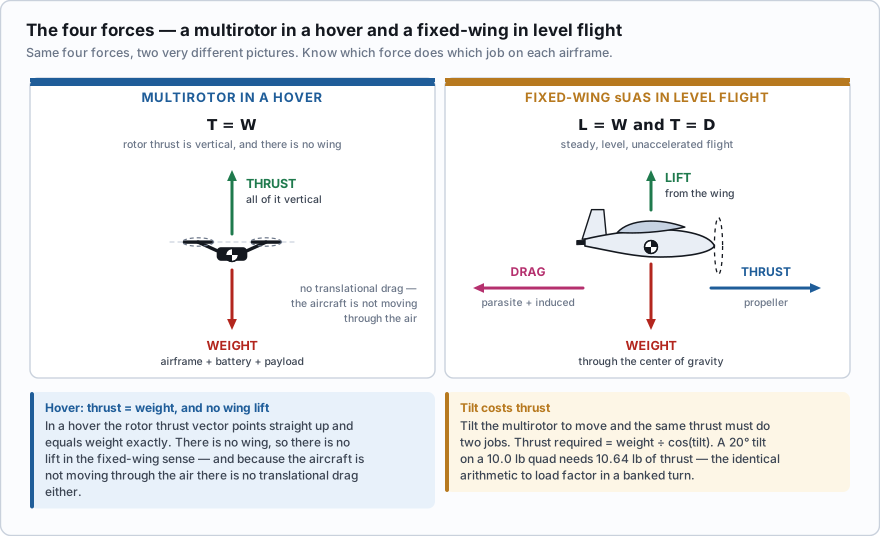
For a fixed-wing sUAS in steady, level, unaccelerated flight, the four forces are in equilibrium: lift equals weight, and thrust equals drag. Increase thrust and the aircraft accelerates until drag rises to match it again. Increase weight and the wing must produce more lift, which it does by flying at a higher angle of attack or a higher airspeed - and producing more lift produces more induced drag, which requires more thrust. Every change ripples through all four.
For a multirotor in a hover, the picture is simpler. All the rotor thrust points straight up, and it exactly equals weight. The aircraft is not moving through the air, so there is no translational drag - only the rotor drag the motors are already fighting. Add weight and the motors spin faster to restore the balance, drawing more current from the battery.
Why forward flight costs a multirotor more
A multirotor cannot point its rotors one way and its body another. To move forward it tilts the whole aircraft, which tilts the rotor disc, which tilts the thrust vector. That single thrust vector now has to do two jobs: the vertical part still has to hold up the entire weight of the aircraft, and the horizontal part pushes the aircraft forward against drag.
That means total thrust must increase as soon as you tilt, because only part of it is now pointing up. The relationship is straightforward trigonometry: thrust required = weight ÷ cosine of the tilt angle. It is the same formula you will meet again in lesson 4.4 as load factor in a turn, which is not a coincidence - both are cases of a lift vector being tilted away from vertical.
A quadcopter weighs 10.0 pounds ready to fly. It is holding position in a hover, then pitches forward 20 degrees to hold station against a headwind. Step 1. In the hover, total rotor thrust equals weight: 10.0 lb. Step 2. At a 20-degree tilt, the vertical component of thrust must still equal 10.0 lb, so total thrust = weight ÷ cos 20°. Step 3. cos 20° = 0.940. So thrust = 10.0 ÷ 0.940 = 10.64 lb. Step 4. The motors are now producing about 6 percent more thrust than in a hover, and drawing more than 6 percent more current, because power rises faster than thrust does. What it means on a job. Holding position in a stiff wind is not free. This is why a manufacturer's advertised flight time - measured hovering in still air - never survives contact with a windy inspection site.
A multirotor tilts forward to accelerate. What happens to the total thrust the rotors must produce if altitude is to be maintained?
- It stays the same, because the weight has not changed
- It must increase, because only part of the thrust now points upward
- It decreases, because forward flight generates additional lift
Answer: B. Tilting the aircraft tilts the thrust vector. The vertical component still has to equal weight, so total thrust must rise by weight divided by the cosine of the tilt angle. The rotors work harder in forward flight and in wind than they do in a still-air hover.
How a quadcopter steers
A quadcopter has no ailerons, no elevator, and no rudder. It has four fixed-pitch propellers and four motors, and it does everything by changing the relative speed of those motors. This is called differential motor speed, and it is worth understanding properly because it explains a lot of what a drone will and will not do when it is overloaded.
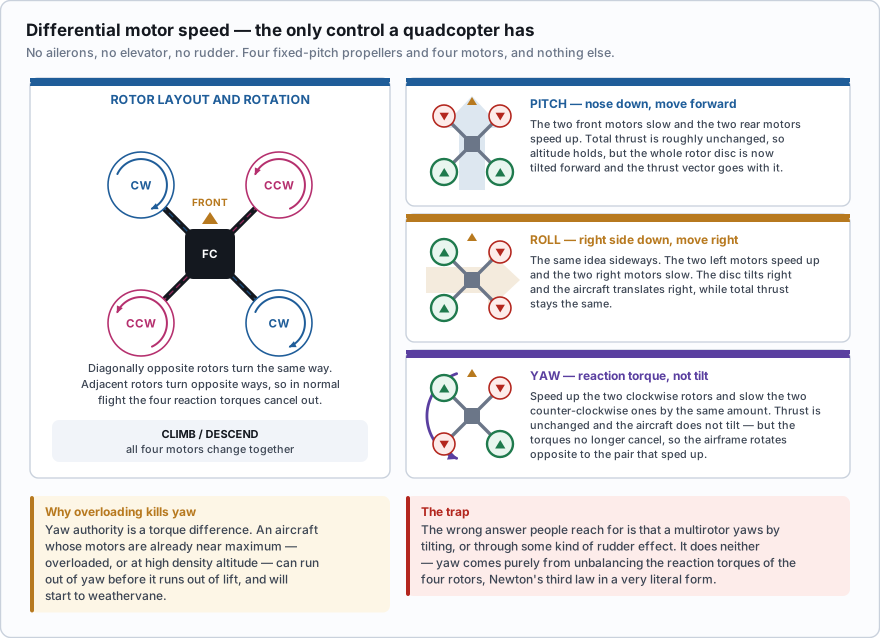
Climb and descend. All four motors speed up together to climb, or slow together to descend. Total thrust exceeds weight, or falls below it.
Pitch. To pitch nose-down and move forward, the two front motors slow and the two rear motors speed up. Total thrust stays roughly constant so the aircraft holds altitude, but the thrust is now tilted forward.
Roll. The same idea sideways. To roll and translate right, the two left motors speed up and the two right motors slow.
Yaw. This one is different and it is the one the exam likes. A quadcopter has two rotors turning clockwise and two turning counterclockwise, arranged so that rotors on the same diagonal turn the same way. In normal flight those torques cancel and the aircraft points where you left it. Every spinning rotor applies a reaction torque to the airframe in the direction opposite to its own rotation - Newton's third law, in a very literal form.
To yaw, the flight controller speeds up one diagonal pair and slows the other by the same amount. Total thrust is unchanged, so altitude holds - but the torques no longer cancel. Speed up the clockwise pair and the airframe experiences a net counterclockwise torque, so the aircraft yaws counterclockwise. The aircraft yaws opposite to the rotation of the pair that sped up.
- A quadcopter controls all three axes with differential motor speed alone - there are no control surfaces
- Pitch and roll: slow one pair, speed up the opposite pair, keeping total thrust roughly constant
- Yaw comes from reaction torque, not from a rudder or a tail rotor. Speeding up one diagonal pair unbalances the torques and the airframe rotates the other way
- Diagonal rotors turn the same direction; adjacent rotors turn opposite directions. This is why propellers are handed and why installing one backwards makes the aircraft uncontrollable
The wrong answer people reach for is that a multirotor yaws by tilting or by some kind of rudder effect. It does not. Yaw comes purely from unbalancing the reaction torques of the rotors. A related practical trap: because yaw authority comes from a torque difference, an aircraft whose motors are already near maximum - overloaded, or in high density altitude - can run out of yaw authority before it runs out of lift, and it will start to weathervane in wind and refuse to hold heading.
Angle of attack and the stall
Now the fixed-wing side, and the single most-tested concept in this whole area. Two terms first, defined plainly.
The chord line is an imaginary straight line drawn from the leading edge of a wing to its trailing edge. The relative wind is the direction the air is moving relative to the wing - directly opposite the flight path. The angle of attack is the angle between the chord line and the relative wind. That is all it is: the angle at which the wing meets the oncoming air.
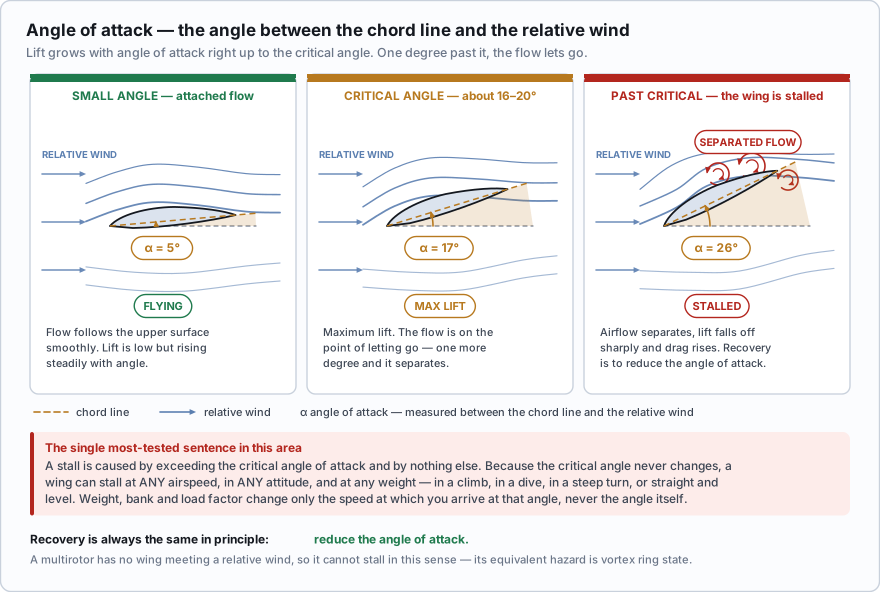
As angle of attack increases, lift increases - up to a point. At the critical angle of attack, typically somewhere around 16 to 20 degrees for a conventional wing, the smooth airflow over the upper surface separates and becomes turbulent. Lift falls off sharply and drag rises. That condition is a stall.
Here is the part that matters, and the FAA tests it directly. A stall is caused by exceeding the critical angle of attack, and by nothing else. Not by flying too slowly. Not by flying too heavy. Not by climbing too steeply. Those things make it easier to reach the critical angle, but the stall itself is purely a matter of angle.
- A stall occurs when the wing exceeds its critical angle of attack - and can therefore happen at any airspeed, any attitude, and any weight
- The critical angle of attack for a typical wing is roughly 16 to 20 degrees, about 18 degrees as a working figure
- The critical angle does not change with weight, altitude, or bank angle. What changes is the speed at which you reach it
- Recovery is always the same in principle: reduce the angle of attack
A stall is caused when the wing:
- Exceeds its maximum allowable operating weight
- Exceeds its critical angle of attack
- Exceeds its maximum speed
Answer: B. This is close to a verbatim FAA sample question. A stall is an angle-of-attack phenomenon. Excess weight and excess speed can both put a pilot in a position where the critical angle is reached, but neither one is the cause. The wing stalls when the air stops following its upper surface, and that is determined by angle.
Beyond the test: a multirotor cannot stall in the fixed-wing sense - it has no wing meeting a relative wind at an angle. What it has instead is vortex ring state, covered in lesson 4.3, where the rotors descend into their own downwash and lose effective lift. The two are different failures with different causes, but they occupy the same place in a pilot's mental model: a condition in which adding what feels like the obvious input makes things worse.
- Lift, weight, thrust, and drag act on every aircraft; in steady level fixed-wing flight lift equals weight and thrust equals drag
- In a hover, a multirotor's rotor thrust is vertical and equals weight; tilting to move forward requires thrust = weight ÷ cos(tilt angle)
- A quadcopter pitches, rolls, and yaws using differential motor speed alone - it has no control surfaces
- Yaw comes from reaction torque: speeding up one diagonal pair unbalances the rotor torques and the airframe rotates the opposite way
- Angle of attack is the angle between the chord line and the relative wind
- A stall is caused by exceeding the critical angle of attack - about 16 to 20 degrees - and can occur at any airspeed and any attitude