Track your progress, take practice exams, and study the flashcards in the app.
3.7 Density Altitude and How Weather Steals Your Performance
- Define density altitude and name the three factors that raise it
- Compute pressure altitude and estimate density altitude from temperature
- Predict the effect of high density altitude on propeller efficiency, climb, endurance and payload
A propeller does not push on altitude. It pushes on air molecules. Take away the molecules and the same propeller at the same RPM produces less thrust, no matter how new the aircraft is or how full the battery is. Density altitude is the single number that tells you how many molecules you have to work with, and it is the reason a drone that leaps off the ground in February struggles to hold a hover in August.
This is the one weather topic that reaches directly into Area IV of the exam as well, because every performance figure a manufacturer publishes assumes standard conditions. Density altitude is how you translate a book number into the number you will actually get today. It is worth twenty minutes of your study time even though it is a single ACS code.
What controls air density
- Pressure. Higher pressure squeezes more molecules into the same volume. Higher pressure means denser air.
- Temperature. Heating air makes it expand and spread its molecules out. Higher temperature means less dense air.
- Humidity. Water vapor is lighter than the nitrogen and oxygen it displaces — a water molecule has a molecular weight of about 18, dry air about 29. Adding water vapor to a fixed volume of air at a given pressure and temperature makes it less dense.
Moist air is less dense than dry air. It feels wrong — humid air feels heavy — but the physics is unambiguous, and it means humidity raises density altitude and hurts performance. Any answer choice that says humid air is denser, or that humidity lowers density altitude, is wrong. This is one of the most reliably missed items in the whole weather area.
Defining density altitude
Density altitude is pressure altitude corrected for nonstandard temperature. In plainer words: it is the altitude in the standard atmosphere at which the air would have the density you actually have right now. It is a yardstick for performance, not a measurement of height. Your aircraft is at 400 feet AGL; the air around it might be behaving like the air at 9,000 feet.
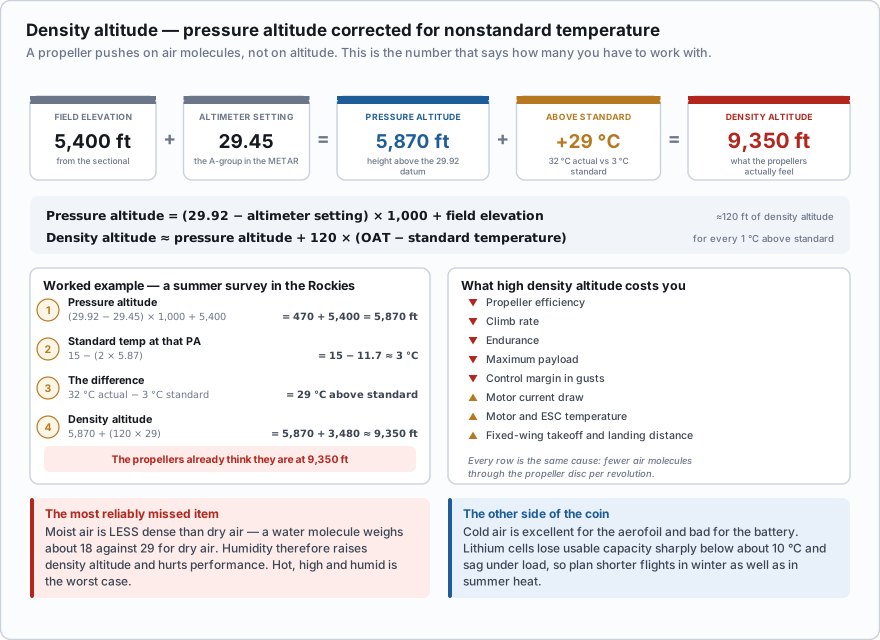
- Pressure altitude = (29.92 − altimeter setting) × 1,000 + field elevation
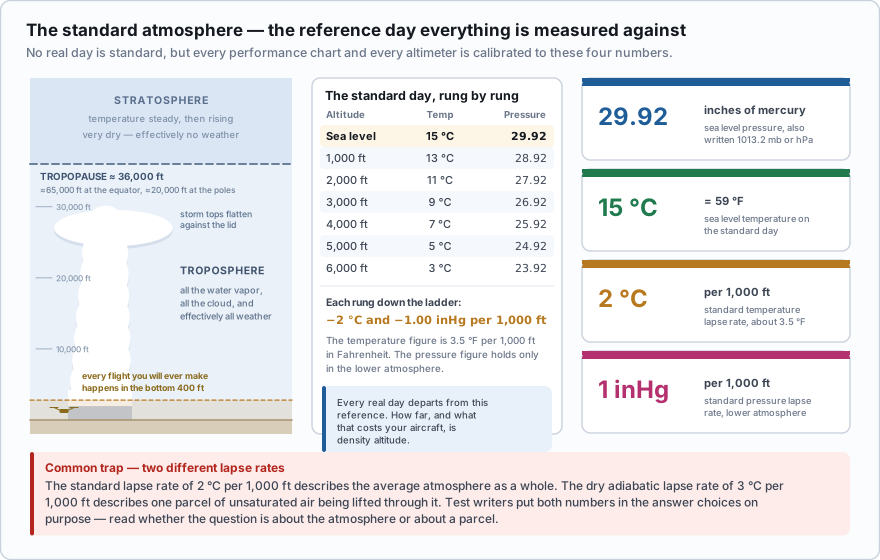
- Standard temperature at any pressure altitude = 15 °C − (2 × pressure altitude in thousands of feet)
- Density altitude ≈ pressure altitude + 120 × (actual OAT − standard temperature), both in °C
- Every 1 °C above standard adds roughly 120 feet of density altitude
- The three raisers, all together: high elevation, high temperature, high humidity — hot, high and humid
The 120-feet-per-degree figure is a well-established estimate, not an exact conversion. For an exam question you will be given a chart or the numbers to plug in; for a job site, the estimate is more than good enough to tell you whether to leave the heavy lens at home.
You need three inputs and all three are easy to get. Field elevation comes from the sectional chart, the Chart Supplement, or your phone's GPS. The altimeter setting is the A-group at the end of any METAR — A2992 means 29.92 — or the last item in an AWOS or ASOS broadcast. The outside air temperature is in the same METAR, in whole degrees Celsius, or on the thermometer clipped to your case. Do the arithmetic once at the truck and you will never be surprised by a sluggish takeoff.
Field elevation 5,400 ft MSL. Altimeter setting 29.45. Outside air temperature 32 °C. Step 1 — pressure altitude (29.92 − 29.45) × 1,000 + 5,400 = 470 + 5,400 = 5,870 ft Step 2 — standard temperature at that pressure altitude 15 − (2 × 5.87) = 15 − 11.7 = about 3 °C Step 3 — the difference 32 − 3 = 29 °C above standard Step 4 — density altitude 5,870 + (120 × 29) = 5,870 + 3,480 = about 9,350 ft The aircraft is sitting on the ground and its propellers already think they are at 9,350 feet. Add humidity and it is worse still. Plan a lighter payload, expect a shorter flight, and do a hover-power check before you commit to the job.
Field elevation 20 ft MSL. Altimeter setting 30.35. Outside air temperature 2 °C. Pressure altitude: (29.92 − 30.35) × 1,000 + 20 = −430 + 20 = −410 ft Standard temperature at −410 ft: about 15.8 °C Difference: 2 − 15.8 = −13.8 °C Density altitude: −410 + (120 × −13.8) = −410 − 1,656 = about −2,070 ft A negative density altitude. The air is denser than sea-level standard and the aircraft will feel unusually strong. The catch on this day is the battery, not the air — see below.
Which combination produces the highest density altitude?
- Low elevation, low temperature, low humidity
- High elevation, high temperature, high humidity
- High elevation, low temperature, low humidity
Answer: B. All three factors raise density altitude: elevation reduces pressure, heat expands the air, and water vapor is lighter than the dry air it displaces. Hot, high and humid together is the worst case.
What high density altitude actually costs you
Thin air degrades every part of the system at once, and the losses compound. A multirotor hovering is already using most of its available thrust to stay level, so anything that reduces thrust eats straight into the reserve that was going to be used for climbing, carrying, and correcting for gusts. A fixed-wing sUAS suffers differently but no less: it must fly at a higher true airspeed to generate the same lift, which lengthens the takeoff run, flattens the climb, and raises the touchdown speed.
| What changes | Why |
|---|---|
| Propeller efficiency decreases | Each revolution moves fewer air molecules, so it produces less thrust |
| Motors draw more current | They must spin faster to make the same thrust, and current rises steeply with RPM |
| Endurance drops | More current for the same lift means the battery empties sooner |
| Climb rate decreases | Less excess thrust is available above what hovering already demands |
| Maximum payload decreases | The margin that carried the heavy camera has been spent on staying up |
| Control margin in gusts shrinks | Less thrust in reserve to correct a disturbance |
| Fixed-wing sUAS need more runway | Higher true airspeed is required to generate the same lift, so takeoff and landing distances increase |
| Cooling gets worse | Thinner air carries away less heat, so motors and speed controllers run hotter |
What effect does high density altitude have on the efficiency of an unmanned aircraft propeller?
- Increased
- Decreased
- No effect
Answer: B. High density altitude means thin air. Fewer air molecules pass through the propeller disc per revolution, so the propeller produces less thrust for the same RPM. Its efficiency is decreased. This is an official FAA sample question.
The other ways weather takes performance
Density altitude is the tested one, but it is not the only weather effect on your numbers.
- Cold and batteries. Lithium polymer cells lose usable capacity sharply below about 10 °C, and a cold pack sags under load — the voltage drops far enough that the aircraft declares a critical battery and lands itself, sometimes with a third of the charge nominally remaining. Keep packs warm in transit, warm them before flight if the manufacturer allows it, and cut your expected flight time. This is the flip side of the cold-morning example above: the air is excellent and the battery is not.
- Wind. Holding position into a headwind is continuous work. A 15-knot wind can take a meaningful bite out of endurance before you have flown anywhere.
- Precipitation and moisture. Water adds weight, degrades propeller efficiency, fouls optical sensors and the downward vision system, and gets into places no consumer aircraft is sealed against.
- Precipitation static. Flying through rain, snow or dust builds a charge on the airframe that can raise the radio noise floor and shorten your effective control range.
Some AWOS installations announce density altitude directly, and by design they do so whenever it exceeds the field elevation by more than 1,000 feet. If you work regularly at elevation, dialling up the AWOS on your handheld radio or by phone is the fastest density altitude check there is — the station has already done the arithmetic for you.
One habit is worth building. On any hot, high, or heavily loaded day, hover the aircraft at three meters for thirty seconds before you commit to the mission and watch the power draw or the throttle position the app reports. If it is working noticeably harder than usual to sit still, you have measured your density altitude in the only units that matter.
- Density altitude is pressure altitude corrected for nonstandard temperature — a performance yardstick, not a height
- Air density falls with lower pressure, higher temperature, and higher humidity
- Moist air is LESS dense than dry air, so humidity raises density altitude and reduces performance
- Pressure altitude = (29.92 − altimeter setting) × 1,000 + field elevation; add about 120 ft of density altitude for every 1 °C above standard
- High density altitude decreases propeller efficiency, climb rate, endurance, payload capacity and control margin, and increases current draw and motor temperature
- Cold air improves aerodynamic performance but degrades lithium battery capacity, so plan shorter flights in winter as well as in summer heat