Track your progress, take practice exams, and study the flashcards in the app.
2.9 TFRs and the NOTAM System
- State the dimensions and timing of the standing stadium flight restriction
- Name the categories of NOTAM and what each one carries
- Obtain a NOTAM briefing through Flight Service and explain why B4UFLY is not a substitute
Charts show you the airspace that is always there. NOTAMs show you the airspace that appeared this morning. A temporary flight restriction can be published two hours before a presidential motorcade and will not be on any chart ever printed. Checking them is not optional.
A person acting as remote pilot in command must comply with the provisions of §§91.137 through 91.145 and 99.7 of this chapter.
That single sentence pulls the entire manned-aviation TFR framework into Part 107. You do not get a drone-sized exception.
The TFR families
| Regulation | Covers |
|---|---|
| §91.137 | Disaster or hazard areas — wildfires, floods, chemical spills, aircraft accident sites |
| §91.138 | National disaster areas in the State of Hawaii |
| §91.139 | Emergency air traffic rules |
| §91.141 | Flight restrictions in the proximity of the President and other parties |
| §91.143 | Flight limitation in the proximity of space flight operations |
| §91.144 | Temporary restriction on flight operations during abnormally high barometric pressure |
| §91.145 | Management of aircraft operations in the vicinity of aerial demonstrations and major sporting events |
| §99.7 | Special security instructions |
Two of these come up constantly in real drone work.
Disaster TFRs (§91.137). When a wildfire, hurricane or major accident scene is active, the FAA puts a restriction over it so firefighting aircraft and medevac helicopters can work. A drone inside one grounds every aircraft on the scene. This is the single most damaging thing an untrained operator does.
Presidential TFRs (§91.141). These normally have two rings: a 30 nautical mile outer ring with limited operations and a 10 nautical mile inner ring that is effectively closed. Drone operations are prohibited throughout. They move with the President and are published by NOTAM, often on short notice.
One permanent restriction is worth naming because it catches visitors. The airspace around Washington, DC is covered by the DC Special Flight Rules Area (SFRA), an outer ring extending 30 miles from Reagan National Airport, with a 15-mile inner ring inside it. Per the FAA, flying an unmanned aircraft within the 15-mile inner ring is prohibited without specific FAA authorization, and flights between the two rings are conditioned on registration, staying below 400 feet, visual line of sight and clear weather. This is not a TFR that comes and goes. It is always there.
A TFR NOTAM reads awkwardly the first time. Look for four things and ignore the rest: the center point (usually a radial and distance from a navigation aid, or a latitude and longitude), the radius, the altitudes — almost always given in feet MSL — and the effective times in UTC. Then convert the altitude to a height above your ground and the times to your local clock before you decide the restriction does not affect you.
The stadium restriction — memorize this one
There is a standing flight restriction over large sporting events, published as FDC NOTAM 4/3621. It is standing, which means it is always in effect and never needs to be re-issued for each game. Every number in it is tested.
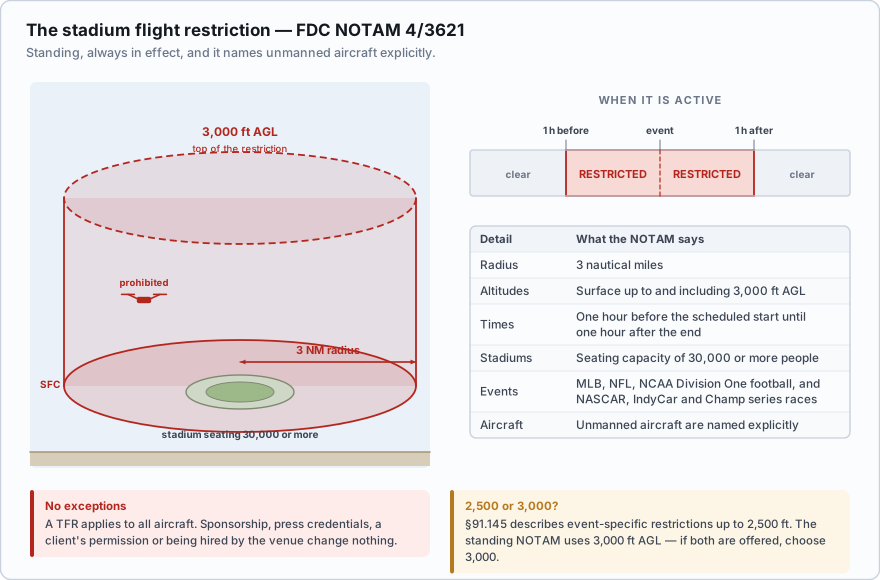
- 3 nautical mile radius around the stadium.
- Surface up to and including 3,000 feet AGL.
- One hour before the scheduled time of the event until one hour after the end of the event.
- Stadiums with a seating capacity of 30,000 or more people.
- Applies to MLB, NFL and NCAA Division One football games, and NASCAR, IndyCar and Champ series races (excluding qualifying and pre-race events).
- The NOTAM explicitly names unmanned aircraft among the prohibited operations.
A word about a number you may see elsewhere. The text of §91.145 describes event-specific restrictions of up to 2,500 feet above the surface within a 3 NM radius. The standing NOTAM 4/3621 uses 3,000 feet AGL, and that is the figure the exam tests and the figure that governs the regular-season games you are most likely to be near. If you see 2,500 and 3,000 offered as options in a stadium question, choose 3,000.
A remote pilot is hired to shoot promotional footage 2 NM from a 45,000-seat NFL stadium, 30 minutes before kickoff. What applies?
- Nothing, because the drone will stay below 400 feet AGL
- The standing stadium flight restriction: 3 NM radius, surface to 3,000 feet AGL, from one hour before until one hour after the event
- The restriction applies only within 1 NM of the stadium structure itself
Answer: B. FDC NOTAM 4/3621 creates a 3 NM radius restriction from the surface to 3,000 feet AGL, beginning one hour before the scheduled start. At 2 NM and 30 minutes prior, the operation is inside the restriction in both space and time.
An official FAA sample question describes a TFR over the Indianapolis 500 and asks whether a pilot may fly because their company sponsors a race team. The answer is no. A TFR applies to all aircraft. Sponsorship, press credentials, a client's permission and being hired by the venue are all irrelevant. The only way in is an FAA waiver or authorization issued for that specific operation.
The NOTAM system
NOTAM stands for Notice to Air Missions. The AIM describes the system as providing pilots with time-critical aeronautical information that is temporary, or information that will be published on a chart later, or information drawn from another operational publication. If something changed and the chart does not know yet, a NOTAM carries it.
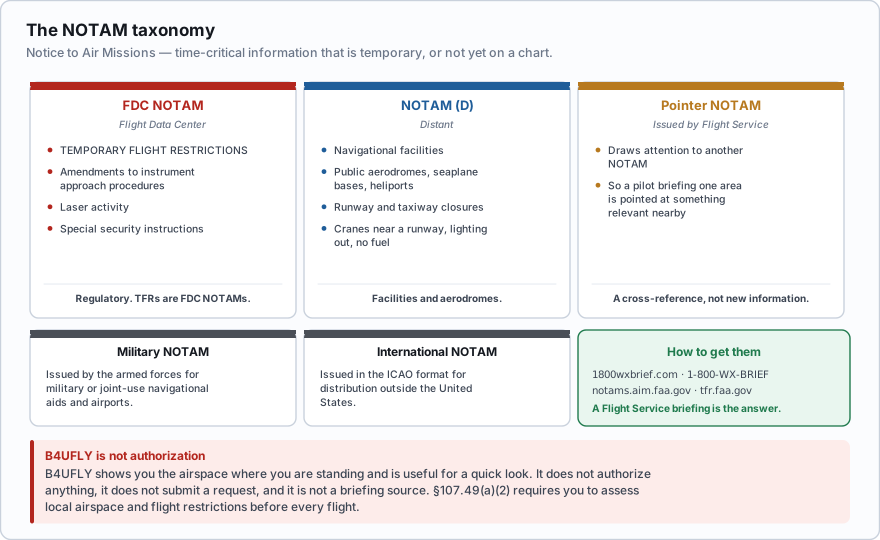
- NOTAM (D) — *distant*. Navigational facilities, public aerodromes, seaplane bases and heliports: runway and taxiway closures, cranes near a runway, airport lighting out of service, fuel unavailable.
- FDC NOTAM — issued by the Flight Data Center and carrying regulatory information: temporary flight restrictions, amendments to instrument approach procedures, laser activity, special security instructions. TFRs are FDC NOTAMs.
- Pointer NOTAM — issued by a Flight Service Station to draw attention to another NOTAM, so a pilot briefing one area is pointed at something relevant nearby.
- Military NOTAM — issued by the armed forces for military or joint-use navigational aids and airports.
- International NOTAM — issued in the ICAO format for distribution outside the United States.
How to actually get them
The exam asks this in plain language, and the answer is plain: obtain a briefing from Flight Service.
- 1800wxbrief.com — the Flight Service website. Create a free account and request a briefing for your operating area. This is the answer to the sample question about how a remote PIC would *check NOTAMs*.
- 1-800-WX-BRIEF (1-800-992-7433) — the same service by telephone, with a live briefer. In Alaska, 1-833-AK-BRIEF.
- NOTAM Search at notams.aim.faa.gov — the FAA's searchable NOTAM database.
- The FAA TFR list at tfr.faa.gov — graphical and textual current TFRs.
- Most LAANC apps display TFRs and NOTAMs alongside the airspace, which is convenient but should not be your only look.
Checking is also a regulatory duty, not merely good practice. §107.49(a)(2) requires the remote PIC, before flight, to assess the operating environment including local airspace and any flight restrictions. A TFR you did not look for is still a TFR you violated.
B4UFLY is not authorization
B4UFLY is the FAA-sponsored situational-awareness app. It shows you the airspace class where you are standing, nearby restrictions and advisories. It is genuinely useful for a quick look.
It does not authorize anything. It is not a briefing source in the regulatory sense, it does not submit an airspace request, and it is not a substitute for LAANC or a Flight Service briefing. If a question offers B4UFLY as the way to check NOTAMs or obtain airspace access, that option is wrong.
Which NOTAM category carries temporary flight restrictions?
- NOTAM (D)
- FDC NOTAM
- Pointer NOTAM
Answer: B. FDC NOTAMs are issued by the Flight Data Center and carry regulatory information, including TFRs, instrument procedure amendments and special security instructions. NOTAM (D) covers facilities and aerodromes.
Build the NOTAM check into a written preflight sequence and do it twice: once the evening before, when you have time to move the job, and once on site an hour before launch, when a fresh fire TFR or a VIP movement may have appeared. Screenshot the briefing with its timestamp. If anything ever goes wrong, a dated briefing showing you looked is the difference between a conversation and a certificate action.
- §107.47 requires remote pilots to comply with §§91.137 through 91.145 and §99.7
- The standing stadium restriction is 3 NM radius, surface to 3,000 feet AGL, one hour before to one hour after, for stadiums seating 30,000 or more
- The stadium figure comes from FDC NOTAM 4/3621; §91.145 text says 2,500 feet, but the exam tests 3,000
- A TFR applies to all aircraft — sponsorship, press access or a client's permission changes nothing
- NOTAM categories include NOTAM (D), FDC, Pointer, Military and International; TFRs are FDC NOTAMs
- Obtain NOTAMs from Flight Service at 1800wxbrief.com or 1-800-WX-BRIEF, or from FAA NOTAM Search
- B4UFLY provides advisory situational awareness only and authorizes nothing