Track your progress, take practice exams, and study the flashcards in the app.
2.11 Potential Flight Hazards and Weather Minimums
- State the Part 107 weather minimums and calculate the maximum legal altitude under a reported ceiling
- Describe the specific flight hazards the FAA expects a remote pilot to recognize and avoid
- Interpret manned aircraft position lights and state the sUAS and ground structure lighting requirements
This lesson closes the airspace module with the two things that decide whether a flight happens: the weather minimums that make it legal, and the hazards that make it survivable. Both are heavily tested, and both are drawn straight from the FAA's own hazard list in the Aeronautical Information Manual.
Part 107 weather minimums
Manned VFR pilots memorize a table of visibility and cloud clearance that changes with airspace class. You do not. Part 107 sets one pair of numbers that applies everywhere.
The minimum flight visibility, as observed from the location of the control station, may not be less than 3 statute miles. The minimum distance from clouds must be no less than 500 feet below the cloud and 2,000 feet horizontally from the cloud.
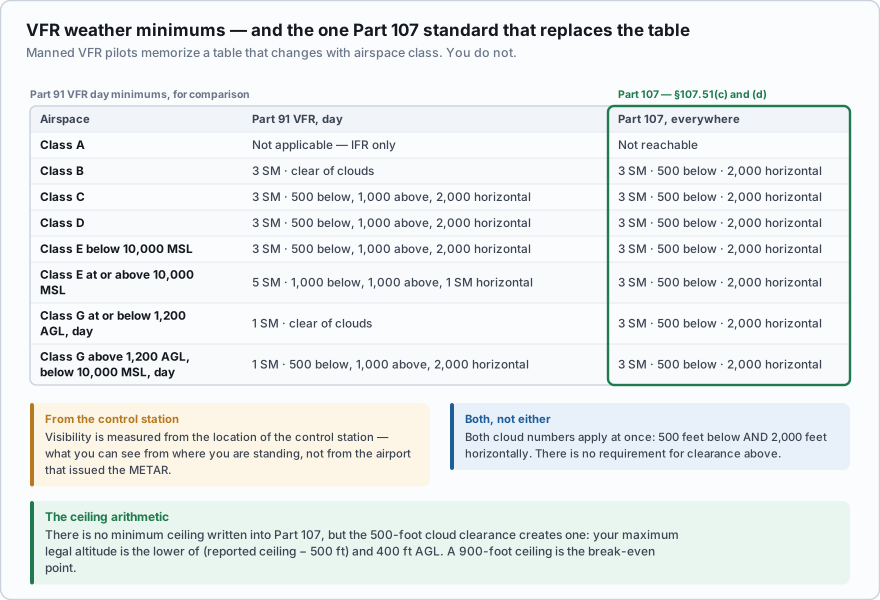
Three details matter. Visibility is measured from the control station, not from the aircraft — what you can see from where you are standing. Both cloud numbers apply at once, not either-or. And these limits are part of §107.51, which means they are waivable, but only with a waiver in hand before the flight.
The ceiling calculation
There is no minimum ceiling written into Part 107. But the 500-foot cloud clearance creates one by arithmetic, and this is one of the most reliably tested calculations on the exam.
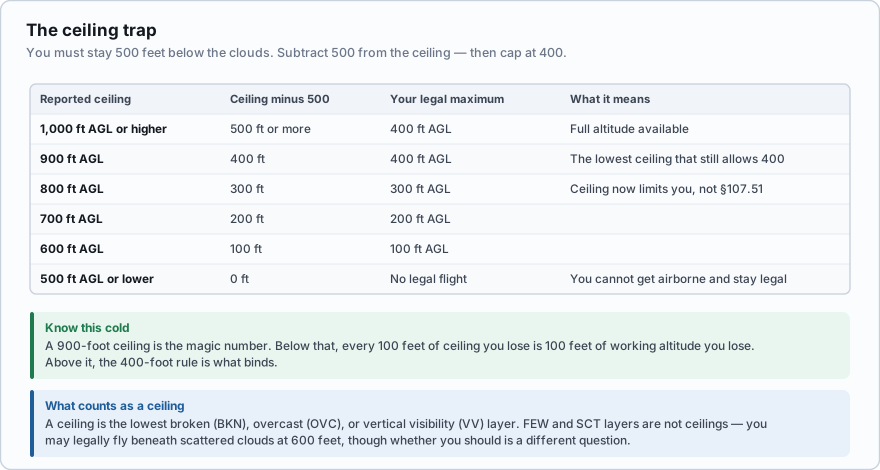
Reported ceiling 1,200 feet AGL. 1,200 − 500 = 700 feet available. §107.51(b) caps you at 400 feet AGL. You may fly to 400. Reported ceiling 900 feet AGL. 900 − 500 = 400 feet available. You may fly to 400. This is the break-even ceiling. Reported ceiling 700 feet AGL. 700 − 500 = 200 feet. That is now your ceiling, not 400. Reported ceiling 400 feet AGL. 400 − 500 = less than zero. You cannot legally leave the ground. The rule in one line: take the lower of (ceiling − 500) and 400 — unless the structure exception below applies.
Inspecting a structure — the § 107.51(b) exception
Towers are one of the few reasons you are allowed above 400 feet AGL. Section 107.51(b) lets you fly higher than 400 feet AGL if you stay within a 400-foot radius of a structure, and do not go more than 400 feet above that structure's immediate uppermost limit. It applies to any structure, not just buildings.
A lighted tower charted 3105 (1205) is 3,105 feet MSL at the top and 1,205 feet AGL tall — the bracketed number is the height above ground. Hired to inspect it, you may fly to 1,605 feet AGL (1,205 + 400), provided you stay within 400 feet of it laterally. Step outside that radius and the 400-foot AGL ceiling snaps straight back.
The exception is a cylinder around the structure, not a general permission to climb. It also does not relieve you of anything else — airspace authorization, visual line of sight and the weather minima all still apply inside it.
The nearest airport reports a ceiling of 800 feet AGL and visibility 5 statute miles. What is the highest a Part 107 flight may legally operate?
- 400 feet AGL
- 300 feet AGL
- 800 feet AGL
Answer: B. §107.51(d) requires 500 feet of clearance below the cloud: 800 − 500 = 300 feet AGL. That is lower than the 400 foot cap, so 300 feet is the limit. Visibility of 5 SM meets the 3 SM minimum.
The FAA's hazard list
The Aeronautical Information Manual devotes a whole section to potential flight hazards, and the ACS names seven of them specifically. Each has one fact the exam wants.
| Hazard | What you need to know |
|---|---|
| Accident causal factors | The leading causes are pilot factors, headed by inadequate preflight preparation and planning. The AIM notes that mid-air collisions have almost invariably occurred in good weather — complacency, not conditions |
| Unmanned balloons | Avoid flight beneath them at all times. A tethered or free balloon trails suspension devices, cables and antennas that are invisible until you are dangerously close. Charts carry CAUTION boxes for known balloon sites, with the top altitude given in MSL |
| Emergency airborne inspection of another aircraft | Flying close alongside an aircraft in trouble to look at it is itself hazardous. The pilot of the affected aircraft must not relinquish control, and both pilots must agree on separation, speeds and communications first |
| Precipitation static | Flying through precipitation, dust or ice crystals builds a static charge that discharges as corona. Effects include complete loss of VHF communications, erratic navigation indications and magnetic compass errors of up to 30 percent |
| Laser operations | Never point a laser at an aircraft. Illumination causes glare, flash blindness and afterimages miles from the source and can cause permanent eye damage. Report an illumination to the nearest ATC facility or Flight Service with the UTC time, aircraft type, altitude, location and beam description. Planned laser activity is published by FDC NOTAM |
| Thermal plumes | Smokestacks, cooling towers and industrial flares generate invisible thermal turbulence that can extend more than 1,000 feet above the top of the stack. Fly upwind of them where possible. A calm, cold day makes an invisible plume more dangerous, not less |
| The wire environment | Transmission lines, guy wires and catenary spans are effectively invisible from a control station. Look for the towers and poles, not the wires, then assume a wire runs between them. Spans cross rivers and canyons with no structure visible in between |
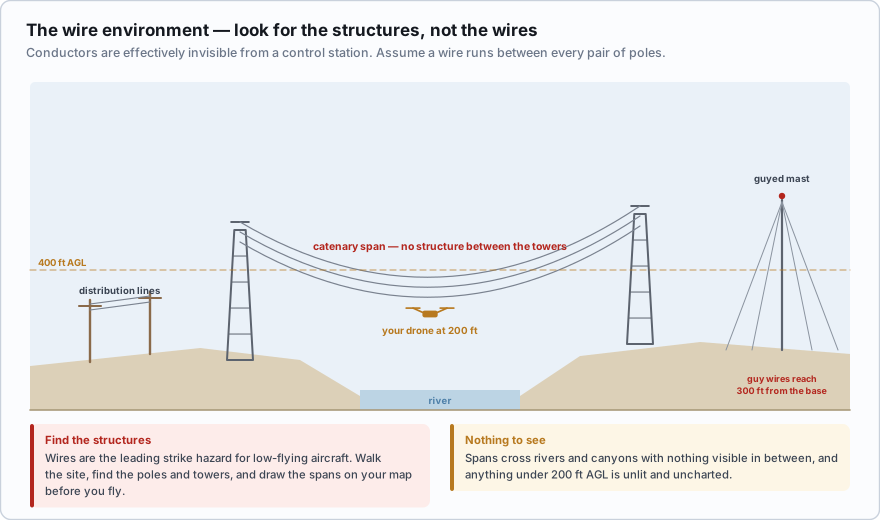
The wire hazard deserves the extra emphasis it gets here. Wires are the leading strike hazard for low-flying aircraft, and a drone at 200 feet lives in exactly the band they occupy. Walk the site. Find the poles. Draw the spans on your map before you fly, not after you snag one.
Ground structures and their lighting
Structures over 200 feet AGL are generally required to be marked and lighted, which is also the height at which they start appearing on sectionals. You will see three lighting types:
- Steady red obstruction lights, used in groups along a tall structure at night.
- Flashing red beacons at the top and at intermediate levels.
- Medium- and high-intensity flashing white strobes, often used instead of paint on very tall towers, and visible by day.
And then there are the hazards with no lighting at all. Anything under 200 feet AGL — meteorological evaluation towers, cell masts, cranes with the lights switched off, silos, light poles, trees, and every wire in the county — may be entirely unlit and entirely uncharted. A night operation must be site-surveyed in daylight. Walk it, photograph it, and mark the obstacles on the map you will fly from after dark.
You are illuminated by a laser during a night operation. What information should your report include?
- Only the location and your name
- UTC time, aircraft type, altitude, location of the event and a description of the beam
- Nothing — laser events are reported by the local police, not by pilots
Answer: B. The AIM asks for the UTC time, aircraft type and altitude, the location of the event and a description of the beam, reported to the nearest ATC facility or Flight Service. Laser reports feed enforcement and produce FDC NOTAMs warning other pilots.
Lighting at night — theirs and yours
Manned aircraft position lights are standardized and they let you work out which way an aircraft is going before you can see its shape.
- Red on the left wingtip.
- Green on the right wingtip.
- White facing aft, on the tail or the trailing edge.
- Plus an anti-collision system: a red rotating beacon and, on most aircraft, white strobes.
The reading is mechanical. Red on your left and green on your right means the aircraft is coming toward you. A single white light means you are looking at its tail and it is moving away. Green only means it is crossing left to right; red only means right to left. That determination takes a second and it is the difference between landing immediately and watching.
Your own aircraft's lighting is set by regulation, not preference.
The small unmanned aircraft must have lighted anti-collision lighting visible for at least 3 statute miles that has a flash rate sufficient to avoid a collision. The remote pilot in command may reduce the intensity of, but may not extinguish, the anti-collision lighting if he or she determines that, because of operating conditions, it would be in the interest of safety to do so.
That requirement applies at night and during civil twilight — the periods 30 minutes before sunrise and 30 minutes after sunset in the lower 48. Note the two halves precisely: visible for at least 3 statute miles, and a flash rate sufficient to avoid a collision. You may dim the light in the interest of safety. You may never turn it off.
Your own equipment matters too. A night operation needs a flashlight with a spare, a way to read a checklist without destroying your night vision, a lit control station, and a plan for the extra battery drain the anti-collision lights impose — the FAA advises accounting for that reduced endurance. Give your visual observer the same kit.
- Part 107 weather minimums: 3 statute miles visibility from the control station, 500 feet below cloud, 2,000 feet horizontally from cloud.
- Maximum legal altitude = the lower of (reported ceiling − 500 ft) and 400 ft AGL — except within 400 feet of a structure, where § 107.51(b) allows 400 feet above its uppermost limit.
- Avoid flight beneath unmanned balloons — the cables and antennas are invisible.
- Precipitation static causes loss of VHF communications and compass errors up to 30 percent.
- Thermal plume turbulence can extend more than 1,000 feet above the top of the stack.
- Report a laser illumination with UTC time, aircraft type, altitude, location and beam description.
- Position lights: red left, green right, white aft. Red left plus green right means it is coming at you.
- §107.29: anti-collision lighting visible 3 statute miles, flash rate sufficient to avoid a collision, may be dimmed but never extinguished.
Two traps live in the weather numbers. First, students apply the Part 91 airspace-by-airspace VFR table to a Part 107 question. Your minimums are 3 SM and 500 below / 2,000 horizontal, everywhere. Second, students read *visibility* as measured at the aircraft. §107.51(c) says as observed from the location of the control station. If fog is sitting over the far end of the field but you can see 3 miles from where you stand, the rule is met — and if it is the other way round, it is not.
Set personal minimums tighter than the regulation and write them down before you are standing in a field with a client watching — no flight below 5 SM visibility, none with a ceiling under 1,000 feet AGL, none in gusts above 20 knots, no unplanned night work. Personal minimums only work if you fix them on a calm day, because the whole point is that they hold on the day you are tempted.
- Part 107 requires 3 statute miles visibility observed from the control station and 500 feet below / 2,000 feet horizontally from clouds
- Maximum legal altitude is the lower of the reported ceiling minus 500 feet, or 400 feet AGL
- Avoid flying beneath unmanned balloons; their cables and antennas are effectively invisible
- Precipitation static can cause complete loss of VHF communications and compass errors up to 30 percent
- Thermal plumes from stacks and cooling towers produce turbulence over 1,000 feet above the stack top
- Wires and unlit structures below 200 feet AGL are neither charted nor lit — survey the site in daylight
- Position lights are red left, green right, white aft; red left plus green right means the aircraft is approaching you, and §107.29 requires your own anti-collision lighting visible for 3 statute miles, dimmable but never extinguished