Track your progress, take practice exams, and study the flashcards in the app.
1.9 Remote ID (Part 89)
- Describe the three ways to comply with Remote ID and the limitation attached to each
- List the message elements a standard Remote ID aircraft broadcasts and how a broadcast module's set differs
- State what a pilot must do if Remote ID equipment fails before takeoff and during flight
Remote ID is a digital license plate. While your aircraft is flying it broadcasts a short packet of data — who and where — that anyone nearby with a phone app can receive. It exists because law enforcement and the FAA needed a way to tell the survey crew from the person flying over a prison yard, and because no rule permitting flight beyond visual line of sight or over crowds was politically possible without it.
Remote ID lives in 14 CFR Part 89, not in Part 107. It is a separate rule with its own numbering, and it applies to every unmanned aircraft required to be registered — recreational and Part 107 alike.
The requirement and the date
Except as otherwise authorized by the Administrator or as provided in § 89.120, after September 16, 2023, no person may operate an unmanned aircraft within the airspace of the United States unless the operation meets the requirements of § 89.110 or § 89.115.
September 16, 2023 is the compliance date to remember. The FAA then exercised enforcement discretion until March 16, 2024 to let operators finish equipping. That grace period is long over; Remote ID has been fully enforced since March 2024.
The three paths
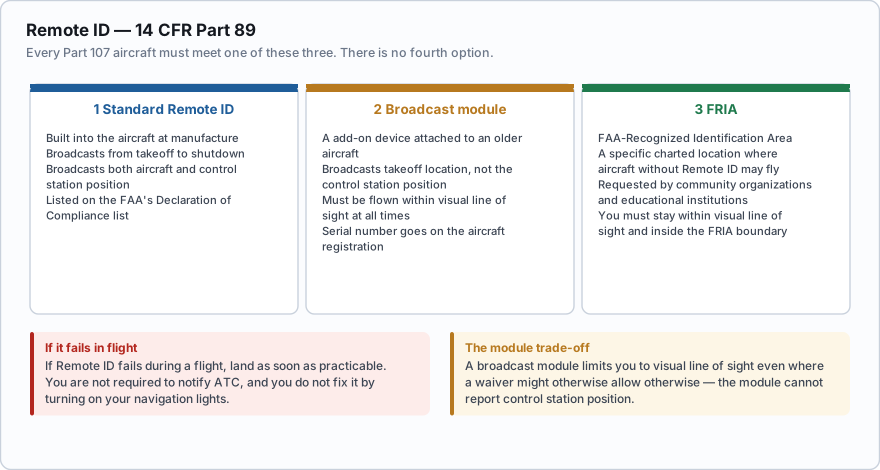
Path 1 — Standard Remote ID unmanned aircraft (§ 89.110)
A standard Remote ID unmanned aircraft is one built with Remote ID inside it. Nearly every drone sold new since late 2022 is one. The aircraft broadcasts the § 89.305 message elements from takeoff to shutdown.
- The Remote ID equipment must be functional and compliant, and the operator may not disable it.
- The aircraft must be listed on an FAA-accepted declaration of compliance, or be covered by a design or production approval issued under Part 21.
- The aircraft's serial number must be listed on the Certificate of Aircraft Registration, or submitted under § 89.130 before the operation.
- If the Remote ID equipment is not working before takeoff, you may not fly.
- If it fails during flight, the person manipulating the flight controls must land the aircraft as soon as practicable.
That last item is a favorite exam question and the wording is specific: land as soon as practicable. Not continue the mission, not notify ATC, not activate lights. Land.
Note what path 1 does not require: Part 89 imposes no visual line of sight condition on a standard Remote ID aircraft. You still owe VLOS under § 107.31, but that comes from Part 107, not from Remote ID. The other two paths add a VLOS requirement of their own.
Path 2 — Remote ID broadcast module (§ 89.115(a))
A broadcast module is a small add-on transmitter you attach to an aircraft that has no built-in Remote ID. It is how you keep a 2019 airframe legal. The module must meet the performance requirements of § 89.320 and its serial number must be listed on an FAA-accepted declaration of compliance and entered on the aircraft's Certificate of Aircraft Registration.
Two conditions attach that do not apply to path 1. The person manipulating the flight controls must be able to see the unmanned aircraft at all times throughout the operation — Part 89 imposes visual line of sight directly here, so no waiver of § 107.31 helps you. And the operator must confirm the module is functioning before takeoff.
Path 3 — FAA-Recognized Identification Area (§ 89.115(b))
A FRIA is a defined geographic area where aircraft without any Remote ID equipment may be flown. The aircraft must remain entirely within the boundaries of the FRIA for the whole operation, and the person flying must be able to see the aircraft at all times.
Only two kinds of applicant may request a FRIA under § 89.205: a community-based organization recognized by the Administrator, and an educational institution — primary and secondary schools, trade schools, colleges, and universities. An individual pilot or a commercial operator cannot apply for one. Requests go through FAADroneZone. A FRIA is effective for 48 calendar months, and a renewal request must be submitted no later than 120 days before expiration.
What must a person manipulating the flight controls do if standard Remote ID stops functioning during flight?
- Land the unmanned aircraft as soon as practicable
- Notify the nearest FAA air traffic control facility
- Activate the aircraft's anti-collision lighting and continue the mission
Answer: A. Section 89.110 requires the aircraft to be landed as soon as practicable when the Remote ID broadcast fails in flight. There is no in-flight notification requirement. If the equipment is inoperative before takeoff, the flight may not begin at all.
What gets broadcast
The broadcast is plain radio — Wi-Fi and Bluetooth on unlicensed frequencies, transmitted directly from the aircraft. There is no internet connection, no cellular data, no subscription, and no FAA server involved in the broadcast itself. Anyone within radio range with a receiver app sees it.
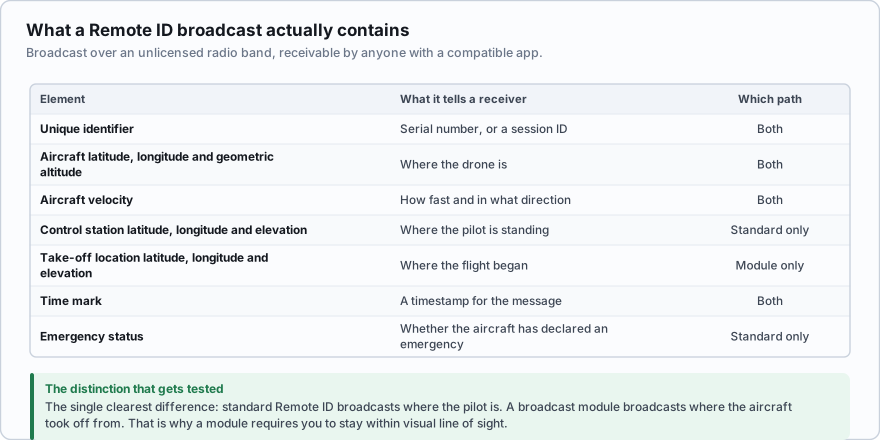
| Element | Standard Remote ID aircraft (§ 89.305) | Broadcast module (§ 89.315) |
|---|---|---|
| Identity | Serial number or session ID | Serial number of the module only |
| Aircraft latitude and longitude | Yes | Yes |
| Aircraft geometric altitude | Yes | Yes |
| Aircraft velocity | Yes | Yes |
| Second position | Control station latitude, longitude and geometric altitude — live | Take-off location latitude, longitude and geometric altitude |
| Time mark | Yes — UTC time of the position source output | Yes — UTC |
| Emergency status | Yes | No such element |
The session ID option matters commercially. A standard Remote ID aircraft may broadcast a randomly assigned session ID instead of its serial number, so a competitor watching a receiver app cannot compile a record of every job your fleet flies. The FAA can still resolve the session ID back to the registration.
The performance floor under § 89.310 is worth a glance rather than memorization: position accurate to within 100 feet of true position with 95 percent probability, control station altitude within 15 feet, aircraft altitude within 150 feet, latency within 1 second, and a message rate of at least one per second.
Three sections that answer three exam questions
- § 89.120 — aeronautical research. The Administrator may authorize an operation without Remote ID where the operation is solely for the purpose of aeronautical research or to show compliance with regulations. It is an application-based authorization from the FAA, not a self-declared exemption, and it is the only route besides a FRIA to fly an unequipped aircraft.
- § 89.125 — ADS-B Out prohibition. ADS-B Out equipment may not be used to comply with Remote ID. This sits alongside § 107.53, which bars ADS-B Out in transmit mode under Part 107. Remember both directions: ADS-B does not satisfy Remote ID, and you should not be transmitting it in the first place.
- § 89.130 — confirmation of identification. A person operating a foreign-registered civil unmanned aircraft in the United States must file a notice of identification with the FAA before the operation — the operator's name, the aircraft serial number or the broadcast module serial number, and registration details — and the FAA issues a confirmation the operator must have available.
Product labeling — § 89.525
The manufacturer, not you, carries two production duties. Under § 89.505 the producer must assign the aircraft or module a serial number that complies with ANSI/CTA-2063-A, the industry standard for small UAS serial numbers — that is the number that ends up on the declaration of compliance and on your Certificate of Aircraft Registration. And under § 89.525 it must label the product. A producer of a standard Remote ID unmanned aircraft or a Remote ID broadcast module must label the product to indicate that it meets the Remote ID requirements of Part 89. The label must be in English, legible, prominent, and permanently affixed. It is the same wording used for the Category 2 and Category 3 labels in Subpart D, which makes both easy to remember together.
- A serial number complying with ANSI/CTA-2063-A (§ 89.505)
- A label, in English, stating the product meets the Remote ID requirements of Part 89 (§ 89.525)
When you buy a used aircraft or a module, look for that label and check the FAA's published list of accepted declarations of compliance. A module with no label and no DoC listing does not make you compliant, whatever the seller says.
- Remote ID has been required since September 16, 2023; enforcement discretion ended March 16, 2024.
- Three paths: standard Remote ID aircraft (§ 89.110), broadcast module (§ 89.115(a)), or fly entirely within a FRIA (§ 89.115(b)).
- Broadcast module and FRIA operations require visual line of sight as a Part 89 condition; standard Remote ID does not add one.
- Serial number goes on the Certificate of Aircraft Registration — for the aircraft or for the module.
- Equipment inoperative before takeoff: do not fly. Fails in flight: land as soon as practicable.
- ADS-B Out cannot be used to satisfy Remote ID (§ 89.125).
- Only community-based organizations and educational institutions may request a FRIA; it lasts 48 calendar months.
Two persistent misconceptions. First, that Remote ID needs an internet or cellular connection — it does not; it is a direct Wi-Fi or Bluetooth radio broadcast from the aircraft. Second, that a broadcast module broadcasts your live control station position. It does not. It sends the take-off location, and it carries no emergency status element at all. Those are the two differences between § 89.305 and § 89.315.
Which Remote ID message element is broadcast by a standard Remote ID unmanned aircraft but not by a Remote ID broadcast module?
- The unmanned aircraft's geometric altitude
- The emergency status of the unmanned aircraft
- A UTC time mark
Answer: B. Section 89.305 includes an emergency status element; the broadcast module element list in § 89.315 does not. Both broadcast the aircraft's position, altitude, velocity, and a UTC time mark. The module also sends the take-off location instead of the live control station position, and it cannot use a session ID.
Download a Remote ID receiver app and look at your own aircraft on the ground before your first paying job. Seeing exactly what a bystander sees — your position, your altitude, your takeoff point — changes how you think about where you park the truck and where you set the control station on sensitive sites.
- Remote ID is 14 CFR Part 89 and has applied to every registered unmanned aircraft since September 16, 2023, with full enforcement since March 16, 2024
- The three compliance paths are a standard Remote ID aircraft under § 89.110, a broadcast module under § 89.115(a), and operation entirely within a FRIA under § 89.115(b)
- Broadcast module and FRIA operations require the person flying to see the aircraft at all times; the serial number of the aircraft or module must be on the Certificate of Aircraft Registration
- If Remote ID is inoperative before takeoff the flight may not begin; if it fails in flight the aircraft must be landed as soon as practicable
- Standard Remote ID broadcasts identity, aircraft position, altitude and velocity, live control station position, a UTC time mark, and emergency status; a module sends take-off location instead and has no emergency status element
- ADS-B Out may not be used to comply with Remote ID, and § 89.120 allows unequipped operation only by FAA authorization for aeronautical research or to show compliance
- Manufacturers must label compliant products in English, legibly, prominently, and permanently under § 89.525