Track your progress, take practice exams, and study the flashcards in the app.
1.8 Operations Over People & Moving Vehicles — Categories 1–4
- State the § 107.39 baseline rule and the three ways a flight over a human being can be lawful
- Distinguish Categories 1 through 4 by weight, kinetic energy, labeling, and airworthiness certificate
- Apply the open-air assembly, closed-site, and moving-vehicle restrictions that attach to each category
Operations over people is its own ACS task with seventeen knowledge elements, which tells you how much of the exam it can occupy. The practical stakes match: a two-pound aircraft falling from 200 feet arrives at roughly 60 miles per hour.
The baseline rule — § 107.39
Start from the default, which is a prohibition. No person may operate a small unmanned aircraft over a human being unless one of three things is true.
- (a) That human being is directly participating in the operation — the remote PIC, the person flying, the visual observer, and anyone essential to the flight who has been briefed under § 107.49(b).
- (b) That human being is located under a covered structure or inside a stationary vehicle that can provide reasonable protection from a falling small unmanned aircraft.
- (c) The operation meets at least one of the operational categories in Subpart D — Categories 1 through 4.
Two words in (b) carry weight. Covered means a roof overhead, not an awning a drone would punch through. Stationary means parked — the moment that vehicle moves, § 107.145 governs instead.
Note also what the rule does not say. Part 107 sets no minimum lateral distance from a person; it restricts flight over people. Whether flying 15 feet beside a crowd is safe is answered by § 107.19(c) and § 107.23, not by a number in the CFR.
Candidates hunt for the minimum distance Part 107 requires from a non-participating person. There is none. If an option offers a specific number of feet as a required lateral standoff, it is wrong.
Which of these people may a small unmanned aircraft lawfully fly directly over without meeting any Subpart D category?
- A pedestrian standing under an open-sided canopy on the sidewalk
- The visual observer, who is directly participating in the operation
- A driver seated in a car that is stopped at a red light
Answer: B. Section 107.39(a) allows flight over a human being who is directly participating in the operation, which includes the visual observer. An open-sided canopy is not a covered structure providing reasonable protection from a falling aircraft, and a car stopped at a light is still a moving vehicle in traffic rather than a stationary one — § 107.145 governs that case.
Subpart D turns repeatedly on the phrase sustained flight over. Crossing above a person in transit is treated differently from hovering or orbiting above them. The FAA publishes no stopwatch figure; the test is loitering over people versus passing above them on the way somewhere else.
The four categories
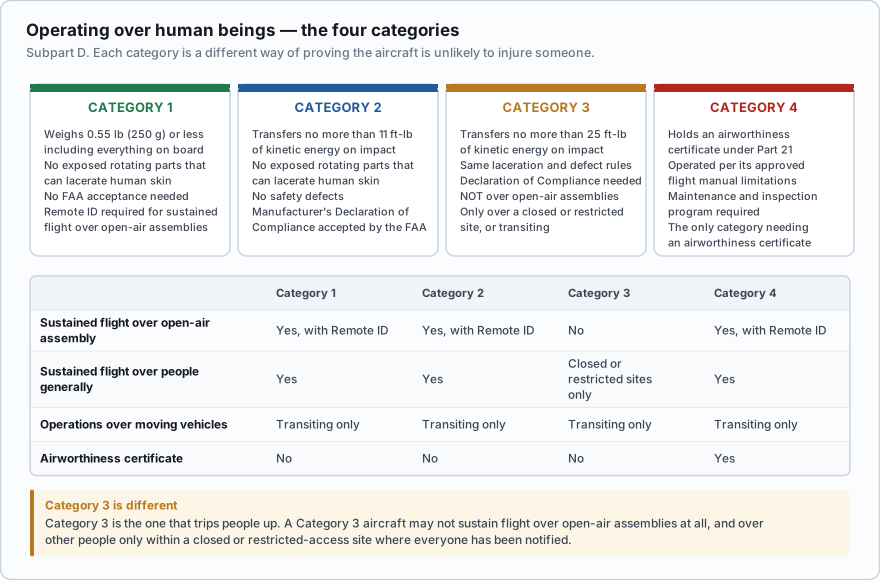
Category 1 — the weight category
Under § 107.110 the aircraft must weigh 0.55 pounds or less on takeoff and throughout the duration of each operation, including everything attached, and must have no exposed rotating parts that would lacerate human skin on impact. Category 1 needs no declaration of compliance and no label — its practical distinction from Categories 2 and 3.
The phrase throughout the duration of each operation is not decoration. Add a lens filter, prop guards, or a payload to a 245-gram aircraft and you can push it out of Category 1 without changing anything else.
Categories 2 and 3 — the kinetic energy categories
These are defined by how hard the aircraft hits rather than by what it weighs. Kinetic energy is the energy of a moving object; it rises with mass and with the square of speed, so a light aircraft moving fast can be as dangerous as a heavier one moving slowly.
| Category | Section | Standard |
|---|---|---|
| Category 2 | § 107.120(a)(1) | Will not cause injury to a human being that is equivalent to or greater than the severity of injury caused by a transfer of 11 foot-pounds of kinetic energy upon impact from a rigid object |
| Category 3 | § 107.130(a)(1) | Will not cause injury to a human being that is equivalent to or greater than the severity of the injury caused by a transfer of 25 foot-pounds of kinetic energy upon impact from a rigid object |
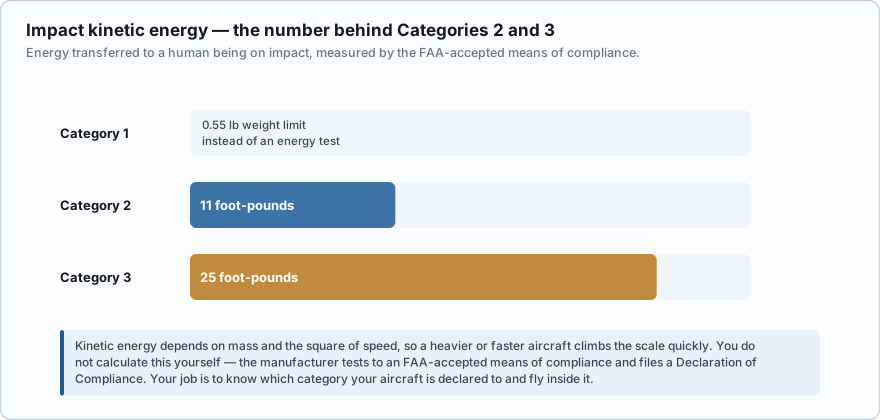
Both add two design requirements identical to Category 1's: no exposed rotating parts that would lacerate human skin, and no safety defects. Both also require the same three-part paperwork chain.
- Means of compliance (§ 107.155). Someone must first establish *how* the energy limit will be demonstrated. It must consist of test, analysis, or inspection, submitted with its procedures, conditions, and methods. The FAA notifies the applicant of acceptance and may rescind it with notice in the Federal Register.
- Declaration of compliance (§ 107.160). The designer, producer, or modifier then files a DoC naming the applicant and address, the aircraft make, model name, and series, the serial number or range of serial numbers, the accepted means of compliance used, and a declaration that no safety defects exist and the FAA may inspect and test.
- Label. The aircraft must display a category label in English, legible, prominent, and permanently affixed.
If the FAA moves to rescind a declaration — § 107.160(d)–(f)
Acceptance is not permanent. If the FAA finds an aircraft no longer meets the category it was declared for, it issues a notice of proposed rescission — and the holder gets a say. The two clocks are worth knowing, because the exam likes process questions where every option sounds procedurally plausible.
- 30 calendar days from the date the proposed rescission notice is issued to submit information showing the aircraft still complies.
- 60 days from an actual rescission to petition the FAA to reconsider, and only on one of three grounds: material new facts, a factual error by the FAA, or a misinterpretation of law.
- 14 CFR part 13, subpart D does not apply. Subpart D is the FAA's *Rules of Practice for FAA Hearings* — informal hearings run through the Office of Adjudication. Section 107.160(f) switches those procedures off for this process, so a rescission is settled inside the FAA on the two clocks above and nothing else.
Two traps live here. The first is the option saying the holder must stop distribution immediately with no chance to respond — wrong, there is a 30-day window to show compliance. The second is any option routing this to the NTSB: appeals to the NTSB are how an action against *your airman certificate* is challenged, not how a manufacturer's declaration of compliance is handled. Section 107.160(f) also rules out part 13 subpart D, so neither route is right.
The FAA notifies a declaration holder that it proposes to rescind the declaration. In a non-emergency case, what does the holder get?
- Nothing — distribution must stop immediately
- 30 calendar days to show compliance, and 60 days after any rescission to petition for reconsideration
- An appeal to the NTSB under part 13, subpart D
Answer: B. Section 107.160(d) gives 30 calendar days from issuance of the notice to demonstrate compliance; 107.160(e) allows a petition to reconsider within 60 days of a rescission on new material facts, FAA factual error, or misinterpretation of law. Section 107.160(f) expressly excludes part 13 subpart D.
The DoC applicant also owes remote pilot operating instructions, made available on sale or transfer, covering the system description, allowable modifications, and mode-change procedures — plus a product support and notification process for defects.
Your side of the chain is short. Confirm the aircraft is listed on an FAA-accepted declaration of compliance, confirm it is labeled, and follow the operating instructions. If the label is damaged or missing, § 107.135 makes it your job: label the aircraft in English, legible, prominent, and remaining on it for the duration of the operation, identifying every category it qualifies for.
A manufacturer wants an aircraft accepted for Category 2 operations. What must it establish first?
- An airworthiness certificate issued under Part 21
- A means of compliance consisting of test, analysis, or inspection, accepted by the FAA
- A type certificate and a production certificate
Answer: B. Section 107.155 requires a means of compliance — test, analysis, or inspection — to be submitted and accepted before a declaration of compliance can rely on it. Airworthiness certification under Part 21 is the Category 4 route and has no role in Categories 2 and 3.
Category 3 — the extra restrictions
Category 3 buys a higher energy allowance and pays for it with operating limits. Under § 107.125, a Category 3 aircraft may operate above a human being only if:
- the operation is within or over a closed- or restricted-access site, and all human beings located within that site are on notice that a small unmanned aircraft may fly over them; or
- the aircraft does not maintain sustained flight over any human being unless that person is directly participating or is located under a covered structure or inside a stationary vehicle offering reasonable protection.
A closed- or restricted-access site is one where the operator controls who enters — a fenced construction site, a private film set, a factory yard. Access control alone is not enough: the people inside must be on notice, through signage at the entrances, a site induction, or an announcement.
Category 3's hardest limit: an aircraft operating under Category 3 must not operate over an open-air assembly of human beings at all. Not briefly, not with Remote ID, not with notice. It is the most reliable Category 3 exam point.
Category 4 — the airworthiness category
Section 107.140 is the outlier. A Category 4 aircraft must hold an airworthiness certificate issued under Part 21 — the framework that certificates manned aircraft, and the reason § 107.2 carves out this one exception. There is no weight limit and no kinetic energy threshold.
It must be operated within the operating limitations of the approved Flight Manual, and those limitations must not prohibit operations over human beings. Category 4 also carries a maintenance regime under § 107.140(c): use the manufacturer's maintenance manual or FAA-approved methods, keep records of the work, the date, and who performed it, track life-limited parts, inspection status, and airworthiness directive compliance, retain records for one year, and transfer the life-limited parts and AD records with the aircraft.
That answers a knowledge element on its own. For Categories 1, 2, and 3 the maintenance rule is the ordinary Part 107 one — the § 107.15 condition-for-safe-operation check plus the manufacturer's instructions. Only Category 4 imports formal recordkeeping.
The whole picture
| Category 1 | Category 2 | Category 3 | Category 4 | |
|---|---|---|---|---|
| Limit | 0.55 lb or less at takeoff and throughout | 11 ft-lb transferred kinetic energy | 25 ft-lb transferred kinetic energy | No weight or energy limit |
| Exposed rotating parts that would lacerate skin | Prohibited | Prohibited | Prohibited | Governed by the airworthiness certificate |
| Safety defects | — | Prohibited | Prohibited | Governed by the airworthiness certificate |
| Declaration of compliance | Not required | Required | Required | Not applicable |
| Label required | No | Yes | Yes | No |
| Airworthiness certificate | No | No | No | Yes — Part 21 |
| Sustained flight over an open-air assembly | Allowed only if the operation meets § 89.110 or § 89.115(a) | Allowed only if the operation meets § 89.110 or § 89.115(a) | Prohibited outright | Allowed only if the operation meets § 89.110 or § 89.115(a) |
| Sustained flight over people generally | Permitted | Permitted | Closed site with notice, or no sustained flight over non-participants | Per the approved Flight Manual |
The Remote ID condition in that table deserves its own sentence. Sustained flight over an open-air assembly under Category 1, 2, or 4 requires the operation to meet § 89.110 (standard Remote ID) or § 89.115(a) (broadcast module). A FRIA does not satisfy it — a FRIA is where nothing is broadcast.
Operations over moving vehicles — § 107.145
Flying over a person inside a moving vehicle gets its own section. It is permitted only if the operation qualifies under Category 1, 2, 3, or 4 and, for Categories 1, 2, and 3, throughout the operation the aircraft either:
- remains within or over a closed- or restricted-access site, with all human beings inside a moving vehicle there on notice that a small unmanned aircraft may fly over them; or
- does not maintain sustained flight over moving vehicles. For Category 4, the aircraft needs its Part 21 airworthiness certificate and the approved Flight Manual limitations.
In practice a highway crossing is generally fine, because the aircraft transits and does not loiter. Following a moving car down a public road to film it is not, unless the road is closed and the occupants notified. That is why car commercials are shot on closed courses.
Modifications, components, and multiple categories
- Modifications. The remote pilot operating instructions specify which modifications are allowable. One they do not permit invalidates the category eligibility — an unapproved payload, untested propellers, or a prop guard removed from the tested configuration.
- If you modified it, you are the applicant. A person who designs, produces, or modifies an aircraft for operations over people must file their own declaration of compliance against an accepted means of compliance. That is also the route for previously manufactured aircraft.
- Required components. Anything the tested configuration depends on — prop guards, a parachute, specific propellers — must be installed for the category to apply.
- Multiple categories (§ 107.150). One aircraft may hold more than one category, as long as a remote PIC cannot inadvertently switch between modes or configurations.
Night, and choosing the site
Operations over people at night are permitted, and require both rule sets at once: the applicable Subpart D category and § 107.29's lighting and post-April-2021 training. Darkness also makes it harder to see who has wandered into the area.
Selecting the operational area is the part no regulation can do for you. Before launch: where would the aircraft land if the motors quit now; is there a route to the subject that avoids crossing above people; can you cordon the launch zone; who controls site access. Then brief every participant, because § 107.49(b) requires it.
- § 107.39 baseline: no flight over a person unless they are directly participating, under a covered structure or in a stationary vehicle, or the operation meets a Subpart D category.
- Cat 1 = 0.55 lb or less. No DoC, no label.
- Cat 2 = 11 ft-lb. Cat 3 = 25 ft-lb. Both need a means of compliance, an accepted DoC, and a label.
- Cat 4 = airworthiness certificate under Part 21, flown per the approved Flight Manual.
- No exposed rotating parts that would lacerate human skin for Categories 1, 2, and 3.
- Category 3 may never operate over an open-air assembly. Categories 1, 2, and 4 may, for sustained flight, only with § 89.110 or § 89.115(a) Remote ID.
- Part 107 sets no minimum lateral distance from a person.
Which category of small unmanned aircraft must have an airworthiness certificate issued by the FAA?
- Category 2
- Category 3
- Category 4
Answer: C. Section 107.140(b)(1) requires a Category 4 aircraft to hold an airworthiness certificate issued under Part 21. Categories 1, 2, and 3 do not — Category 1 is defined by weight, and Categories 2 and 3 by demonstrated impact kinetic energy under an accepted means of compliance.
Even where the category permits it, the smart plan keeps the aircraft off the crowd line. Fly parallel to a crowd rather than across it, put the path over the street or the roof, and treat category eligibility as your margin for the unexpected rather than your operating plan.
- Section 107.39 prohibits flight over a human being unless they are directly participating, under a covered structure or in a stationary vehicle, or the flight meets a Subpart D category
- Category 1 requires 0.55 pounds or less at takeoff and throughout, with no exposed rotating parts that would lacerate skin, and needs no declaration of compliance or label
- Categories 2 and 3 are defined by transferred impact kinetic energy of 11 and 25 foot-pounds and require an accepted means of compliance, an FAA-accepted declaration of compliance, and a permanent English label
- Category 4 requires an airworthiness certificate issued under Part 21, operation per the approved Flight Manual, and maintenance records retained for one year
- Category 3 may never operate over an open-air assembly; Categories 1, 2, and 4 may conduct sustained flight over one only when the operation meets § 89.110 or § 89.115(a) Remote ID
- Section 107.145 allows flight over people in moving vehicles only within a closed site with notice, or without sustained flight over the vehicles
- An unapproved modification voids category eligibility, and an aircraft may hold multiple categories only if the remote PIC cannot inadvertently switch between them