Track your progress, take practice exams, and study the flashcards in the app.
1.10 Accidents, Inspections, Records, Alcohol & Drugs, Waivers
- Apply the § 107.9 reporting criteria and the 10-calendar-day deadline to a given event
- State the alcohol and drug limits and the consequences of a conviction or a refusal to test
- List the regulations that may be waived under § 107.205 and identify the ones that may not
This lesson gathers the rules that apply after something happens, plus the two administrative topics that finish Area I: keeping your certificate current, and getting permission to break a rule on purpose.
Reporting a safety event — § 107.9
The section has been retitled Safety event reporting, though most study material still calls it accident reporting. Its structure is a deadline and two triggers.
No later than 10 calendar days after an operation that meets the criteria of either paragraph (a) or (b), a remote pilot in command must report to the FAA, in a manner acceptable to the Administrator, any operation of the small unmanned aircraft involving at least: (a) serious injury to any person or any loss of consciousness; or (b) damage to any property, other than the small unmanned aircraft, unless (1) the cost of repair, including materials and labor, does not exceed $500; or (2) the fair market value of the property does not exceed $500 in the event of total loss.
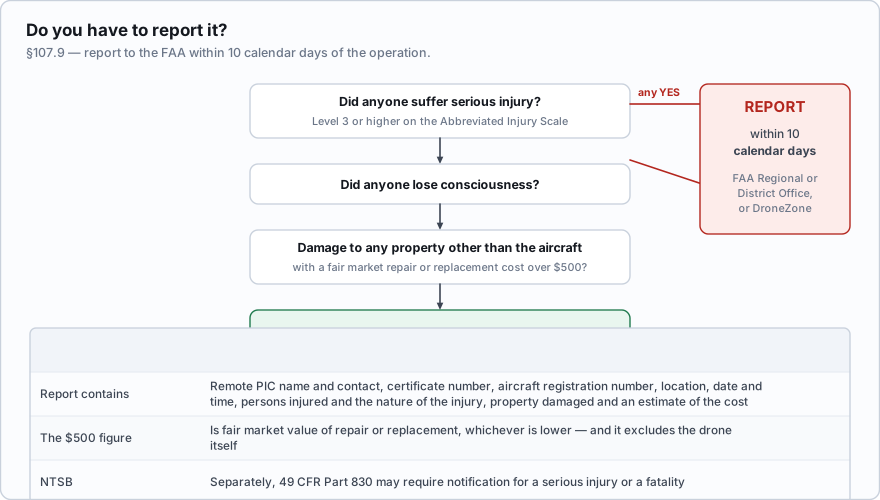
Read paragraph (b) as an exclusion, not a trigger. Report property damage unless one of the $500 conditions is satisfied. Damage of exactly $500 falls inside the exclusion; $501 does not. Damage to your own aircraft never counts, however expensive — the text says property other than the small unmanned aircraft.
Serious injury means an injury at Level 3 or above on the Abbreviated Injury Scale — a broken bone, a laceration requiring hospitalization, a significant burn. A scratch is not one. Any loss of consciousness is reportable on its own.
Reports go to the appropriate FAA Regional Operations Center, electronically or by phone, with the remote PIC's name and certificate number, the aircraft registration number, the location and time, the injuries, the property damage, and a description of what happened.
Your aircraft strikes a parked car, causing $600 of damage to the car and destroying your $2,400 drone. Nobody is hurt. What does § 107.9 require?
- No report — no one was injured
- A report to the FAA within 10 calendar days, because damage to property other than the aircraft exceeded $500
- A report to the FAA within 24 hours, because the total loss exceeded $500
Answer: B. Damage to property other than the small unmanned aircraft must be reported unless repair cost or fair market value is $500 or less. The $600 of damage to the car exceeds the threshold. The value of your own aircraft is excluded entirely, and the deadline is 10 calendar days.
Section 107.9 is the FAA's rule. The NTSB has its own, in 49 CFR Part 830: an unmanned aircraft occurrence in which any person suffers death or serious injury must be reported to the NTSB immediately. If someone is seriously hurt you owe two reports, not one.
In-flight emergencies — § 107.21
In an in-flight emergency requiring immediate action, the remote PIC may deviate from any rule of Part 107 to the extent necessary to meet that emergency, and must then send a written report of the deviation upon request of the Administrator.
Two details decide the exam question. The authority is broad — any rule of this part — but available only for an emergency requiring immediate action. And the report is owed only if the FAA asks; there is no automatic filing and no report to ATC or the NTSB.
Inspection, testing, and demonstration of compliance — § 107.7
A remote PIC, owner, or person manipulating the flight controls must have the remote pilot certificate and identification in that person's physical possession and readily accessible when exercising the privileges of the certificate, and must present them on request from:
- The Administrator (the FAA);
- An authorized representative of the National Transportation Safety Board;
- Any Federal, State, or local law enforcement officer; or
- An authorized representative of the Transportation Security Administration.
That list is wider than most people expect — a city police officer may ask on a job site and you must produce it. The section also requires you to make available any record the rules require you to keep, and to allow the FAA to test or inspect the aircraft and the people involved. Note the standard: physical possession, not a photograph on your phone.
Falsification
This rule has moved. Falsification used to be § 107.5. That section was removed and reserved effective November 3, 2025, and the prohibition now sits in 14 CFR Part 3, Subpart D — §§ 3.403 and 3.405 — applying across FAA certificates. The substance is unchanged, and the substance is what the exam tests.
- No fraudulent or intentionally false statement may be made in any application, certificate, record, or report submitted under the rules, and the same applies to reproducing or altering a certificate, rating, authorization, record, or report for fraudulent purpose, or omitting material facts.
- The consequence is denial of the application, or suspension or revocation of any certificate, rating, or authorization the person holds. A material incorrect statement is grounds for withdrawing an FAA approval even without fraud.
- Falsifying a federal document can also carry criminal penalties independent of any certificate action.
You will see study material citing § 107.5 for falsification. That citation is out of date; § 107.5 is reserved. The concept and the consequences are what get tested, so answer on the substance: fraudulent or intentionally false statements bring denial, suspension, or revocation.
Alcohol and drugs
Section 107.27 writes no limits of its own. It pulls in § 91.17 and § 91.19, the rules that bind airline crews, and applies them to the person manipulating the controls, the remote PIC, and the visual observer.
- 8 hours from bottle to throttle — no operation within 8 hours after consuming any alcoholic beverage.
- 0.04 percent blood alcohol concentration or greater is prohibited, regardless of the 8 hours.
- No operation while under the influence, and none while using any drug that affects the person's faculties in any way contrary to safety.
- § 91.19: no carriage of narcotic drugs, marijuana, or depressant or stimulant drugs aboard the aircraft.
- These bind the remote PIC, the person flying, and the visual observer.
The 8-hour rule and the 0.04 percent rule are independent and both must be satisfied. Eight hours after a heavy night you can still be above 0.04 percent, and being below 0.04 percent does not excuse flying seven hours after your last drink.
| Section | Trigger | Consequence |
|---|---|---|
| § 107.57(a) | A conviction under any Federal or State statute relating to the growing, processing, manufacture, sale, disposition, possession, transportation, or importation of narcotic drugs, marijuana, or depressant or stimulant drugs | Denial of an application for up to 1 year after the date of final conviction, or suspension or revocation of a certificate held |
| § 107.57(b) | Committing an act prohibited by § 91.17(a) or § 91.19(a) | Denial for up to 1 year after the date of that act, or suspension or revocation |
| § 107.59 | Refusing a blood alcohol test requested by a law enforcement officer under § 91.17(c), or refusing to furnish or authorize release of the results to the Administrator | Denial for up to 1 year after the date of that refusal, or suspension or revocation |
Notice that a refusal carries the same consequence as the offense. There is no advantage in declining the test.
Staying current — § 107.65
The remote pilot certificate never expires. What expires is your aeronautical knowledge recency. Within the previous 24 calendar months you must have accomplished one of the following:
- Passed an initial aeronautical knowledge test covering the § 107.73 areas — what you are studying for now; or
- Completed recurrent training covering the § 107.73 areas — the free online course ALC-677 on the FAA Safety Team website; or
- If you hold a Part 61 pilot certificate other than student pilot and meet the § 61.56 flight review requirement, completed training covering the § 107.74 areas — the free course ALC-515.
There has been no recurrent knowledge test since April 6, 2021. You do not return to a testing center and you do not pay again. You log in to faasafety.gov, work through a roughly two-hour course, and print the completion certificate — one of the documents § 107.7 requires you to produce on request.
The most common outdated claim in Part 107 study material is that you must retake the knowledge test every 24 months. You must not. The requirement is free online recurrent training every 24 calendar months, and the certificate itself has no expiration date.
A remote pilot passed the initial knowledge test in March 2024. What must the pilot do to continue exercising remote PIC privileges after March 2026?
- Retake the initial knowledge test at a PSI testing center
- Complete the free online recurrent training course within 24 calendar months of the last qualifying event
- Apply for a new remote pilot certificate through IACRA
Answer: B. Section 107.65 requires one of three things within the previous 24 calendar months: an initial knowledge test, recurrent training, or § 107.74 training for a current Part 61 pilot. Since April 6, 2021 there is no recurrent knowledge test, and the certificate itself does not expire, so no new application is needed.
Waivers — §§ 107.200 and 107.205
A certificate of waiver is FAA permission to deviate from a specific regulation. Under § 107.200 the Administrator may issue one if the operation can safely be conducted under the terms of that certificate. The request must contain a complete description of the proposed operation and a justification establishing that, and you must comply with every condition imposed.
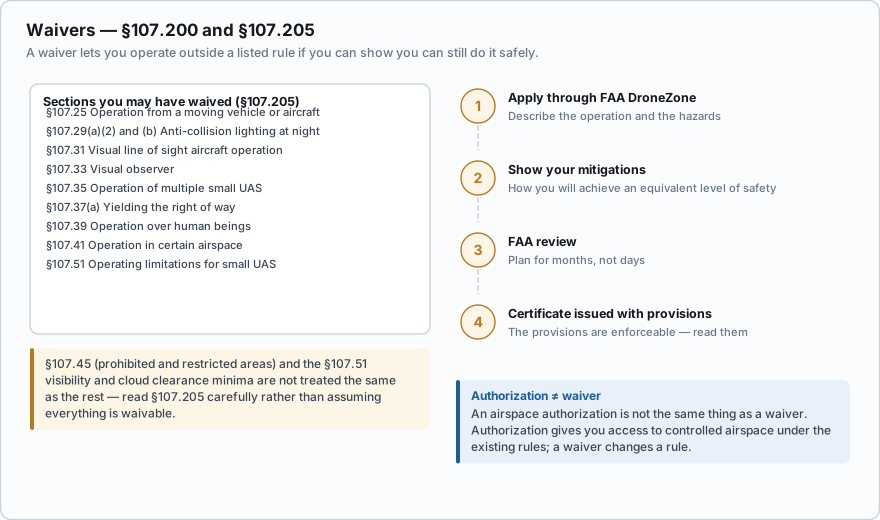
Section 107.205 is a closed list of ten items. Learn it as a list; questions are often phrased as which of these may not be waived.
| § 107.205 | Section | Subject | Limitation on the waiver |
|---|---|---|---|
| (a) | § 107.25 | Operation from a moving vehicle or aircraft | No waiver to allow carriage of another's property for compensation or hire |
| (b) | § 107.29(a)(2) and (b) | Anti-collision lighting for night and civil twilight | Only the lighting — the night training requirement is not waivable |
| (c) | § 107.31 | Visual line of sight aircraft operation | No waiver to allow carriage of another's property for compensation or hire |
| (d) | § 107.33 | Visual observer | — |
| (e) | § 107.35 | Operation of multiple small unmanned aircraft | — |
| (f) | § 107.37(a) | Yielding the right of way | Only (a) — the collision-hazard prohibition in (b) is not waivable |
| (g) | § 107.39 | Operation over human beings | — |
| (h) | § 107.41 | Operation in certain airspace | — |
| (i) | § 107.51 | Operating limitations for small unmanned aircraft | — |
| (j) | § 107.145 | Operations over moving vehicles | — |
What is not on the list is as testable as what is. You cannot waive § 107.12 (the certificate requirement), § 107.15 (condition for safe operation), § 107.17 (medical condition), § 107.23 (careless or reckless operation and dropping objects), § 107.36 (hazardous material), or § 107.49 (preflight). There is no waiver for flying an unsafe aircraft or skipping the preflight.
Applications go through the FAA's Aviation Safety (AVS) Hub, which took over Part 107 waiver processing from FAADroneZone in 2026. Airspace authorizations remain in FAADroneZone and LAANC — an authorization to enter controlled airspace is a different animal from a waiver. The FAA targets a decision in about 90 days, so apply early.
Records, multiple categories, and older aircraft
Part 107 imposes no logbook requirement on you — no flight time to log and no FAA-prescribed maintenance log. The recordkeeping duties in Area I fall mostly on manufacturers, with three that can reach an operator.
- § 107.165 — declaration of compliance holders. A producer retains the compliance information for 2 years after production ceases; a designer or modifier retains it for 2 years after submitting the DoC. File your own DoC and this becomes yours.
- § 107.155 — means of compliance submitters retain the description and justification for as long as the means of compliance remains accepted.
- § 107.140(c) — Category 4 operators keep maintenance records for 1 year and transfer the life-limited parts and airworthiness directive records with the aircraft.
Multiple category aircraft (§ 107.150). A small UAS may be eligible for more than one category of operation over human beings, as long as a remote PIC cannot inadvertently switch between modes or configurations, and its label must identify each category correctly.
Previously manufactured aircraft. Subpart D and Part 89 both arrived after many drones were already in service, and both provide a route forward. An aircraft built before the operations-over-people rule can become Category 2 or 3 eligible when someone demonstrates compliance and files a DoC. One built without Remote ID stays legal through a broadcast module or inside a FRIA.
Which of the following may NOT be waived under § 107.205?
- § 107.51, operating limitations for small unmanned aircraft
- § 107.49, preflight familiarization, inspection, and actions
- § 107.39, operation over human beings
Answer: B. Section 107.205 lists ten waivable regulations, and § 107.49 is not among them. Sections 107.51 and 107.39 are both on the list, at (i) and (g). Preflight, condition for safe operation, careless or reckless operation, hazardous materials, and the certificate requirement can never be waived.
That closes Area I. You now hold the whole regulatory frame: what Part 107 covers, what the aircraft and pilot must be, where and how high you may fly, what happens over people, how the aircraft identifies itself, and what you owe the FAA afterward.
- Section 107.9 requires a report to the FAA within 10 calendar days for serious injury or any loss of consciousness, or for damage to property other than the aircraft unless repair cost or fair market value is $500 or less
- Section 107.21 permits deviation from any rule of Part 107 in an in-flight emergency requiring immediate action, with a written report only upon request of the Administrator
- Section 107.7 requires the certificate and identification in physical possession and readily accessible, presentable to the FAA, NTSB, any federal, state, or local law enforcement officer, and the TSA
- Falsification moved from § 107.5 to 14 CFR Part 3 Subpart D in November 2025; fraudulent or intentionally false statements bring denial, suspension, or revocation
- Alcohol and drug rules come from §§ 91.17 and 91.19 — 8 hours bottle to throttle, nothing at 0.04 percent BAC or above — and a conviction, a prohibited act, or a refusal to test can each bring denial for up to 1 year or suspension or revocation
- Recency under § 107.65 is free online recurrent training every 24 calendar months, not a retest, and the certificate itself never expires
- Section 107.205 lists exactly ten waivable regulations; preflight, condition for safe operation, medical condition, careless or reckless operation, hazmat, and the certificate requirement are not among them