Track your progress, take practice exams, and study the flashcards in the app.
1.7 Night & Civil Twilight Operations
- State the two conditions § 107.29 places on night operations and the one condition it places on civil twilight
- Define night and civil twilight precisely, including the Alaska exception
- Explain the anti-collision lighting standard and when its intensity may be reduced
Until April 2021 flying a drone after dark required a waiver, and the FAA issued thousands of them. That era is over. Night operations are now routine and require no waiver — but they require two things you must be able to state exactly, because this is one of the most heavily tested sections in the whole rule.
The three periods of the day
Part 107 divides the day into three regimes, and each has a different requirement. Get the boundaries clear before anything else.
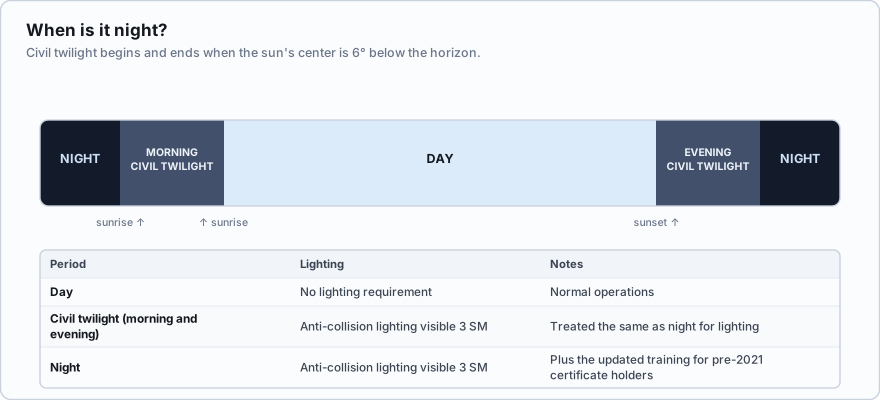
| Period | Definition | Requirement |
|---|---|---|
| Daylight | Official sunrise to official sunset | No lighting or training requirement under § 107.29 |
| Civil twilight | 30 minutes before official sunrise to sunrise, and official sunset to 30 minutes after sunset | Anti-collision lighting visible for at least 3 statute miles |
| Night | The period between the end of evening civil twilight and the beginning of morning civil twilight | Anti-collision lighting visible for at least 3 statute miles and knowledge test or training completed after April 6, 2021 |
Section 107.29(c) states the civil twilight definition for the record: except in Alaska, morning civil twilight begins 30 minutes before official sunrise and ends at official sunrise; evening civil twilight begins at official sunset and ends 30 minutes after official sunset. In Alaska, civil twilight is the period defined in the Air Almanac, which can run far longer than 30 minutes at high latitudes.
Condition one: the training
No person may operate a small unmanned aircraft system at night unless the remote pilot in command has completed an initial knowledge test or training, as applicable, under § 107.65 after April 6, 2021.
The date is the pivot. The UAG knowledge test was rewritten on April 6, 2021 to add a night operations knowledge area, and the free recurrent training course was rewritten at the same time. If you take your initial test today, you have satisfied this requirement the moment you pass — the night material is baked into the exam you are studying for.
If you already held a certificate from before that date, you must complete the updated recurrent training — the free online course ALC-677 on the FAA Safety Team site, or ALC-515 if you hold a Part 61 certificate with a current flight review — before you conduct a night operation. The FAA has been explicit: pre-April-2021 certificate holders need the updated training before flying at night, regardless of whether their 24-month recency clock has run out yet.
Note what this condition is not. It is not waivable. Section 107.205(b) makes only § 107.29(a)(2) and (b) — the lighting — subject to waiver. There is no route around the training requirement.
Condition two: the lighting
The small unmanned aircraft must have lighted anti-collision lighting visible for at least 3 statute miles that has a flash rate sufficient to avoid a collision. The remote pilot in command may reduce the intensity of, but may not extinguish, the anti-collision lighting if he or she determines that, because of operating conditions, it would be in the interest of safety to do so.
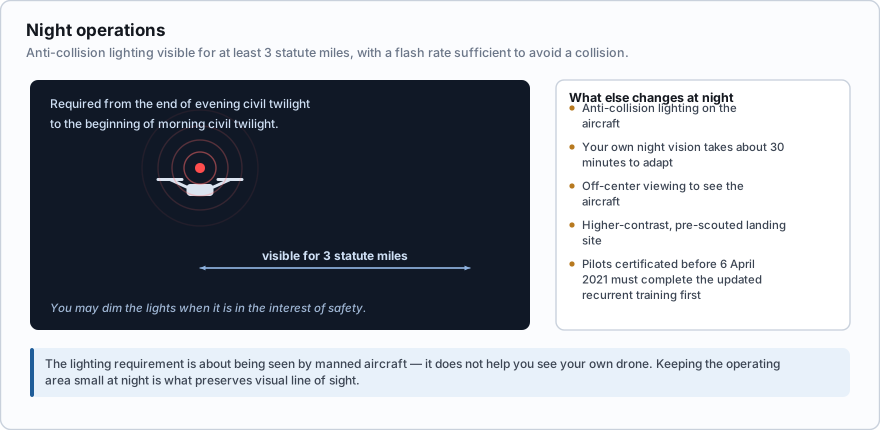
Three details carry points.
- 3 statute miles is the visibility standard for the light. It is the same number as the flight visibility minimum in § 107.51(c), which makes it easy to remember and easy to confuse — one describes the weather, the other describes the strobe.
- Flash rate sufficient to avoid a collision. The rule sets no rate in flashes per minute. A steady, non-flashing light does not meet the standard, and neither do the small orientation LEDs most consumer aircraft carry from the factory. You will almost certainly need to add a strobe.
- Reduce, never extinguish. If the strobe is destroying your own night vision or reflecting off fog badly enough to hurt the operation, you may dim it. Turning it off is a violation even for a moment.
The lighting is required for civil twilight as well as night. That is the trap in § 107.29(b) and one of the FAA's own sample questions turns on it: operating a small unmanned aircraft within 30 minutes after official sunset requires the use of anti-collision lighting.
What is required to operate a small unmanned aircraft 20 minutes after official sunset?
- Use of anti-collision lighting visible for at least 3 statute miles
- Operation only in a rural area
- Use of an ATC transponder
Answer: A. Twenty minutes after official sunset falls inside evening civil twilight, which runs from sunset to 30 minutes after sunset. Section 107.29(b) requires anti-collision lighting visible for at least 3 statute miles during civil twilight. Transponders are prohibited under § 107.52.
The fine distinction worth a point
Read the two paragraphs side by side. Paragraph (a) governs night and imposes both the training and the lighting. Paragraph (b) governs civil twilight and imposes only the lighting. A pilot who passed the knowledge test in 2019 and never took the updated recurrent training may legally fly during evening civil twilight with a proper strobe, but may not fly one minute past the end of it.
- Night requires: training or initial test completed after April 6, 2021 and anti-collision lighting visible for 3 statute miles.
- Civil twilight requires: anti-collision lighting only.
- Civil twilight is 30 minutes before sunrise to sunrise and sunset to 30 minutes after sunset — except Alaska, where the Air Almanac governs.
- Intensity may be reduced in the interest of safety; the light may never be extinguished.
- No waiver is needed to fly at night. Only the lighting requirement is waivable — the training requirement is not.
A stubbornly popular wrong answer says night operations require a certificate of waiver. They did once. Section 107.29 was amended effective April 21, 2021, and existing night waivers issued before March 16, 2021 terminated on May 17, 2021. Today the answer is training plus lighting, not paperwork.
What changes operationally after dark
The regulation is short; the flying is not. Depth perception collapses without ground reference, so a drone at 200 feet and a drone at 80 feet look identical. Your own strobe makes the aircraft's orientation harder to read, not easier, once it is more than a few hundred feet out. Obstacles that were obvious in daylight — a guy wire, a bare branch, an unlit pole — disappear entirely.
- Walk the site in daylight if you possibly can, and photograph the obstacle field.
- Test the strobe on the ground as part of the § 107.49 preflight, and carry a spare with charged batteries.
- Allow roughly 30 minutes for your eyes to adapt to darkness, and protect that adaptation — a white flashlight in the face resets the clock.
- Light the landing zone with something dim and colored, positioned so it does not shine up into your eyes or the camera.
- Brief the VO on lighting cues, since orientation calls at night depend on which lights they can see.
When may a remote pilot reduce the intensity of the aircraft's anti-collision lighting during a night flight?
- Never — the lighting must remain at full intensity
- When a manned aircraft is operating in the vicinity
- When the remote PIC determines that, because of operating conditions, it would be in the interest of safety to do so
Answer: C. Section 107.29 permits the remote PIC to reduce the intensity of the anti-collision lighting when operating conditions make it safer to do so — glare, fog, or loss of the pilot's own night vision, for example. The light may be dimmed but may never be extinguished.
Sunrise, sunset, and civil twilight times are published by the U.S. Naval Observatory and are built into most flight-planning apps. Look them up for the actual date and coordinates rather than assuming, because the length of civil twilight varies with latitude and season, and screenshot the result. It is the cheapest possible record of why you believed you were legal at 8:14 p.m.
- Night operations require no waiver, but they require the remote PIC to have completed an initial knowledge test or § 107.65 training after April 6, 2021
- Both night and civil twilight operations require anti-collision lighting visible for at least 3 statute miles with a flash rate sufficient to avoid a collision
- Civil twilight runs from 30 minutes before official sunrise to sunrise and from official sunset to 30 minutes after sunset, except in Alaska where the Air Almanac defines it
- The remote PIC may reduce the intensity of the anti-collision lighting in the interest of safety but may never extinguish it
- Only § 107.29(a)(2) and (b) — the lighting — may be waived; the training requirement in § 107.29(a)(1) cannot
- Pilots certificated before April 6, 2021 must complete the updated recurrent training, ALC-677 or ALC-515, before conducting night operations