Track your progress, take practice exams, and study the flashcards in the app.
1.6 Right of Way, Hazardous Operations & Moving Vehicles
- State the § 107.37 right-of-way rule and what yielding means in regulatory terms
- Describe an effective visual scan and explain why an aircraft on a collision course is the hardest to see
- Apply § 107.23 and § 107.25 to careless operation, dropped objects, and flight from a moving vehicle
Three short sections in this lesson carry more enforcement weight than anything else in Part 107. They are the sections the FAA reaches for when a flight was legal on paper and reckless in fact.
You always yield — § 107.37
Each small unmanned aircraft must yield the right of way to all aircraft, airborne vehicles, and launch and reentry vehicles. Yielding the right of way means that the small unmanned aircraft must give way to the aircraft or vehicle and may not pass over, under, or ahead of it unless well clear.
There is no exception. Not for a slower aircraft, not for one converging from your right, not for a balloon, not for another drone that saw you first. The manned-aircraft right-of-way rules in § 91.113 set up a pecking order — balloons over gliders over airplanes and so on. Part 107 puts you at the bottom of every one of those lists, permanently.
Read the definition of yielding closely. It is not enough to avoid a collision. You may not pass over, under, or ahead of the other aircraft unless you are well clear. In practice the response is almost always the same and almost always correct: descend and hold. A manned aircraft's crew has no reasonable chance of seeing you; putting yourself low and stationary removes the problem.
Paragraph (b) adds a separate prohibition: no person may operate a small unmanned aircraft so close to another aircraft as to create a collision hazard. That one stands on its own. You can violate (b) even where nobody had to yield.
See and avoid, when you are the one who has to see
Manned pilots share the see-and-avoid burden with you. Realistically, they will not see a two-foot quadcopter. The whole job of detection is yours, and it is a learned skill rather than a matter of staring harder.
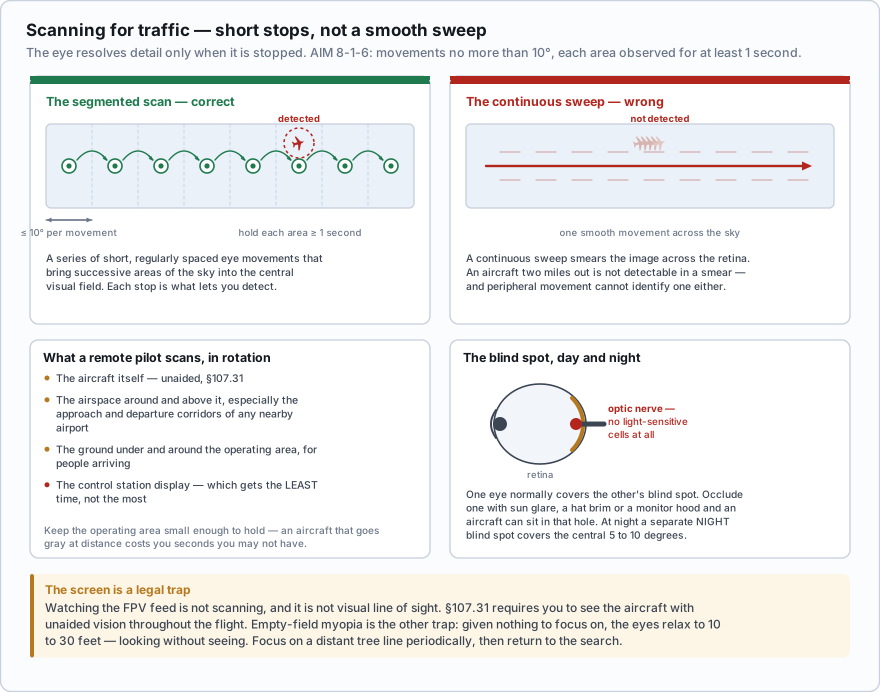
- Scan in segments. Divide the sky into blocks roughly 10 degrees wide and pause on each for a second or two. A continuous sweep produces a blur; the eye resolves detail only when it stops.
- An aircraft on a collision course does not appear to move. It sits at a constant relative bearing and grows. Because your eye is tuned to detect motion, the single most dangerous target is the one that looks static against the background.
- Look and listen. Engine noise often arrives before a visual, especially for aircraft low on approach. A crew that hears an aircraft it cannot see should get the drone down first and find the traffic second.
- Use the visual observer deliberately. Assign sectors. One person watching the aircraft and one watching the approach path beats two people watching the same drone.
Which technique should a remote pilot use to scan for traffic?
- Systematically focus on different segments of the sky for short intervals
- Concentrate on relative movement detected in the peripheral field of vision
- Sweep the eyes continuously from one side of the sky to the other
Answer: A. Effective scanning uses a series of short, regularly spaced eye movements that bring successive segments of sky into the central field of vision, pausing in each. A continuous sweep does not let the eye resolve detail, and peripheral vision alone will miss the target that matters most — the one on a constant bearing that is not apparently moving.
Careless or reckless, and dropping objects — § 107.23
Section 107.23 has two paragraphs and each is a separate offense.
- (a) No person may operate a small UAS in a careless or reckless manner so as to endanger the life or property of another.
- (b) No person may allow an object to be dropped from a small unmanned aircraft in a manner that creates an undue hazard to persons or property.
Paragraph (a) is the FAA's catch-all. It does not require a specific numeric violation. Flying in wind beyond the aircraft's demonstrated capability, launching with a known-damaged propeller, flying while your attention is on a client conversation, chasing wildlife, buzzing a beach to get a reaction — all of these can be careless or reckless even if the aircraft never left 200 feet or exceeded any published limit. It is the section that fills the gap between the letter of the rules and safe operation.
Paragraph (b) is more often misread than any other line in Part 107. Dropping objects is not prohibited. Dropping them in a manner that creates an undue hazard is. Delivering a life ring to a swimmer, releasing sterile insects over an orchard, dropping a marker on a survey point, and lowering a tool to a roofer with a winch are all legal Part 107 operations, provided you have thought about what happens if the object falls where you did not intend.
Two neighboring rules constrain the same activity from different directions. Section 107.36 forbids carrying hazardous material at all, so nothing on the 49 CFR 171.8 list may be dropped or carried. And dispensing an economic poison — a pesticide, herbicide, or fungicide — for agriculture is agricultural aircraft operation under Part 137, which requires its own operating certificate on top of Part 107.
Operating from a moving vehicle — § 107.25
This section governs where you and your control station are, not where the aircraft flies.
No person may operate a small unmanned aircraft system (a) from a moving aircraft; or (b) from a moving land- or water-borne vehicle unless the small unmanned aircraft is flown over a sparsely populated area and is not transporting another person's property for compensation or hire.
From a moving aircraft: never, full stop, without a waiver. From a moving car, truck, or boat: allowed, but only over a sparsely populated area, and never while carrying somebody else's property for hire. The FAA does not define sparsely populated with a number; it is a judgment about how many people and structures are beneath the aircraft, and the burden of that judgment is yours.
Section 107.25 is waivable — it is item (a) on the § 107.205 list. The waiver entry carries its own caveat: no waiver of this provision will be issued to allow the carriage of another person's property by aircraft for compensation or hire. Pipeline patrol from a moving truck is a plausible waiver. Delivering packages from a moving van is not.
Section 107.25 and § 107.145 sound alike and mean different things. § 107.25 is about the operation being conducted from a moving vehicle — where the pilot is. § 107.145 is about flying the aircraft over a human being inside a moving vehicle — where the aircraft is. A question about a pilot in a boat is § 107.25. A question about a drone above a highway is § 107.145, which you will meet in Lesson 1.8.
- Small unmanned aircraft always yield to all aircraft, airborne vehicles, and launch and reentry vehicles — no exceptions.
- Yielding means giving way and not passing over, under, or ahead unless well clear.
- An aircraft on a collision course shows no apparent relative motion — it only grows larger.
- Dropping objects is legal unless it creates an undue hazard. Carrying hazardous material is never legal.
- Never from a moving aircraft. From a moving land or water vehicle only over a sparsely populated area and not carrying another's property for hire.
A remote pilot is flying from the deck of a moving boat on a large lake, photographing the shoreline for a resort's marketing. Is this permitted?
- No — Part 107 prohibits operation from any moving vehicle
- Yes, provided the aircraft is flown over a sparsely populated area and is not carrying another person's property for compensation or hire
- Yes, but only with a visual observer aboard the boat
Answer: B. Section 107.25(b) permits operation from a moving water-borne vehicle when the aircraft is flown over a sparsely populated area and is not transporting another person's property for compensation or hire. The prohibition without exception applies to moving aircraft, in § 107.25(a). A visual observer is optional here.
Build a habit that costs nothing: before you take your eyes off the sky to check the tablet, say the altitude and heading out loud. It gives your VO a cue, it timestamps your own awareness, and after a few weeks you will notice how often you were about to look down at exactly the wrong moment.
- Small unmanned aircraft yield the right of way to all aircraft, airborne vehicles, and launch and reentry vehicles, without exception
- Yielding means giving way and not passing over, under, or ahead unless well clear; § 107.37(b) separately bars operating so close as to create a collision hazard
- Scan the sky in short segmented steps — an aircraft on a collision course holds a constant relative bearing and shows no apparent motion
- Section 107.23 bars careless or reckless operation and bars dropping an object in a manner that creates an undue hazard; dropping itself is not prohibited
- Agricultural dispensing of economic poisons requires a Part 137 certificate, and hazardous material may never be carried
- Operation from a moving aircraft is prohibited; operation from a moving land or water vehicle is allowed only over a sparsely populated area and not for carriage of another's property for hire
- Section 107.25 concerns where the pilot is; § 107.145 concerns flight over people in moving vehicles