Track your progress, take practice exams, and study the flashcards in the app.
1.5 Operating Rules II — Where, When, How High, How Fast
- Recite the four § 107.51 operating limitations and apply the 400-foot structure exception
- Convert a reported ceiling and visibility into a maximum legal operating altitude
- Identify which airspace and which designated areas require permission before you fly, and from whom
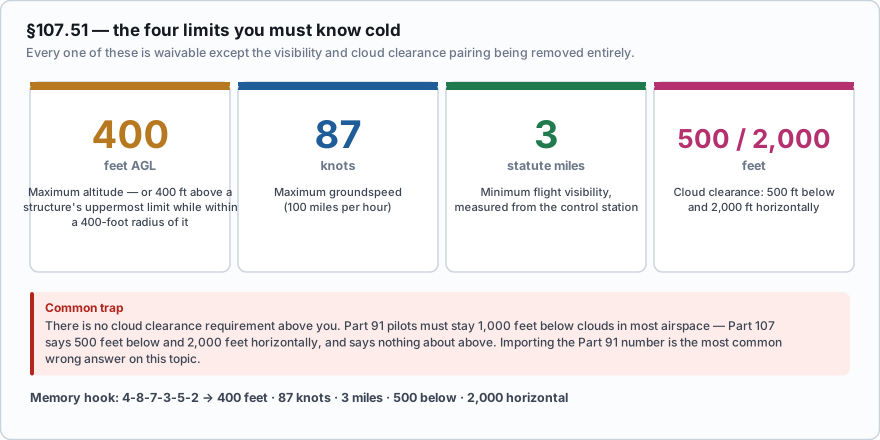
Four numbers. If you memorize nothing else in this module, memorize the four numbers in § 107.51. They appear on almost every practice exam and they govern almost every flight you will ever make.
§ 107.51(a) — Groundspeed: 87 knots
The groundspeed of the small unmanned aircraft may not exceed 87 knots (100 miles per hour). Both figures appear in the regulation, so either can appear in an answer choice.
The limit is on groundspeed — speed over the ground — not airspeed. A drone with an 80-knot airspeed capability flying downwind in a 15-knot tailwind is doing 95 knots across the ground and is illegal, even though the aircraft never exceeded its own published speed. Very few multirotors can approach 87 knots. Fixed-wing mapping aircraft can, and so can a light quad in a strong tailwind on the return leg of a long transect.
§ 107.51(b) — Altitude: 400 feet AGL, with one exception
The altitude of the small unmanned aircraft cannot be higher than 400 feet above ground level, unless the aircraft (1) is flown within a 400-foot radius of a structure, and (2) does not fly higher than 400 feet above the structure's immediate uppermost limit.
Read the exception as a bubble. Draw a cylinder around the structure with a radius of 400 feet, and put a lid on it 400 feet above the structure's highest point. Inside that bubble you may exceed 400 feet AGL. Step outside the 400-foot radius and you are back under the plain 400-foot ceiling immediately.
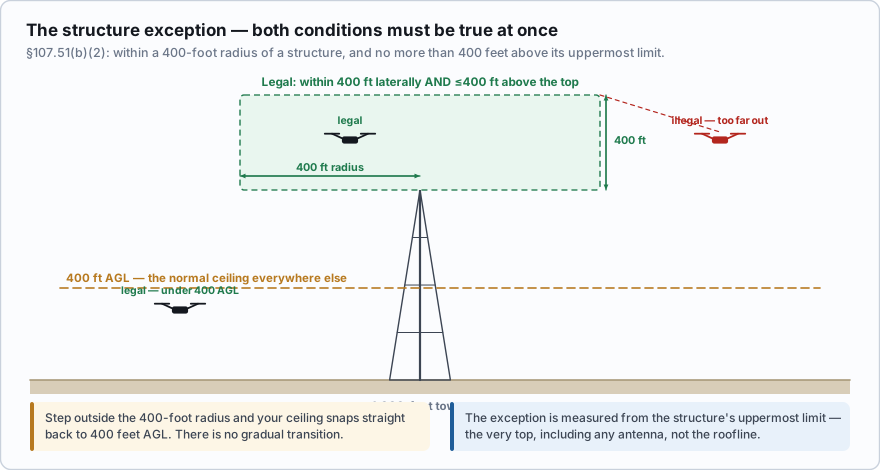
A broadcast tower stands 1,200 feet AGL. You are hired to inspect the top-mounted antenna. Within 400 feet horizontally of that tower you may climb to 1,600 feet AGL — 400 above the structure's uppermost limit. Fly 500 feet away from the tower to get a wider establishing shot and your legal ceiling drops back to 400 feet AGL. The two conditions are joined by and, not or.
AGL means above ground level — height above the terrain directly beneath the aircraft, not above your takeoff point. Fly from a hilltop out over a valley and your aircraft's AGL height increases even though its altitude reading has not moved. This is a Module 2 topic, but it bites people in the field long before the exam does.
You are inspecting a 900-foot AGL smokestack. What is the highest you may legally fly, and where?
- 400 feet AGL anywhere, because the structure exception applies only to towers
- 1,300 feet AGL, but only within a 400-foot radius of the smokestack
- 1,300 feet AGL anywhere within visual line of sight
Answer: B. Section 107.51(b) permits flight up to 400 feet above the structure's immediate uppermost limit — 900 + 400 = 1,300 feet AGL — but only while the aircraft is within a 400-foot radius of that structure. Outside the radius the 400-foot AGL limit applies again.
§ 107.51(c) — Flight visibility: 3 statute miles
The minimum flight visibility, as observed from the location of the control station, must be no less than 3 statute miles. Statute miles, not nautical — this is one of the few aviation numbers given in statute miles, and the FAA does that deliberately because visibility in weather reports is given the same way.
The measuring point matters. It is the visibility from where you are standing, not from the airport six miles away whose METAR you read. The METAR is your best available evidence, and it is what you should document, but if you are in a fog bank and the airport is clear, you are the one with the problem.
§ 107.51(d) — Cloud clearance: 500 below, 2,000 horizontal
The minimum distance of the aircraft from clouds must be no less than 500 feet below the cloud and 2,000 feet horizontally from the cloud, again as observed from the control station.
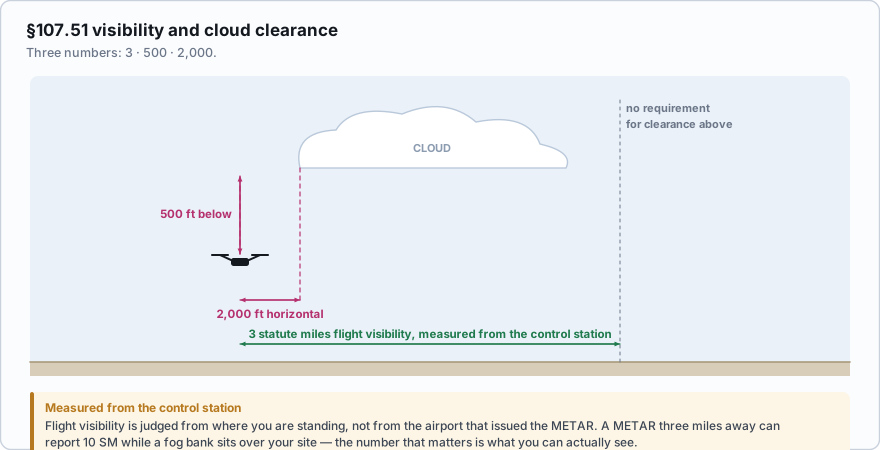
A useful hook: 3-5-2. Three statute miles, five hundred below, two thousand horizontal. It works because the numbers stay in that order on the card and in the regulation.
Now combine (b) and (d), because that combination is the most reliably missed calculation on the exam. A cloud layer reported as broken or overcast constitutes a ceiling. You must stay 500 feet below it. So the reported ceiling minus 500 feet is your real altitude limit whenever the ceiling is below 900 feet AGL.
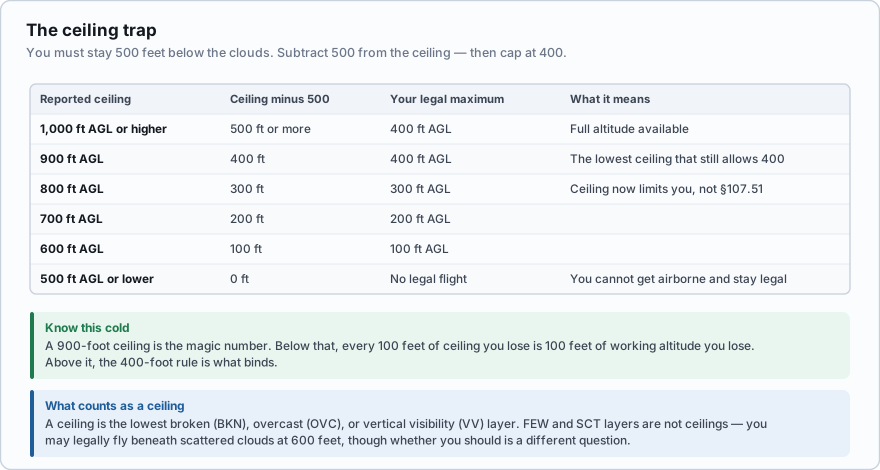
| Reported ceiling (AGL) | Cloud clearance limit | Maximum legal altitude |
|---|---|---|
| OVC005 — 500 ft | 500 − 500 = 0 ft | You cannot fly |
| BKN007 — 700 ft | 700 − 500 = 200 ft | 200 ft AGL |
| OVC010 — 1,000 ft | 1,000 − 500 = 500 ft | 400 ft AGL (§ 107.51(b) governs) |
| SCT025 — 2,500 ft | Scattered is not a ceiling | 400 ft AGL |
The nearest weather report gives a 700-foot overcast ceiling and 5 statute miles visibility. What is your maximum legal altitude?
- 400 feet AGL
- 200 feet AGL
- 700 feet AGL
Answer: B. You must remain at least 500 feet below the cloud. With the cloud base at 700 feet AGL, that puts your ceiling at 200 feet AGL — more restrictive than the 400-foot rule, so it governs. Visibility of 5 SM is above the 3 SM minimum and is not the limiting factor here.
Where you need permission
Four sections cover permission, and each names a different authority. Confusing them is a classic exam error.
| Section | Where | Permission required from |
|---|---|---|
| § 107.41 | Class B, Class C, Class D, and within the lateral boundaries of the surface area of Class E airspace designated for an airport | Prior authorization from ATC — in practice through LAANC or FAADroneZone |
| § 107.43 | In the vicinity of any airport, heliport, or seaplane base | No permission — but you may not interfere with operations and traffic patterns |
| § 107.45 | Prohibited areas and restricted areas | Permission from the using or controlling agency, as appropriate |
| § 107.47 | Areas designated by NOTAM | Comply with §§ 91.137 through 91.145 and § 99.7 — temporary flight restrictions and ADIZ rules |
Two currency points that most published courses get wrong. First, Class E airspace with a floor at 700 or 1,200 feet AGL requires no authorization at all. Only a Class E surface area designated for an airport does. A drone at 400 feet AGL underneath a 700-foot Class E floor is in Class G airspace and needs nobody's permission. Second, the old requirement to notify any airport within 5 miles came from the recreational rules and is obsolete for Part 107. What replaced it is § 107.41 authorization inside controlled airspace and § 107.43 non-interference everywhere else.
On § 107.47: the temporary flight restriction you are most likely to meet is the standing stadium restriction. Under FDC NOTAM 4/3621, flight is prohibited within a 3 nautical mile radius, from the surface to 3,000 feet AGL, over any stadium seating 30,000 or more people, from one hour before to one hour after a Major League Baseball, National Football League, NCAA Division I football, or major motor speedway event. Sponsorship, press credentials, and the team's permission make no difference.
Preflight familiarization — § 107.49
Before every flight, the remote PIC must do six things. The first is an assessment of the operating environment considering risks to persons and property in the immediate vicinity both on the surface and in the air, and it must include four specific items.
- Assess the operating environment — local weather conditions, local airspace and any flight restrictions, the location of persons and property on the surface, and other ground hazards.
- Brief all persons directly participating on operating conditions, emergency procedures, contingency procedures, roles and responsibilities, and potential hazards.
- Ensure that all control links between the control station and the aircraft are working properly.
- If the aircraft is powered, ensure there is enough available power to operate for the intended operational time.
- Ensure any object attached to or carried by the aircraft is secure and does not adversely affect its flight characteristics or controllability.
- If the flight will be conducted over human beings under Subpart D, ensure the aircraft meets the applicable category requirements.
- 87 knots / 100 mph maximum groundspeed.
- 400 feet AGL, or 400 feet above a structure's uppermost limit while within a 400-foot radius of it.
- 3 statute miles minimum flight visibility from the control station.
- 500 feet below and 2,000 feet horizontally from clouds.
- Class B, C, D and Class E surface areas need prior ATC authorization. Class E at 700 or 1,200 ft AGL does not.
- Stadiums: 3 NM, surface to 3,000 ft AGL, one hour before to one hour after, for venues seating 30,000 or more.
The structure exception is regularly misread as 400 feet above the structure, anywhere within visual line of sight. It is not. Both conditions bind at once: within a 400-foot radius of the structure and no more than 400 feet above its immediate uppermost limit. Leave the radius and you are back to 400 feet AGL, instantly.
Screenshot your LAANC authorization, your NOTAM check, and the METAR you relied on, and store them with the job folder. Nothing in Part 107 requires it. Everything about defending yourself after an incident does, and it takes about thirty seconds.
- Section 107.51 sets four limits: 87 knots groundspeed, 400 feet AGL, 3 statute miles flight visibility, and 500 feet below / 2,000 feet horizontally from clouds
- The altitude exception allows 400 feet above a structure's uppermost limit only while within a 400-foot radius of that structure
- Visibility and cloud clearance are measured as observed from the control station, and a low ceiling can cap you well below 400 feet
- Class B, C, D and Class E surface areas require prior ATC authorization under § 107.41; Class E at 700 or 1,200 feet AGL does not
- Prohibited and restricted areas require permission from the using or controlling agency, and § 107.47 pulls in the TFR rules of §§ 91.137–91.145 and § 99.7
- The standing stadium restriction is 3 NM, surface to 3,000 feet AGL, one hour before through one hour after events at venues seating 30,000 or more
- Section 107.49 requires an environment assessment, a participant briefing, a control-link check, a power check, a secure-payload check, and a Subpart D check when flying over people