Track your progress, take practice exams, and study the flashcards in the app.
1.4 Operating Rules I — The Aircraft and the Crew
- State the four things visual line of sight must let you determine, and who must maintain it
- Describe the three duties that apply whenever a visual observer is used
- Apply the rules on multiple aircraft, hazardous materials, automated flight, carriage of property, transponders, and ADS-B Out
This lesson and the next one split Part 107's operating rules in two. Here you deal with the aircraft and the people running it. In Lesson 1.5 you deal with the sky it flies through.
Visual line of sight — § 107.31
Visual line of sight, usually shortened to VLOS, is the single rule that most shapes how a Part 107 job looks. The regulation is precise about what seeing the aircraft has to accomplish.
With vision that is unaided by any device other than corrective lenses, the remote PIC, the visual observer (if one is used), and the person manipulating the flight controls must be able to see the unmanned aircraft throughout the entire flight in order to: (1) know the aircraft's location; (2) determine the aircraft's attitude, altitude, and direction of flight; (3) observe the airspace for other air traffic or hazards; and (4) determine that the aircraft does not endanger the life or property of another.
Four purposes. The exam has asked for them individually and as a set. Attitude, altitude, and direction of flight is the phrase most worth memorizing, because it rules out a lot of what pilots would like to do. If the aircraft is a speck you can locate but whose nose you cannot orient, you have lost VLOS in the legal sense even though you can still point at it.
Paragraph (b) tells you who has to hold that picture. Throughout the entire flight, the ability described above must be exercised by either the remote PIC together with the person manipulating the flight controls, or by a visual observer. That is the loophole that makes FPV goggles legal: the pilot flying in goggles cannot see the aircraft, so a visual observer supplies the eyes.
Unaided means unaided. Binoculars, spotting scopes, the camera feed on your screen, and zoom lenses do not extend VLOS. FAA guidance permits momentary use of a visual aid to enhance situational awareness — to identify a distant aircraft you have already spotted — but not to see a drone you could not otherwise see. Corrective lenses are the only permanent exception, and § 107.3 defines those as spectacles or contact lenses.
Visual observers — § 107.33
A visual observer is optional. When you use one, three requirements attach, and all three are the remote PIC's problem.
- The remote PIC, the person manipulating the controls, and the VO must maintain effective communication with each other at all times.
- The remote PIC must ensure that the VO is able to see the unmanned aircraft in the manner specified in § 107.31.
- All three must coordinate to scan the airspace for potential collision hazards and to maintain awareness of the aircraft's position through direct visual observation.
Effective communication does not mean shouting distance. It means a method that reliably works for the whole flight: standing side by side, a two-way radio, or a phone call left open. If your VO is 400 feet away behind a building on a windy day, you do not have effective communication and the arrangement fails.
A visual observer needs no certificate, no test, and no registration. What a VO does need is a briefing (required by § 107.49), the physical ability to see the aircraft, and freedom from any condition that would interfere with safe operation (§ 107.17). A VO who is also spotting for the camera operator, minding the cordon, and answering the client's questions is not observing.
A remote pilot wants to fly using first-person-view goggles. What does Part 107 require?
- Nothing extra — the goggle feed satisfies visual line of sight
- A visual observer who can see the aircraft with unaided vision throughout the flight
- A waiver of § 107.31 in every case
Answer: B. The goggle feed is not unaided vision. Section 107.31(b) allows the visual line of sight ability to be exercised by a visual observer, so a VO watching the aircraft directly makes FPV flight legal without a waiver.
One aircraft at a time — § 107.35
The rule is one sentence: a person may not manipulate flight controls, or act as a remote PIC or visual observer, in the operation of more than one unmanned aircraft at the same time. Note that it captures the VO as well. Two aircraft in the air need two pilots and, if observers are used, separate observers. This is the section a swarm light show waives — § 107.35 appears on the § 107.205 waivable list.
Hazardous materials — § 107.36
A small unmanned aircraft may not carry hazardous material, and the rule borrows the definition from 49 CFR 171.8 — the Department of Transportation's hazmat definition. That sweeps in explosives, flammable liquids and gases, corrosives, oxidizers, poisons, radioactive material, and, relevant to drone work, many agricultural chemicals.
This prohibition is not waivable. Section 107.205 does not list it. The lithium batteries powering your aircraft are not cargo and are not affected; a case of lithium batteries slung underneath as a delivery is.
Automated and autonomous operations — § 107.19(e)
Part 107 does not prohibit automated flight. Waypoint missions, orbit modes, mapping grids, and return-to-home are all legal and are how most survey and inspection work is actually flown. What the rule requires is that the remote PIC retain the ability to direct the small unmanned aircraft to ensure compliance — § 107.19(e) — and that the aircraft remain within visual line of sight, under 400 feet, clear of other aircraft, and inside every other limit while the software is flying it.
In practice that means three things: you can interrupt the mission at any moment, you are watching the aircraft rather than the tablet, and you know what the aircraft will do if the link drops. Automation is a tool that executes your plan. It does not become the pilot in command, and the FAA will not accept the software as the responsible party.
Carrying property for compensation or hire — § 107.3 and AC 107-2A
Part 107 permits you to transport another person's property for compensation or hire — drone delivery, in ordinary language — but hems it in tightly.
- The total weight of the aircraft plus its payload must be less than 55 pounds at takeoff, like any other Part 107 flight.
- The operation must be wholly within a single state. Carrying property across state lines, or between a state and a point outside the United States, is interstate air transportation and requires air carrier certification.
- No hazardous materials, per § 107.36.
- No waiver of § 107.31 (visual line of sight) or § 107.25 (operation from a moving vehicle) will be issued to allow carriage of another person's property for compensation or hire. Both waiver entries in § 107.205 say so explicitly.
That last bullet is the reason serious package-delivery companies operate under § 44807 exemptions and Part 135 certificates rather than under Part 107.
Two pieces of equipment you must switch off
Sections 107.52 and 107.53 are short, easy points on the exam, and they surprise people because they are prohibitions rather than requirements.
| Section | Rule |
|---|---|
| § 107.52 — ATC transponder | Unless otherwise authorized by the Administrator, no person may operate a small UAS under Part 107 with a transponder on. |
| § 107.53 — ADS-B Out | Unless otherwise authorized by the Administrator, no person may operate a small UAS under Part 107 with ADS-B Out equipment in transmit mode. |
The reasoning is capacity. Air traffic control displays and airborne collision-avoidance systems were built for a few thousand transponder-equipped aircraft, not for a million drones at 200 feet. Tens of thousands of low-altitude targets would swamp controller screens and trigger resolution advisories in airliner cockpits. Remote ID, covered in Lesson 1.9, is the drone-scale answer — and § 89.125 confirms it from the other direction: ADS-B Out may not be used to satisfy Remote ID.
- VLOS must let you know location and determine attitude, altitude, and direction of flight, observe the airspace, and confirm you endanger no one.
- VLOS is exercised by the remote PIC and the person flying, OR by a visual observer — not necessarily by everyone at once.
- Unaided vision except corrective lenses. Binoculars may be used momentarily for situational awareness, never to extend VLOS.
- One aircraft per person — pilot or VO — at a time (§ 107.35).
- No hazardous material as defined in 49 CFR 171.8, and this is not waivable.
- Transponder off. ADS-B Out off. Unless the FAA specifically authorizes otherwise.
A frequent wrong answer holds that using a visual observer relieves the remote PIC of the duty to see the aircraft. It relieves the remote PIC of the *direct visual observation* task only — every other duty in § 107.19 stays put, and the remote PIC must still ensure the VO can actually see the aircraft and maintain effective communication throughout. The VO is an extension of the remote PIC, not a substitute for one.
Under Part 107, when may a remote pilot operate two small unmanned aircraft simultaneously?
- When each aircraft has its own visual observer
- When both aircraft remain within 400 feet of the control station
- Never, unless the operation is conducted under a certificate of waiver
Answer: C. Section 107.35 bars any one person from manipulating the controls of, or acting as remote PIC or visual observer for, more than one unmanned aircraft at a time. Section 107.35 is on the § 107.205 waivable list, so a waiver is the only route — which is exactly how drone light shows operate.
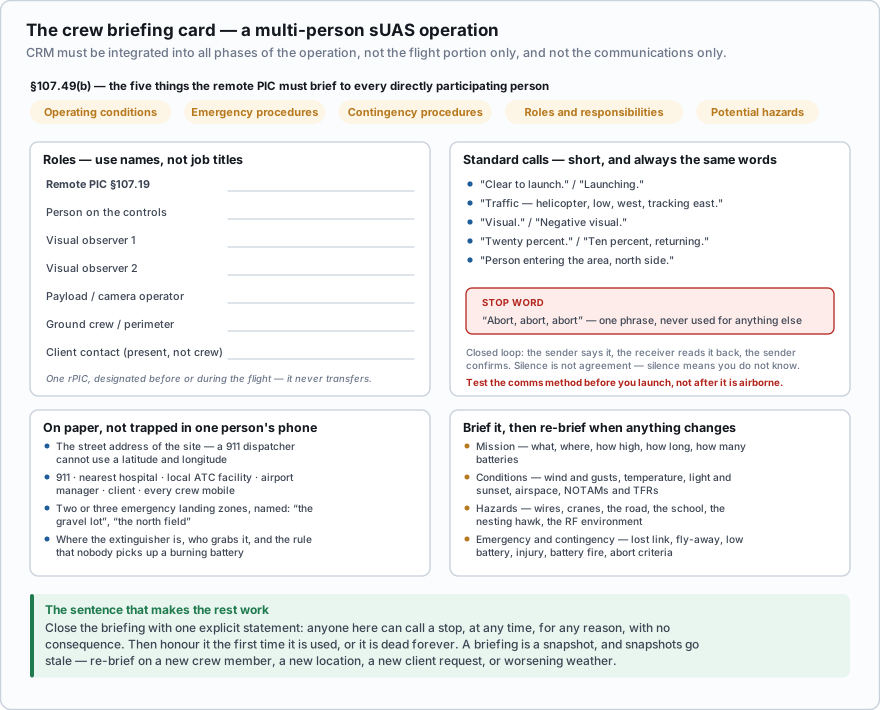
Write your VO phraseology down before the job and use it every time: traffic, three o'clock, low, closing beats hey, there is a plane. Agree on one word that stops the flight instantly — many crews use abort — and agree that anyone on the crew may say it without explaining first.
- Visual line of sight requires unaided vision, corrective lenses excepted, sufficient to know location and determine attitude, altitude, and direction of flight, scan for hazards, and confirm the flight endangers no one
- VLOS may be exercised by the remote PIC and the person flying together, or by a visual observer — which is what makes FPV flight legal
- When a VO is used, the crew must maintain effective communication at all times, the remote PIC must ensure the VO can see the aircraft, and all must coordinate to scan and track it
- No person may operate more than one unmanned aircraft at a time, and no small unmanned aircraft may carry hazardous material as defined in 49 CFR 171.8
- Automated flight is permitted, but the remote PIC must retain the ability to direct the aircraft and remains responsible for every limit
- Carriage of another's property for hire is allowed only intrastate, under 55 pounds total, with no hazmat — and no § 107.31 or § 107.25 waiver may authorize it
- Transponders must be off and ADS-B Out must not be in transmit mode unless the FAA authorizes otherwise