Track your progress, take practice exams, and study the flashcards in the app.
1.3 The Remote PIC: Authority, Responsibility, and Who May Fly
- State the remote PIC's five duties under § 107.19 and explain what final authority means in practice
- Identify who may legally manipulate the flight controls of a small UAS
- List the eligibility requirements for a remote pilot certificate and the steps to obtain one
Every Part 107 flight has exactly one remote pilot in command. Not a committee, not the client, not the person holding the controller if that is someone else. One person is answerable for the flight, and if you hold the certificate on a job site, that person is you.
What § 107.19 actually says
The section is five short paragraphs, and the exam draws from all of them.
- (a) A remote PIC must be designated before or during the flight. Naming one afterward, when something has gone wrong, is not an option.
- (b) The remote PIC is directly responsible for, and is the final authority as to, the operation of the small UAS.
- (c) The remote PIC must ensure the aircraft will pose no undue hazard to other people, aircraft, or property in the event of a loss of control for any reason.
- (d) The remote PIC must ensure the operation complies with all applicable regulations of the chapter — not only Part 107.
- (e) The remote PIC must have the ability to direct the small unmanned aircraft to ensure compliance.
Paragraph (c) deserves a second read. The standard is not that you will not lose control. The standard is that if you lose control — battery failure, motor failure, radio interference, a bird strike — the aircraft still poses no undue hazard. That is a planning requirement. It is why you position yourself so the aircraft is never directly over the crowd, why you choose a takeoff point that is not in a parking lot, and why you know before you launch where a dead aircraft would fall.
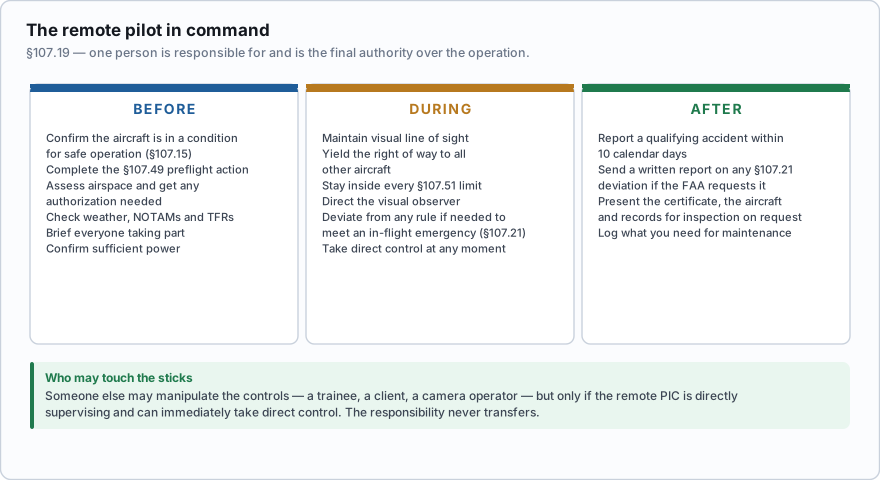
Final authority means you can say no
Final authority is a legal term with a practical edge. Your client wants one more pass at dusk in gusting wind. Your site foreman wants you over the active crane. Your employer wants the shot. Section 107.19(b) makes you the person who decides, and § 107.23 makes you the person who answers for it if the decision was careless. Nobody who pressures you into a bad flight will be named on the enforcement action.
You are shooting a construction progress set. The superintendent asks you to hover over the crew pouring a slab so the client can see the finish work. Your aircraft is a 5-pound quad with no operations-over-people category. The correct answer is no, and the correct next sentence is an alternative: you can shoot the same slab obliquely from 60 feet to the side, or you can shoot it in ten minutes when the crew breaks for lunch. Final authority is easier to exercise when you arrive with a plan B.
Who may touch the controls
Section 107.12 answers this and it surprises people. A person may manipulate the flight controls of a small UAS if either of the following is true:
- That person holds a remote pilot certificate with a small UAS rating and meets the recency requirements of § 107.65; or
- That person is under the direct supervision of a remote PIC, and the remote PIC has the ability to immediately take direct control of the aircraft.
The second path is real and useful. You can hand the controller to an untrained client, a student, or a crew member as long as you are supervising and can take over at once — typically through a dual-controller trainer link, or by taking the controller back. Handing someone a controller and walking away is not supervision. Standing beside them with a slave controller and your thumb near the override is.
The point that matters most: delegating the sticks does not delegate the responsibility. You remain the remote PIC. Everything that person does with your aircraft lands on your certificate.
A certificated remote PIC lets an uncertificated colleague fly the aircraft during a survey. Which statement is correct?
- This is prohibited — only a certificate holder may manipulate the controls
- This is allowed if the remote PIC directly supervises and can immediately take direct control, and the remote PIC remains responsible for the operation
- This is allowed only if the colleague has passed TRUST
Answer: B. Section 107.12(a)(2) permits an uncertificated person to manipulate the controls under the direct supervision of a remote PIC who has the ability to immediately take direct control. TRUST is the recreational test and has no role under Part 107. The remote PIC keeps full responsibility under § 107.19.
Two conditions you must verify before every flight
Condition for safe operation — § 107.15. No person may operate a small UAS unless it is in a condition for safe operation, and prior to each flight the remote PIC must check the aircraft to determine that it is. The rule then adds a second, continuous duty: no person may continue flight when he or she knows or has reason to know the aircraft is no longer in a condition for safe operation. A vibration that starts mid-flight, a battery warning, a control surface that stops responding cleanly — the flight ends.
Medical condition — § 107.17. No person may manipulate the controls, or act as remote PIC, visual observer, or direct participant, if that person knows or has reason to know of a physical or mental condition that would interfere with the safe operation of the small UAS. Note the breadth: it reaches the VO and the crew, not only the pilot.
- Part 107 requires no medical certificate — no third-class medical, no flight physical, no doctor's signature. It requires self-assessment under § 107.17.
- The § 107.17 standard is knows or has reason to know. Ignorance you should have cured is not a defense.
- The remote PIC must be designated before or during the flight, and is the final authority.
- An uncertificated person may fly under direct supervision with the remote PIC able to immediately take direct control.
A common wrong answer says a remote pilot must hold at least a third-class medical certificate, or must be examined by an Aviation Medical Examiner. Neither is true. Part 107 substitutes a self-assessment duty for the medical certificate, and that duty extends to visual observers and direct participants — people who could never hold a pilot medical in the first place.
Getting the certificate: eligibility and the path
Section 107.61 sets four eligibility requirements. Subject to the alcohol and drug provisions of §§ 107.57 and 107.59, a person must:
- Be at least 16 years of age;
- Be able to read, speak, write, and understand the English language — if a medical condition prevents one of these, the FAA may issue with operating limitations;
- Not know or have reason to know of a physical or mental condition that would interfere with safe operation; and
- Demonstrate aeronautical knowledge by passing the initial knowledge test, or — if the applicant holds a Part 61 pilot certificate other than student pilot and has a current § 61.56 flight review — by completing the § 107.74 online training.
You may take the test at 14 but you cannot hold the certificate until 16. Those are two different ages and the exam knows it.
The path after you pass looks like this: your Airman Knowledge Test Report is valid for 24 calendar months. You file FAA Form 8710-13 through IACRA, using the FAA Tracking Number you created before the test. The TSA runs a security threat assessment. When it clears, you can print a temporary certificate — valid for up to 120 calendar days under § 107.64 — and the permanent plastic card arrives by mail. The certificate itself never expires; what expires is your knowledge recency, covered in Lesson 1.10.
What is the minimum age to be issued a remote pilot certificate with a small UAS rating?
- 14 years old
- 16 years old
- 18 years old
Answer: B. Section 107.61(a) requires the applicant to be at least 16 years of age. A person may sit the knowledge test at 14, but the certificate cannot be issued until 16.
Put your remote PIC designation in writing on multi-person jobs. A one-line entry in the crew briefing — name, certificate number, the phrase remote pilot in command — costs nothing and removes any argument later about who was in charge. It also forces the conversation on jobs where a client assumes their staff member is running the flight.
- A remote PIC must be designated before or during every flight and is directly responsible for, and the final authority as to, the operation
- The remote PIC must ensure the aircraft poses no undue hazard to people, aircraft, or property even in the event of a loss of control
- An uncertificated person may manipulate the controls under the direct supervision of a remote PIC who can immediately take direct control — responsibility stays with the remote PIC
- Section 107.15 requires a preflight check for condition for safe operation and requires the flight to stop if the aircraft is no longer safe
- Section 107.17 bars anyone who knows or has reason to know of a disqualifying physical or mental condition from acting as remote PIC, VO, direct participant, or control manipulator — there is no medical certificate requirement
- Eligibility under § 107.61: at least 16 years old, English proficient, no disqualifying condition, and pass the initial knowledge test or complete the § 107.74 training as a current Part 61 pilot