Track your progress, take practice exams, and study the flashcards in the app.
1.2 Registration & Marking (Parts 47 & 48)
- Determine whether a given aircraft must be registered, and under Part 48 or Part 47
- State the registration fee, the term of validity, and the minimum age of the registrant
- Apply the § 48.205 marking requirements to a real aircraft
Registration is the least glamorous requirement in Part 107 and one of the most heavily tested. It is also the one that most often catches working pilots out, because the rule that applies to your hobby drone is not the rule that applies to the same drone the moment you fly it for work.
Section 107.13 handles it in a single line: a small unmanned aircraft operated under Part 107 must be registered in accordance with § 91.203(a)(2) — which means it must have a valid Certificate of Aircraft Registration and you must be able to produce it.
Which aircraft must be registered
A registration is not a permission to fly and it is not a certificate of airworthiness. It is a record tying a specific aircraft to a specific responsible person, so that a drone recovered from a roof or a runway can be traced back to somebody.
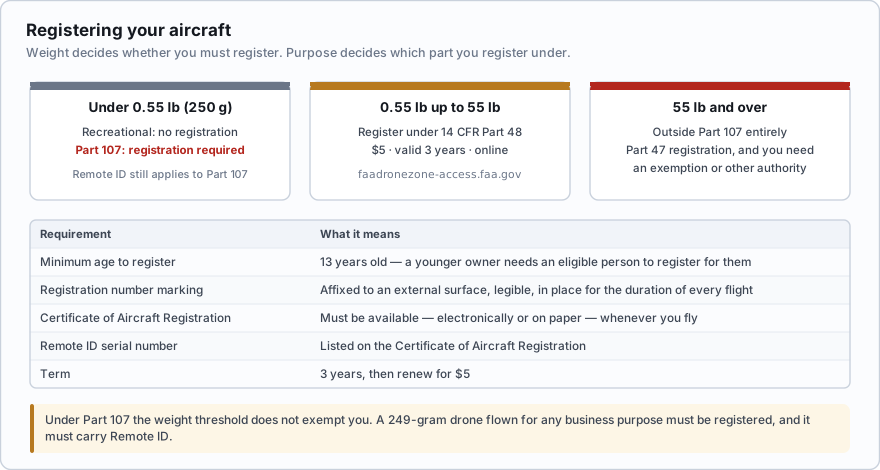
Start with the threshold everyone quotes: 0.55 pounds, which is 250 grams. Then read the exemption carefully, because the wording matters.
Registration is not required for a small unmanned aircraft that weighs 0.55 pounds or less on takeoff, including everything on board or attached — and that is operated exclusively in compliance with 49 U.S.C. § 44809, the recreational exception.
Both halves must be true for the exemption to apply. A 249-gram drone flown for fun does not need to be registered. The same drone flown under Part 107 does. There is no weight floor for commercial work. If you are flying under Part 107, register the aircraft no matter how little it weighs.
At the other end, 55 pounds is the ceiling for Part 48 online registration. An aircraft weighing 55 pounds or more at takeoff is not a small unmanned aircraft at all and must be registered under Part 47, the traditional aircraft registration process — paper application, N-number, the whole manned-aircraft procedure.
Part 48 versus Part 47
Part 48 is the online small-UAS registry you reach through FAADroneZone. It is designed for exactly what you are doing. Three situations push you out of Part 48 and into Part 47 even for a small aircraft:
- The aircraft will be operated outside the territorial airspace of the United States.
- The aircraft is registered through a trust or voting trust.
- The registrant wants a traditional N-number for the aircraft, or the aircraft weighs 55 pounds or more.
The numbers to memorize
- $5.00 per aircraft to issue or renew a Certificate of Aircraft Registration (§ 48.30).
- The certificate expires 3 years after the date of issue unless renewed (§ 48.100).
- The registrant must be at least 13 years of age. If the owner is younger, an adult of at least 13 must register it for them (§ 48.25).
- Under § 48.20 the aircraft must not be registered under the laws of a foreign country, and must be owned by a U.S. citizen, a lawful permanent resident, a qualifying U.S.-organized corporation, or a U.S. government entity.
- 0.55 pounds or less and flown exclusively under § 44809 is the only registration exemption. Part 107 flights have none.
One structural difference is worth its own sentence, because it is a favorite exam distinction. Under the recreational exception, one registration number covers all the aircraft you own. Under Part 107, each aircraft is registered individually and receives its own registration number. Fly three drones commercially and you pay three times five dollars and manage three certificates.
You buy a 240-gram (0.53 lb) drone to shoot progress photos of a construction site for your employer. What must you do?
- Nothing — it is under the 0.55 pound threshold
- Register it under Part 48 and mark it, because the weight exemption applies only to purely recreational flights
- Register it under Part 47 because it will be used commercially
Answer: B. The § 48.15 exemption requires both that the aircraft weigh 0.55 pounds or less and that it be operated exclusively under the recreational exception. A Part 107 flight fails the second condition, so the aircraft must be registered under Part 48 regardless of weight.
Marking the aircraft
Once registered, the aircraft gets a unique identifier — either the registration number issued by the FAA or, if you prefer, the manufacturer's serial number if you supplied it during registration. Section 48.205 tells you what to do with it, in three short requirements.
(a) The unique identifier must be maintained in a condition that is legible. (b) It must be affixed by any means necessary to ensure it remains affixed for the duration of each operation. (c) It must be legibly displayed on an external surface of the small unmanned aircraft.
External surface is the operative phrase. The original 2015 rule let you tuck the number inside a battery compartment as long as it could be reached without tools. The FAA closed that option in February 2019 so first responders approaching a downed or suspicious drone would not have to open anything to identify it. Write it on the outside, where somebody can read it without touching your aircraft.
There is no required font size, color, or location. A permanent marker on the underside of the shell, an engraved plate, or a printed label all satisfy the rule. What fails is a number that has rubbed off, peeled away in flight, or been covered by a sticker or a landing pad.
Students remember a phrase from the old rule — that the marking could be inside a compartment accessible without tools — and pick that answer. The current requirement is an external surface, legible, and affixed for the whole operation. If an option mentions an interior compartment, it is wrong.
Carrying the certificate
Section 91.203(a)(2), pulled in by § 107.13, requires the Certificate of Aircraft Registration to be available for inspection. For a small UAS the FAA accepts an electronic copy — a PDF on your phone counts. Keep one on every job. Law enforcement, an FAA inspector, or a site manager can ask, and "it is at home" is not an answer that helps you.
The registration also feeds Remote ID, which you will meet in Lesson 1.9. When you fly with standard Remote ID or a broadcast module, the serial number of the aircraft or module must be listed on the Certificate of Aircraft Registration. You enter it in FAADroneZone. A drone that broadcasts a serial number the FAA cannot tie to a registration is not compliant.
Where must a small unmanned aircraft's serial number be listed when the operator complies with Remote ID using a broadcast module?
- On the manufacturer's Declaration of Compliance
- On the Certificate of Aircraft Registration
- In the remote pilot's logbook
Answer: B. The serial number of the standard Remote ID aircraft or of the broadcast module must appear on the aircraft's Certificate of Aircraft Registration. The Declaration of Compliance is the manufacturer's filing, and Part 107 requires no logbook at all.
Set a calendar reminder for month 34 of your three-year registration. An expired registration is an easy, avoidable violation, and FAADroneZone renewal takes about four minutes. If you fly a fleet, register everything on one FAADroneZone account so the expirations show on a single screen.
Registration is paperwork you do once every three years. The next lesson is about the thing you carry into every single flight: the authority and the responsibility of the remote pilot in command.
- Under Part 107, every aircraft must be registered regardless of weight — the 0.55-pound exemption applies only to aircraft flown exclusively under the recreational exception
- Part 48 online registration costs $5.00 per aircraft and is valid for 3 years; the registrant must be at least 13 years old
- Part 47 registration is required at 55 pounds and above, for operation outside U.S. territorial airspace, and for aircraft registered through a trust
- Part 107 registers each aircraft individually; recreational registration covers all of one person's aircraft under a single number
- The unique identifier must be legible, affixed for the duration of each operation, and displayed on an external surface — not inside a compartment
- The Certificate of Aircraft Registration must be available for inspection, and it is where the Remote ID serial number is recorded