Track your progress, take practice exams, and study the flashcards in the app.
1.1 What Part 107 Covers — and What It Doesn't
- Determine whether a given flight falls under Part 107, the recreational exception, or neither
- State the four categories of operation that Part 107 explicitly does not cover
- Define the Part 107 terms the exam tests, including the 55-pound weight definition
Part 107 is the FAA's rulebook for flying a drone as anything other than a hobby. It is a chunk of federal regulation — 14 CFR Part 107 — and it is short enough to read in an evening. You will not have to recite it. You will have to know what it requires, what it forbids, and where its edges are. This lesson draws those edges.
Everything in this module builds on one question: does Part 107 apply to this flight? Get that wrong and every other rule you know is aimed at the wrong target.
The one-sentence version
You will meet the rule in three places: on the exam, in the authorization you request before a flight in controlled airspace, and in the enforcement action that follows a flight that went wrong. All three read the same text.
Part 107 governs the registration, airman certification, and operation of civil small unmanned aircraft systems in the United States. Three words in that sentence are doing real work.
- Civil means privately owned and operated — your drone, your client's drone, your employer's drone. It excludes public aircraft operations flown by a government entity under a Certificate of Waiver or Authorization, and it excludes military aircraft.
- Small means the aircraft weighs less than 55 pounds on takeoff, including everything that is on board or otherwise attached to it. Camera, gimbal, batteries, payload, prop guards, the parachute you bolted on — all of it counts.
- Unmanned aircraft system means the aircraft plus everything required to fly it safely: the control station, the communication links, the software.
Part 107 applies to the registration, airman certification, and operation of civil small unmanned aircraft systems within the United States — except as provided in paragraph (b).
The four things Part 107 does not cover
Section 107.1(b) lists four kinds of operation that sit outside the rule. Memorize the list; the exam likes to ask which of several operations is not conducted under Part 107.
- Air carrier operations. Scheduled or common-carriage passenger and cargo work belongs to Parts 119, 121, and 135.
- Aircraft operated under 49 U.S.C. § 44809 — the recreational flyer exception. This is the big one for you, and it is covered below.
- Operations under a Section 333 exemption or 49 U.S.C. § 44807, unless the exemption itself says Part 107 applies. These are case-by-case FAA grants, usually for aircraft or operations Part 107 cannot accommodate.
- Part 91 operations of a small UAS that holds an airworthiness certificate. If the aircraft has been type- and production-certificated like a manned airplane, it can be flown under the general operating rules of Part 91 instead.
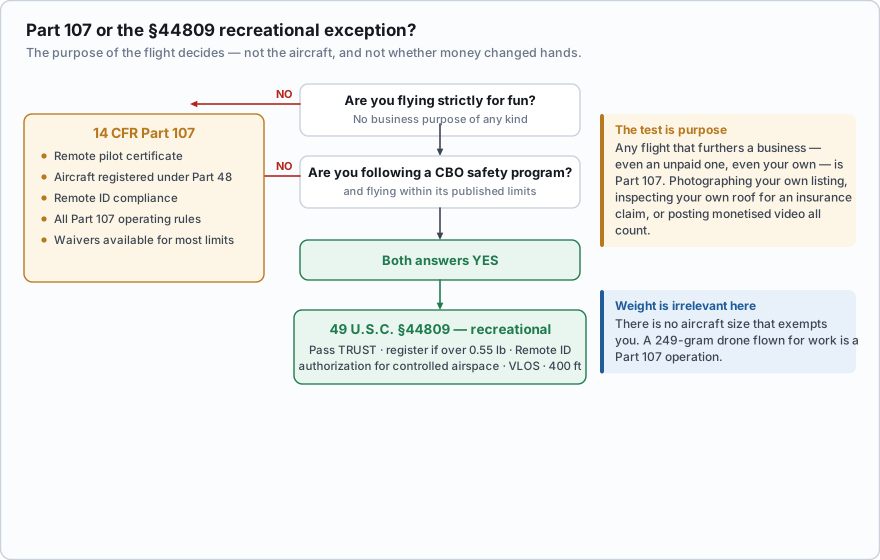
Recreational or commercial? Purpose decides, not payment
The recreational exception in 49 U.S.C. § 44809 lets you fly without a remote pilot certificate if — and only if — you meet every one of its conditions: the aircraft is flown strictly for recreational purposes, you follow the safety guidelines of an FAA-recognized community-based organization, you keep it within visual line of sight, you yield to manned aircraft, you get airspace authorization before entering controlled airspace, you stay at or below 400 feet in uncontrolled airspace, you have passed TRUST (The Recreational UAS Safety Test), and you carry proof of that plus your registration.
Notice what is missing from that list: money. Payment is not the test. Purpose is the test. If the flight furthers a business or professional interest in any way, it is a Part 107 flight, even if nobody hands you a dollar.
You fly over your own house on a Sunday to see the shingles because you are curious. That is recreational — § 44809 applies. You fly over the same roof to produce photos for the insurance claim you are filing. That is not recreation; it is Part 107. Your neighbor asks you to photograph her roof for free because you are the guy with the drone, and you post the shots on your handyman page. Free, friendly, and still Part 107 — the flight furthered a business.
A real estate agent's friend flies a drone over a listed house and gives the photos to the agent at no charge. Under which rule was the flight conducted?
- 49 U.S.C. § 44809, because no money changed hands
- 14 CFR Part 107, because the flight furthered a business purpose
- Neither — flights on private property are unregulated
Answer: B. The recreational exception requires the flight be strictly for recreational purposes. Producing marketing imagery for a business is a non-recreational purpose regardless of payment, so Part 107 applies and the pilot needs a remote pilot certificate.
The definitions the FAA tests
Section 107.3 defines a handful of terms, and the test writers quote them almost word for word. Read these once carefully now; you will meet them constantly.
| Term | Definition |
|---|---|
| Unmanned aircraft | An aircraft operated without the possibility of direct human intervention from within or on the aircraft. |
| Small unmanned aircraft | An unmanned aircraft weighing less than 55 pounds on takeoff, including everything that is on board or otherwise attached to the aircraft. |
| Small UAS | A small unmanned aircraft and its associated elements — including communication links and the components that control the aircraft — required for safe and efficient operation in the national airspace system. |
| Control station | An interface used by the remote pilot to control the flight path of the small unmanned aircraft. |
| Visual observer | A person designated by the remote pilot in command to assist the remote PIC and the person manipulating the controls to see and avoid other air traffic or objects aloft or on the ground. |
| Corrective lenses | Spectacles or contact lenses. |
| Declaration of compliance | A record submitted to the FAA certifying that the aircraft conforms to the Category 2 or Category 3 requirements of Subpart D. |
- Less than 55 pounds on takeoff, including everything attached. Aircraft plus battery plus payload plus accessories.
- Corrective lenses = spectacles or contact lenses only. Binoculars, telephoto screens, and night-vision devices are not corrective lenses.
- A visual observer is designated by the remote PIC — the VO needs no certificate and holds no independent authority.
- Part 107 covers civil aircraft. Public (government) aircraft operations and military aircraft are outside it.
Two different numbers use the digits 5 and 5, and students swap them under time pressure. 55 pounds is the upper limit that makes an aircraft *small*. 0.55 pounds is the registration threshold and the Category 1 operations-over-people limit. If a question says 0.55, it is not talking about the definition of a small unmanned aircraft.
One more definitional point, because it explains why Category 4 in Lesson 1.8 looks so different from the rest. Section 107.2 says the aircraft certification rules of Part 21 do not apply to a small UAS operated under Part 107 — unless that aircraft will be flown over human beings under § 107.140. That single exception is the reason Category 4 requires an airworthiness certificate and the other three categories do not.
Which of these qualifies as a small unmanned aircraft under § 107.3?
- A 53-pound airframe carrying a 4-pound sensor pod
- A 48-pound airframe carrying a 6-pound sensor pod
- A 52-pound airframe carrying a 5-pound spray tank
Answer: B. Add the payload first, then compare. Option A totals 57 pounds and option C totals 57 pounds — both are 55 or more, so neither is a small unmanned aircraft. Option B totals 54 pounds, which is less than 55 including everything attached.
You will hear about Part 108 and beyond-visual-line-of-sight rules. As of now Part 108 is a proposed rule only — an NPRM published in August 2025 whose comment period has closed. It is not law, it is not on the exam, and nothing in it authorizes a flight today. Until a final rule is published, BVLOS is available only through a § 107.31 waiver or a § 44807 exemption.
That is the boundary drawn. Everything from here forward assumes you have answered yes to the question that opened this lesson: Part 107 applies to this flight. Next comes the paperwork the rule requires before the aircraft ever leaves the ground.
- Part 107 governs civil small UAS — under 55 pounds at takeoff including everything attached — operated for any purpose other than pure recreation
- Part 107 does not apply to air carrier operations, § 44809 recreational flights, § 333 / § 44807 exemption operations, or Part 91 flights of an airworthiness-certificated small UAS
- Purpose, not payment, separates recreational flying from Part 107 flying — unpaid work that furthers a business is still Part 107
- Recreational flyers must pass TRUST, follow CBO safety guidelines, and meet every other § 44809 condition or they fall back under Part 107
- Learn the § 107.3 definitions verbatim: unmanned aircraft, small unmanned aircraft, small UAS, control station, visual observer, corrective lenses
- Part 21 airworthiness certification does not apply to Part 107 aircraft except for Category 4 operations over people