Track your progress, take practice exams, and study the flashcards in the app.
0.4 Your Study Plan
- Use the diagnostic quiz to set a personalised module order
- Describe how the weak-area engine and the flashcard deck fit into a weekly routine
- State the readiness gate that tells you it is time to book the exam
You have a plan length. Now here is how to spend it. The short version: take the diagnostic, work the modules in order, let the weak-area engine steer your review, drill flashcards in the gaps of your day, and do not book the exam until you clear the readiness gate. The rest of this lesson explains each of those.
Start with the diagnostic
Before Module 1, take the 15-question diagnostic. It is deliberately short and deliberately spread across all five ACS areas. You are expected to do badly on it - that is the point. It is not a score, it is a map.
The diagnostic produces two things. First, a recommended module order: if you already read charts because you sail or hunt, airspace may drop down your list; if you have a pilot in the family and know your METAR codes, weather moves later. Second, it seeds the coverage heat map on your dashboard, so from day one you can see which ACS codes are cold, warm, and mastered.
The default module order, and when to change it
- Module 1, Regulations. First, always. Everything else references it, and the vocabulary you build here makes the other modules readable.
- Module 2, Airspace and Chart Reading. Second, because it is the hardest for most people and you want maximum time to let it settle. Budget more days here than the module length suggests.
- Module 3, Weather. Largely self-contained and heavily memorization-based, so it responds well to flashcards.
- Module 4, Loading and Performance. Short. Do it in a single sitting if you can; the four lessons build on each other.
- Module 5, Operations. The biggest module and the biggest share of the exam. It comes late because it leans on airport and airspace vocabulary from Module 2.
- Module 6, Exam Preparation. The last week: registration, test day, cram sheet, chart drill, and the mock exams.
One legitimate reason to deviate: if your plan gets compressed and you are going to run out of time, move Module 5 ahead of Module 3. Operations is 35 to 45 percent of the exam and Weather is 11 to 16 percent. If something has to be short-changed, it should not be the biggest area on the test.
Your four-week plan slips and you have only ten days left. Which module should you protect first?
- Module 3, Weather
- Module 5, Operations
- Module 4, Loading and Performance
Answer: B. Operations is 35 to 45 percent of the exam - roughly 24 questions. Weather is 11 to 16 percent and Loading and Performance is 7 to 11 percent. When time is short, protect the area with the most points on it.
A worked four-week schedule
| Week | Weekdays | Weekend |
|---|---|---|
| 1 | Module 0 (one sitting), then Module 1 lessons 1.1 to 1.10 with the quiz after each | Module 1 exam, then re-drill every missed code |
| 2 | Module 2 lessons 2.1 to 2.11 - two lessons a night, and open the training sectional every single time | Chart Reading Lab, then the Module 2 exam |
| 3 | Module 3 lessons 3.1 to 3.10, then all four Module 4 lessons | METAR/TAF decoder drill, Module 3 and Module 4 exams |
| 4 | Module 5 lessons 5.1 to 5.12 - three nights of Operations, one night of Module 6.1 to 6.3 | Mock exam 1, review, mock exam 2, chart drill, book the test |
How to work a single lesson
Read the objectives at the top before the body. They are short, and they tell your brain what to look for, which measurably improves what you retain. Then read the lesson straight through without stopping to take notes - notes on a first pass mostly transcribe rather than think. Answer the inline checks honestly as you meet them; if you get one wrong, reread the paragraph above it before moving on.
When you finish the body, cover the summary bullets and try to state them from memory before you read them. Then take the lesson quiz. If you score below 80 percent, do not go on to the next lesson - reread the sections tied to the codes you missed and retake it. Moving forward on a shaky lesson is how a small gap in Module 2 becomes a failed chart question in Module 6.
Let the weak-area engine do the steering
Every question in this course carries an ACS knowledge code. When you miss one, the app records the code, not only the question. Over a week that builds a precise picture: you might be solid on airspace classes but consistently missing altitude boxes, or fine on regulations but weak on the operations-over-people categories.
The dashboard turns that picture into a custom drill - a quiz generated only from your weakest codes. Run one at the end of every study session, ten questions, five minutes. This is the highest-value five minutes in your day, because it is the only study time that is guaranteed to be aimed at something you do not already know.
The comfortable mistake is re-reading the module you already understand because it feels good to get things right. That is not studying, it is reassurance. If your heat map is green on Regulations and amber on Operations, the amber is where the points are. Trust the map over the feeling.
Flashcards are for the numbers
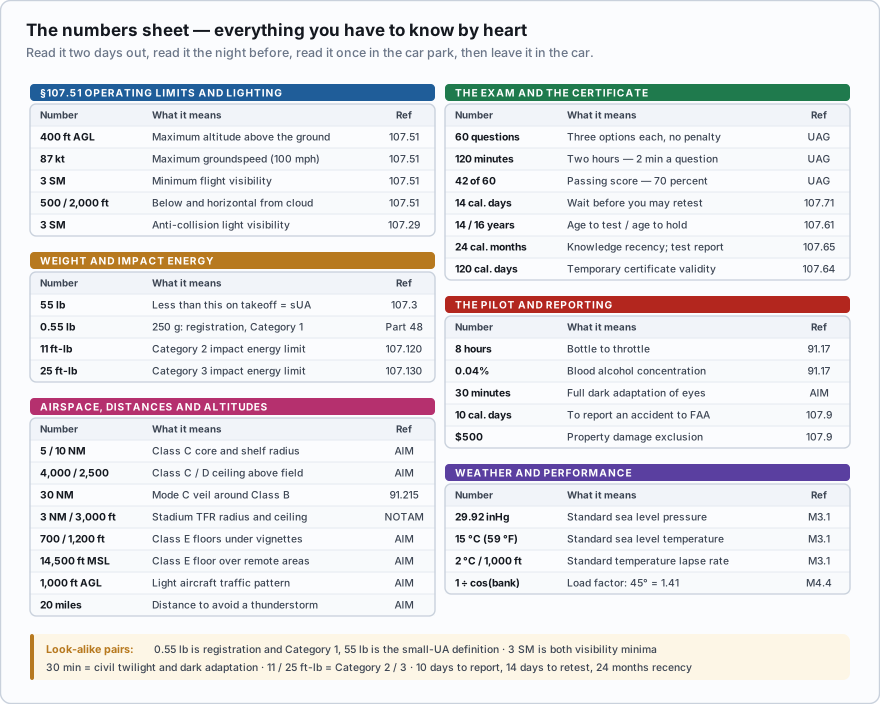
A large slice of this exam is raw recall: 400 feet, 87 knots, 3 statute miles, 500 below and 2,000 horizontal, 55 pounds, 0.55 pounds, 11 and 25 foot-pounds, 30 minutes, 8 hours, 0.04 percent, 10 days, $500, 24 calendar months, 14 days. You cannot reason your way to these. You can only have them or not have them.
The flashcard deck uses spaced repetition - cards you get right come back less often, cards you miss come back tomorrow. Five minutes waiting for coffee, five minutes at lunch. Fifteen minutes a day of flashcards over four weeks will hand you every number on the test, and it costs you no study time at all because it fits in dead time.
- Book your exam when you have scored 85% or better on two consecutive full-length mock exams
- The mocks are 60 questions, 120 minutes, drawn in the FAA's published area proportions, with no feedback until you submit
- 85% on a mock corresponds to roughly 51 of 60 - a 15-point cushion above the 42 you need
- Two consecutive, not two out of three. One good score can be luck; two in a row is a level
- If you clear the gate, stop studying new material and rest. Cramming the night before costs you more in fatigue than it gains you in recall
Why 85 and not 70? Because a mock exam at home is easier than the real thing - you are relaxed, the room is quiet, and you have seen the question style before. A 15-point cushion absorbs test-day nerves, an unfamiliar chart plate, and the two or three questions that will be worded in a way you did not expect. People who book at 72 percent on their mocks are the people who retest in fourteen days.
You score 88% on mock exam 1 and 79% on mock exam 2. What does the readiness gate say?
- You are ready - your average is above 80%
- Not yet - you need 85% or better on two consecutive mocks
- You are ready, because both are above the 70% pass mark
Answer: B. The gate is 85% on two consecutive mocks, not an average and not a single good result. The 79% tells you something is still soft. Run a weak-area drill on the codes you missed, then take mock 3.
Beyond the test: keep the flashcard deck after you pass. The recency requirement comes around every 24 calendar months, and the numbers you drilled for the exam - cloud clearance, reporting thresholds, kinetic energy limits - are the numbers you will actually use on a job site when a client asks whether something is legal. The deck stops being exam prep and becomes a reference you already have in your head.
That is the whole method. Diagnostic, modules in order, quiz after every lesson, weak-area drill at the end of every session, flashcards in the dead time, and two mocks at 85 percent before you book. Start Module 1.
- Take the 15-question diagnostic first; it produces a recommended module order and seeds your ACS coverage heat map
- Default order is Modules 1 through 6; if time gets short, move Module 5 (Operations) ahead of Module 3 (Weather)
- Run a weak-area drill of ten questions at the end of every study session - it is the only study aimed purely at what you do not know
- Use the spaced-repetition flashcards for pure-recall numbers in the dead time of your day
- The readiness gate is 85% on two consecutive full-length mock exams, not an average and not a single result
- Once you clear the gate, stop learning new material and rest before test day