Track your progress, take practice exams, and study the flashcards in the app.
0.3 The Exam, Demystified
- State the format, scoring, cost, and validity rules of the UAG knowledge test
- Interpret the FAA published area percentages and convert them into study priorities
- Describe the FAA-CT-8080-2H supplement and how it is used during the exam
Uncertainty is what makes a test frightening, so let us remove it. By the end of this lesson you will know precisely what the exam contains, how it is scored, what is handed to you, and what happens if it goes badly.
- 60 questions, multiple choice, three options each, exactly one correct
- 120 minutes - two minutes per question
- 70% to pass = 42 correct of 60. You may miss 18
- About $175, paid to the testing center, not to the FAA
- Taken at a PSI testing center - roughly 800 FAA-approved Knowledge Testing Centers nationwide
- No penalty for guessing. An unanswered question and a wrong answer score the same, so answer every one
- FAA-CT-8080-2H, the Airman Knowledge Testing Supplement, is handed to you at the center. You do not bring your own
- Fail, and you may retest after 14 calendar days
- Pass, and your Airman Knowledge Test Report is valid for 24 calendar months
Where the 60 questions come from
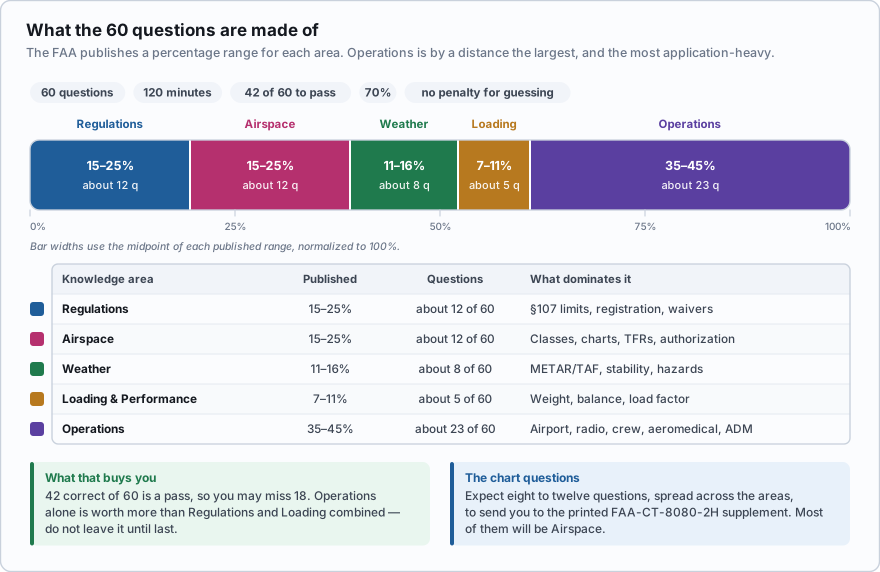
| ACS area | Share of the test | Approx. questions | Course module |
|---|---|---|---|
| I. Regulations | 15 to 25% | about 12 | Module 1 |
| II. Airspace and operating requirements | 15 to 25% | about 12 | Module 2 |
| III. Weather | 11 to 16% | about 8 | Module 3 |
| IV. Loading and performance | 7 to 11% | about 5 | Module 4 |
| V. Operations | 35 to 45% | about 24 | Module 5 |
Read that table again, because it should change how you budget your time. Operations is nearly half the exam. It covers radio communications and the phonetic alphabet, airport operations and traffic patterns, runway markings and lighting, emergency procedures and lithium batteries, radio frequency interference, aeronautical decision-making, crew resource management, physiology and vision, and maintenance and preflight inspection. Most people expect the test to be mostly regulations. It is not.
Loading and performance is the smallest area at 7 to 11 percent, which is roughly five questions. That is not nothing, and Module 4 is short, so it is the cheapest module in the course in points-per-hour. Do not skip it because it looks like physics.
One more note on the weighting. Airspace is 15 to 25 percent on paper, but chart reading shows up inside other areas too - a question tagged to Operations may still require you to read an airport data block off a sectional. Practically, chart skill is worth more than its published share, which is why this course drills it in three dedicated lessons plus a final drill in Module 6.
If you had one extra hour of study time and wanted the most likely point gain, where would you spend it?
- Regulations, because Part 107 is the basis of everything
- Operations, because it is 35 to 45 percent of the exam
- Loading and performance, because it involves calculations
Answer: B. Operations is roughly 24 of the 60 questions. Regulations matters and underpins the rest, but at 15 to 25 percent it carries about half the weight. Study by the FAA's published proportions, not by what feels most official.
The supplement book
Some questions refer to a figure - a sectional chart excerpt, a METAR, a load factor chart, a chart legend. Those figures are not on your screen in full detail. They are printed in a booklet called the Airman Knowledge Testing Supplement, FAA-CT-8080-2H, which the testing center hands you when you sit down. It is a physical book of plates, in color, shared across several airman tests, so most of it is irrelevant to you. The question tells you which figure to open.
The most useful single thing you can do outside this course is download FAA-CT-8080-2H free from faa.gov and practice against the actual plates. This course teaches you the skill of reading a chart, using a purpose-built training sectional. The supplement gives you the exact images you will see on the day. Using both is far better than using either alone.
Students lose points by reading the wrong part of a chart because they never handled the supplement before test day. The plates are dense, the excerpts are cropped oddly, and the area of interest is marked with a small numbered box that is easy to miss. Open the book at home first. Find figure 20, find area 3, and confirm you know what those numbered boxes look like.
What the questions actually look like
There are broadly four question shapes on this exam, and recognizing the shape tells you how to attack it. Straight recall questions ask for a number or a definition: the maximum groundspeed, the minimum flight visibility, what a declaration of compliance is. Regulatory application questions put you in a short scenario and ask what the rule requires: a client wants footage over a parade, a tower needs inspecting at 600 feet, a crew member had two beers at lunch. Figure questions send you to the supplement for a chart, a METAR, or a load factor graph. And judgment questions - almost all of them in the Operations area - describe a situation and ask which decision, attitude, or procedure applies.
The wording is plain. The FAA is not trying to trick you with grammar. Where questions are hard, it is because two of the three options are genuinely plausible and you need the specific fact to separate them - which is exactly why the Common trap boxes in this course name the wrong answer rather than only stating the right one.
Scoring, guessing, and pacing
The test is scored on correct answers only. There is no deduction for a wrong answer, which means a blank is strictly worse than a guess. With three options, a pure guess is a one-in-three shot. If you eliminate a single option you are at even money. Never hand back an unanswered question.
Two minutes per question sounds tight and is not. Most questions are pure recall and take fifteen seconds. Chart questions take two to four minutes. If you answer the recall questions quickly, you will have thirty to forty minutes left for the eight or ten chart items and a review pass. Module 6 gives you a full pacing strategy.
If it goes wrong, and what your result is worth
If you score below 70 percent, you may reapply for the test after 14 calendar days. You pay the fee again. Your report will list the ACS knowledge codes for the questions you missed, which is a precise study list - bring those codes back into the weak-area engine here and drill exactly those.
When you pass, you receive an Airman Knowledge Test Report. It is valid for 24 calendar months, which is the window in which you must complete your certificate application. Calendar months means the end of the month, not the day - a report dated 12 March 2026 is good through 31 March 2028. Almost nobody uses more than a week of that window, but it exists.
You are five minutes from time expiring and three questions remain unanswered. What do you do?
- Leave them blank rather than risk a wrong answer
- Answer all three, eliminating what you can and guessing among the rest
- Answer only the ones you are confident about
Answer: B. There is no penalty for a wrong answer on the UAG test. A blank scores zero with certainty; a guess among three options scores about a third of a point on average, and better than that if you can eliminate one. Answer every question.
Beyond the test: the FAA publishes 46 sample UAG questions and does not publish an answer key for them. They are genuine, they are in the public domain, and they are a good calibration tool. This course includes all 46 with worked explanations derived from primary sources, in Appendix G. They are a sample of style, not a leaked exam - do not treat memorizing them as a study plan.
- 60 questions, three options each, 120 minutes, 70% to pass - 42 correct, 18 allowed wrong, about $175 at a PSI center
- The FAA publishes the area weighting: Operations 35 to 45%, Regulations 15 to 25%, Airspace 15 to 25%, Weather 11 to 16%, Loading and Performance 7 to 11%
- Operations is nearly half the exam and deserves nearly half your study time
- Figures come from FAA-CT-8080-2H, handed to you at the center; download it free and practice with the real plates
- There is no penalty for guessing, so never leave a question blank
- Fail and you retest after 14 calendar days; pass and the test report is valid 24 calendar months