Track your progress, take practice exams, and study the flashcards in the app.
0.2 What the Part 107 Certificate Lets You Do
- Distinguish a Part 107 operation from a recreational operation under 49 U.S.C. 44809
- Apply the purpose-of-the-flight test to decide whether a given flight needs a Part 107 certificate
- List the operations Part 107 does not permit without a waiver
- Explain how state and local law layers on top of federal aviation law
There are exactly two lawful ways for a civilian to fly a drone in the United States. You either fly under 14 CFR Part 107 as a certificated remote pilot, or you fly under the recreational exception at 49 U.S.C. 44809. There is no third option, no gray zone, and no hobby loophole for someone who is being helpful to a business.
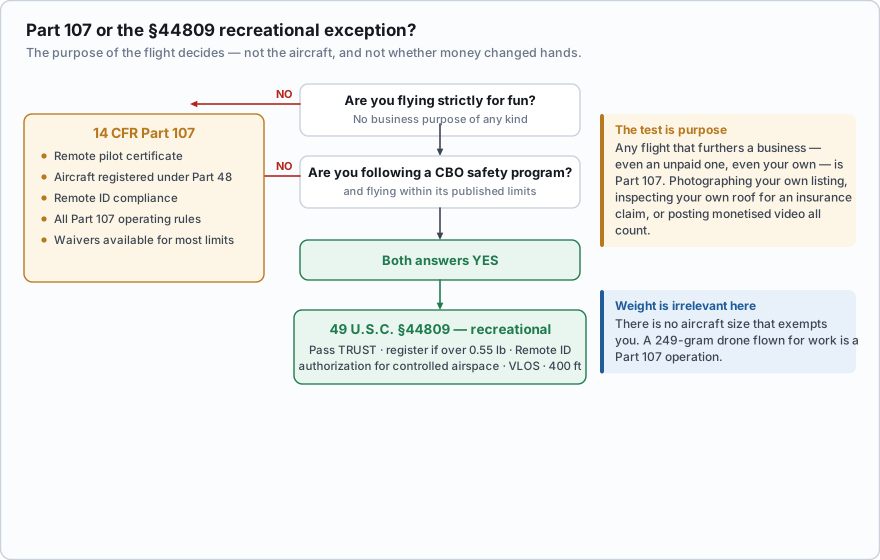
Part 107 against the recreational exception
| Part 107 | Recreational exception (49 U.S.C. 44809) | |
|---|---|---|
| Purpose of the flight | Any purpose, including business | Strictly recreational only |
| What you must pass | The UAG knowledge test at a testing center, about $175 | TRUST - The Recreational UAS Safety Test, free, online, cannot be failed |
| Certificate | Remote Pilot Certificate with sUAS rating, minimum age 16 | No certificate. You carry proof of TRUST completion |
| Registration | Every aircraft registered individually under Part 48, $5 for 3 years | One registration number covers all your recreational aircraft |
| Controlled airspace | Prior ATC authorization, normally through LAANC | Prior authorization required too, normally through LAANC |
| Altitude | 400 ft AGL, with the structure exception | 400 ft AGL in Class G, and per the authorization elsewhere |
| Operating rules | All of Part 107, and waivers are available | The safety guidelines of an FAA-recognized community-based organization; no waivers |
| Flying over people, at night, for pay | Possible within the rules or with a waiver | Not available |
TRUST is worth understanding even though you are not taking it. It is a free online test administered by FAA-approved organizations. You cannot fail it - if you answer wrong, it walks you through the correct answer and asks again. It never expires, and you must be able to present the completion certificate to the FAA or to law enforcement on request. It is a safety briefing, not a license, and it grants none of the privileges you are studying for.
Part 107 does not apply to air carrier operations, to any aircraft subject to 49 U.S.C. 44809, to operations under a section 44807 exemption unless the exemption says otherwise, or to small UAS operated under Part 91 with an airworthiness certificate. Everything else civil and under 55 pounds is Part 107.
What counts as commercial
This is the point people get wrong, and the FAA is unusually clear about it. The test is the purpose of the flight, not whether money changed hands. The statute says recreational operations must be flown strictly for recreational purposes. If the flight furthers a business in any way, it is not recreational, and it is a Part 107 operation - even if you were paid nothing, even if the business is your own, even if you are doing a friend a favor.
A realtor photographs her own listing with her own drone and posts the images with the listing. No money changed hands for the flight - but the flight furthered her business. Part 107. A roofer flies over a customer's house to check for hail damage before writing a quote, and does not charge for the flight. It furthered his business. Part 107. A hobbyist flies his quadcopter at the park on a Sunday, purely for fun, and posts the video to a personal account with no monetisation and no business tie. Recreational under 44809. The same hobbyist later sells that same video clip to a stock footage site. The flight was recreational when it happened, but the FAA treats the operation by its purpose - and if you intended to sell it, that intent makes it a Part 107 flight. Do not build a business on the theory that intent is unprovable.
The wrong answer people carry into the test - and into their business - is no money changed hands, so it was recreational. Compensation is not the test. Furthering a business at all, including your own, including a non-profit, including a favor for a client you hope to keep, puts the flight under Part 107.
A farmer flies his own drone over his own fields to check irrigation coverage. He sells nothing and pays no one. Under which rule is he operating?
- The recreational exception, because no money changed hands
- Part 107, because the flight furthers his business
- Neither, because he is flying over his own property
Answer: B. The purpose of the flight is agricultural business, not recreation. Compensation is irrelevant, and owning the land underneath does not change which federal rule applies. He needs a remote pilot certificate.
The work the certificate opens up
Part 107 work is not one job, it is a dozen small markets that mostly hire per project. The list below is what people are actually being paid to do. Treat the numbers as a picture of a typical United States market rather than a quotation - rates vary enormously by region, by deliverable, and by whether you are working direct or subcontracting for a national network.
| Work | What you deliver | Typical range |
|---|---|---|
| Real estate photography | 15 to 25 stills plus a short video for a residential listing | $150 to $400 per listing; $500 to $1,500 for luxury or commercial |
| Roof and property inspection | Annotated photo set, sometimes a damage report | $150 to $400 per residential roof; more for commercial or insurance work |
| Construction progress documentation | Monthly or biweekly site visit, consistent camera positions | $300 to $1,000 per visit, often on retainer |
| Mapping and survey | Orthomosaic, point cloud, volume calculation | $500 to $2,500 per site day depending on processing |
| Agriculture | Multispectral or NDVI field maps, stand counts | $2 to $10 per acre, scale-dependent |
| Infrastructure and tower inspection | High-resolution structured capture of a tower, bridge, or line | $300 to $800 per structure, frequently subcontracted |
| Film, television, and commercial | Cinema-quality aerial unit for a shoot day | $1,000 to $3,500 per day with a professional platform |
| Events and weddings | Aerial coverage cut into the main deliverable | $500 to $1,500 |
| Public safety and search and rescue | Scene documentation, thermal search, mapping | Usually a staff or volunteer role rather than contract work |
What Part 107 does not let you do
The certificate is broad but it is not unlimited. Each of these is prohibited by a specific section, and each of them is waivable - meaning the FAA can authorise it case by case if you apply and justify it. Until that certificate of waiver is in your hand, the prohibition stands.
- Flying beyond visual line of sight (107.31). You, or a visual observer, must be able to see the aircraft with vision unaided by anything but corrective lenses, for the whole flight. Binoculars may be used momentarily for situational awareness, never to extend your line of sight.
- Flying over people who are not participating and not sheltered (107.39). Unless the operation fits one of the four categories in Subpart D, or the people are directly participating, or they are under a covered structure or inside a stationary vehicle.
- Operating more than one aircraft at a time (107.35). One person, one aircraft. This applies to the remote pilot in command, to the person manipulating the controls, and to the visual observer.
- Operating from a moving vehicle (107.25) unless the flight is over a sparsely populated area and you are not transporting another person's property for compensation or hire. From a moving aircraft, never - and no waiver will be issued to allow carriage of another person's property for hire from a moving vehicle.
- Exceeding the 107.51 limits: above 400 feet AGL, faster than 87 knots groundspeed, in less than 3 statute miles of flight visibility, or closer than 500 feet below and 2,000 feet horizontally from a cloud.
- Flying in Class B, C, or D airspace, or in the surface area of Class E designated for an airport, without prior ATC authorization (107.41). In practice you get this in seconds through LAANC rather than by waiver.
- 107.205 lists exactly ten waivable sections. Among them: 107.25, 107.29(a)(2) and (b), 107.31, 107.33, 107.35, 107.37(a), 107.39, 107.41, 107.51, and 107.145
- Not waivable, ever: 107.12 certification, 107.15 condition for safe operation, 107.17 medical condition, 107.23 careless or reckless operation, 107.36 hazardous material, and 107.49 preflight familiarization
- Night flight no longer requires a waiver. It requires anti-collision lighting visible for 3 statute miles and a knowledge test or recurrent training completed after 6 April 2021
- Part 108, the proposed rule for beyond-visual-line-of-sight operations, is pending and is not law. Today, BVLOS requires a 107.31 waiver or a 44807 exemption
Which of these can a Part 107 remote pilot never obtain a waiver for?
- Operating two aircraft at the same time
- The preflight familiarization requirements of 107.49
- Flying above 400 feet AGL
Answer: B. Section 107.49 is not on the 107.205 list of waivable sections, so the FAA has no authority to waive it. Multiple aircraft (107.35) and the operating limitations (107.51) are both on the list and are routinely waived for qualified operators.
Federal law is not the only law
The FAA regulates the aircraft and the airspace. It does not regulate everything about your business. States, counties, cities, and landowners regulate what happens on the ground and what you do with the images - trespass, harassment, voyeurism, privacy statutes, commercial filming permits, and whether you may take off and land from a particular park or parking lot. Those rules are layered on top of Part 107, not replaced by it.
Two specifics that catch new pilots. National Park Service lands prohibit launching, landing, and operating a drone from within park boundaries. And many state parks, city parks, and school districts have their own launch-and-land bans. None of these are FAA rules, and none of them appear on your knowledge test - but a lawful Part 107 flight can still get you a citation from a park ranger. Before a job in an unfamiliar jurisdiction, check the airspace and then check the ground.
Beyond the test: get liability insurance before your first paid job. On-demand policies are inexpensive by the hour or by the day, and many commercial clients will not let you on site without a certificate of insurance naming them as additionally insured. This is not an FAA requirement and it will not be on the exam. It is the difference between a business and a hobby with invoices.
- Every civilian drone flight is either a Part 107 operation or a recreational operation under 49 U.S.C. 44809 - there is no third category
- The test for recreational is the purpose of the flight, not whether money changed hands; furthering a business at all makes it Part 107
- TRUST is a free, unfailable online safety test for recreational flyers and grants none of the Part 107 privileges
- Part 107 does not permit BVLOS, flight over unsheltered non-participants outside Subpart D, multiple aircraft, or operation from a moving vehicle outside a sparsely populated area - each requires a waiver
- Section 107.205 lists exactly ten waivable sections; 107.15, 107.17, 107.23, 107.36 and 107.49 are not among them
- State, local, and landowner rules govern takeoff, landing, trespass, and privacy on top of federal law