Track your progress, take practice exams, and study the flashcards in the app.
0.1 Welcome & How to Use This Course
- Describe what the Part 107 knowledge test is and why it is passable in 15 to 20 hours of study
- Choose one of the three study plans and commit to a finish date
- Explain how a lesson, a quiz, and a mock exam fit together in this course
You are here because you want to fly a drone for work. Maybe you are a photographer whose clients keep asking for aerials. Maybe you inspect roofs and you are tired of ladders. Maybe you farm, or sell houses, or shoot weddings, or run a construction site and want your own progress photos. Whatever brought you, the requirement is the same: to fly a drone for any purpose that is not strictly recreational, you need a Remote Pilot Certificate with a small UAS rating, and to get one you pass a 60-question multiple-choice test called the Unmanned Aircraft General - Small, or UAG.
Here is the first thing to understand, and it matters more than any fact in this course: this test is passable, and thousands of people with no aviation background pass it every month. You do not need to have flown an airplane. You do not need to know what a VOR is yet. You need to learn a defined body of material, most of which is memorization, some of which is chart reading, and none of which is beyond an adult who can concentrate for an hour at a time.
The people who fail are almost never the people who could not understand it. They are the people who skimmed, who never practiced on an actual sectional chart, or who studied the parts that felt interesting instead of the parts the FAA actually weights. This course is built to stop all three of those things from happening to you.
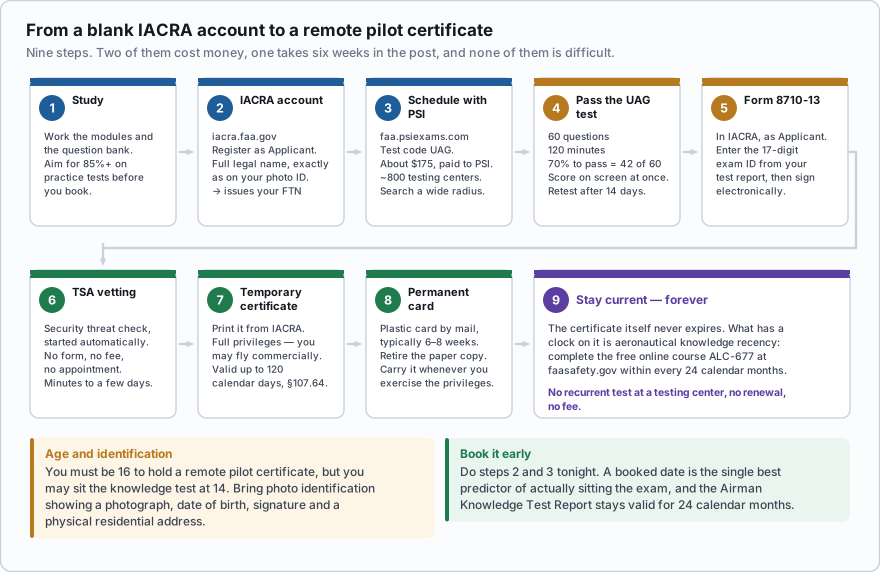
- 60 multiple-choice questions, three options each, exactly one correct
- 120 minutes - two full minutes per question
- 70% to pass, which is 42 of 60 correct. You can miss 18 questions and still pass
- About $175, paid to the testing center
- You must be 16 to hold the certificate; you may take the test at 14
- No penalty for a wrong answer, so you never leave a question blank
Pick a study plan and pick a date
Nothing predicts passing like having a test date on the calendar. Pick one of the three plans below, count forward, and schedule the exam now. You can reschedule if you need to. What you cannot do is study indefinitely toward a date that does not exist.
| Plan | Daily commitment | Length | Best for |
|---|---|---|---|
| 2-week sprint | about 2 hours a day | 14 days | You have a job waiting, or time off, and you can concentrate in long blocks |
| 4-week standard | about 1 hour a day | 28 days | Most people. Enough spacing to remember things, short enough to keep momentum |
| 8-week relaxed | about 30 minutes a day | 56 days | You have a full schedule, or you want the material to stick for the long term |
The 2-week sprint front-loads regulations and airspace, gives three solid days to chart reading, and spends the last three days entirely on practice exams. It works, but it is demanding and it assumes you will not miss a day.
The 4-week standard is the default recommendation. One module per week, with the weekend used for the module exam and for re-drilling anything you missed. Airspace and chart reading get the most room because that is where most people lose points.
The 8-week relaxed plan spends thirty minutes a day and leans hard on the flashcard deck. If you are the kind of person who learns by repeated short exposure rather than long sessions, this is your plan, and you will probably score higher than the sprinters.
You can miss how many questions on the UAG test and still pass?
- 12
- 18
- 6
Answer: B. Passing is 70% of 60 questions, which is 42 correct. 60 minus 42 leaves 18 you can get wrong. Knowing this changes how you feel walking in: you are not chasing perfection, you are clearing a bar.
How the course is organized
The FAA publishes a document called the Airman Certification Standards - FAA-S-ACS-10B - that lists every subject the test may cover, broken into five areas, each with a published percentage of the exam. This course is built directly on that document. Every lesson lists the specific knowledge codes it covers, and the dashboard shows you a live map of which codes you have mastered and which you have not touched.
- Module 0 - Start Here. What you are reading. Orientation, the exam, and your plan.
- Module 1 - Regulations. What Part 107 requires of you, your aircraft, and your crew.
- Module 2 - Airspace & Chart Reading. The largest single source of missed questions, and the biggest module after Operations.
- Module 3 - Weather. Reading a METAR, understanding stability, and knowing when not to fly.
- Module 4 - Loading & Performance. How drones fly, weight and balance, and the handful of calculations you will be asked to do.
- Module 5 - Operations. The biggest area on the test at 35 to 45 percent. Radio, airports, emergencies, decision-making, physiology, and maintenance.
- Module 6 - Exam Preparation. Registration, test day, the cram sheet, a final chart drill, and what happens after you pass.
Every lesson has the same shape. It opens with objectives and the ACS codes it covers. The body mixes prose with Know this cold boxes for pure memorization, Common trap boxes that name the specific wrong answer people pick, worked examples, and figures. Two or more knowledge checks are scattered through the text rather than piled at the end, because answering a question thirty seconds after reading something is what makes it stick. Each lesson closes with a short summary you can reread the night before the exam.
How the app works for you
- Per-lesson quizzes with an explanation on every option, not only the correct one.
- Module exams that pull from the whole module.
- Full-length mock exams: 60 questions, 120 minutes, no feedback until you submit, then a breakdown of exactly which ACS areas cost you points.
- The weak-area engine. Every question you miss is tagged by knowledge code. The dashboard builds you a custom drill from the codes you are weakest in, so your study time goes where it earns the most.
- Flashcards with spaced repetition for the pure-memorization numbers - altitudes, distances, times, and thresholds.
- Bookmarks, notes, and full-text search across every lesson, plus a printable view if you prefer paper.
The single most common way to waste study time is passive reading - moving your eyes over a lesson, nodding, and moving on. It feels productive and it produces almost nothing. Do the inline checks. Take the quiz even when you feel confident. Getting a question wrong in the app costs you nothing; getting it wrong at the testing center costs you $175 and fourteen days.
Which ACS area is worth the largest share of the exam?
- Regulations
- Airspace and Requirements
- Operations
Answer: C. Operations is 35 to 45 percent of the test - roughly 24 of the 60 questions, and more than Regulations and Airspace combined. It covers radio procedures, airports, emergencies, decision-making, physiology, and maintenance. Many courses under-teach it because it feels less official than the regulations. This one does not.
Beyond the test: passing UAG makes you legal. It does not make you good. Once you have the certificate, the things that actually keep you employed are a written preflight checklist, a maintenance log, liability insurance, and the discipline to cancel a flight when conditions are wrong. Lessons flagged Beyond the test throughout this course point at that second body of knowledge so you can tell it apart from what you must memorize this month.
One last thing before you start. You will hit a lesson - probably in airspace, possibly in weather - where you feel like you are reading a foreign language. That is normal, it happens to nearly everyone, and it is not a signal that you cannot do this. Slow down, look at the figure, and come back to the lesson the next day. It reads differently the second time. Every certificated remote pilot went through the same wall.
- The UAG test is 60 questions in 120 minutes, 70% to pass, which means 42 correct and 18 you are allowed to miss
- You need no aviation background; the material is finite, defined by FAA-S-ACS-10B, and passable in 15 to 20 hours
- Pick one of three plans - 2-week sprint at 2 hr/day, 4-week standard at 1 hr/day, or 8-week relaxed at 30 min/day - and schedule the exam now
- Every lesson maps to published ACS knowledge codes, and the dashboard tracks your mastery code by code
- Do the inline checks and the quizzes; passive reading is the most common way people waste study time
- Operations is the largest area of the exam at 35 to 45 percent, so it gets the largest module