Track your progress, take practice exams, and study the flashcards in the app.
6.5 After You Pass
- Complete FAA Form 8710-13 in IACRA and describe the TSA security threat assessment
- Distinguish the temporary certificate from the permanent certificate and state the carriage requirement
- Explain the 24-calendar-month recency requirement and how it is satisfied
- Register an aircraft under Part 48 and mark it correctly
You passed. Before you celebrate, do the paperwork - it takes about fifteen minutes and it starts a clock you would rather have started today than next week.
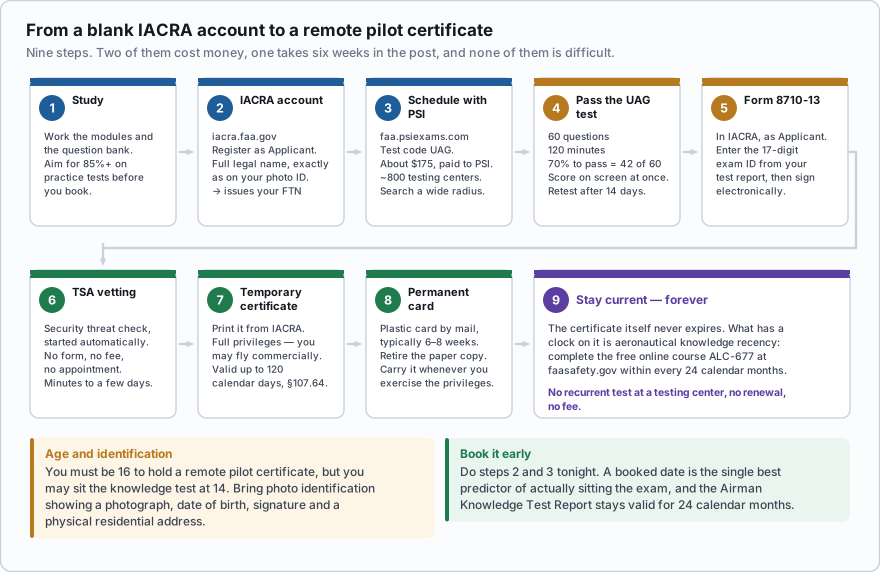
Step 1 — FAA Form 8710-13 in IACRA
You leave the testing center with your Airman Knowledge Test Report, which carries your score and a 17-digit exam identification number. That number is what links your test result to your application. The result also posts electronically, generally within about 48 hours, so if IACRA cannot find your test on the same evening, wait a day and try again.
- Log in to iacra.faa.gov with the account you created in lesson 6.1, as an Applicant.
- Choose Start New Application. Application type: Pilot. Certifications: Remote Pilot. Then Start Application.
- Work through the sections. IACRA is populating FAA Form 8710-13, the Remote Pilot Certificate application.
- Enter your 17-digit exam ID from the test report when asked for knowledge test information.
- Review every page. An error here delays the certificate and is tedious to correct afterwards.
- Sign electronically and submit. You will receive a confirmation email.
Step 2 — the TSA security threat assessment
Submitting the application automatically initiates a TSA security threat assessment. You do nothing - no separate form, no fee, no appointment. The TSA screens the application against its watch lists and returns a result to the FAA.
For the overwhelming majority of applicants this completes within a few minutes to a few days. When it clears, you receive an email telling you that you may log back into IACRA and print your temporary certificate. If it takes longer than a couple of weeks, that is unusual but not alarming - it is a queue, not an accusation.
Step 3 — temporary certificate, then the permanent card
Once the TSA vetting clears, log back into IACRA and print your temporary remote pilot certificate. This is a full-privilege certificate. You may fly commercially the moment you have it in hand.
A temporary remote pilot certificate is issued for up to 120 calendar days. It expires on the expiration date shown on it, upon receipt of the permanent certificate, or upon receipt of notice that the certificate sought is denied or revoked.
The permanent plastic card arrives by mail, typically within six to eight weeks. When it does, retire the paper copy. If 120 days pass and no card has arrived, contact the FAA Airman Certification Branch - do not keep flying on an expired temporary.
- The temporary certificate is valid for up to 120 calendar days and carries full privileges
- Under 107.7 you must have the remote pilot certificate and identification in your physical possession and readily accessible whenever you exercise the privileges of the certificate
- You must present them on request to the Administrator, an authorized NTSB representative, any federal, state, or local law enforcement officer, or an authorized TSA representative
- Under 107.77, after 30 days from a change of permanent mailing address you may not exercise your privileges until you have notified the FAA
You printed your temporary certificate three weeks ago and the permanent card has not arrived. A client wants you to fly tomorrow. May you?
- No - you must wait for the permanent plastic card
- Yes - the temporary certificate carries full privileges for up to 120 calendar days
- Only if you also carry your Airman Knowledge Test Report
Answer: B. The temporary certificate issued under 107.64 is valid for up to 120 calendar days and grants the same privileges as the permanent one. Carry it, along with government-issued photo identification, in your physical possession and readily accessible.
Register the aircraft — the certificate is not enough
Your certificate makes you legal. It says nothing about your aircraft. Under Part 107 every small unmanned aircraft must be registered before it flies, at any weight. The 0.55-pound exemption in §48.15 applies only to aircraft flown *exclusively* under the recreational exception, so it never covers a Part 107 flight.
- Register at FAADroneZone under Part 48. The fee is $5 per aircraft and registration is valid for 3 years.
- Under Part 107 each aircraft is registered individually and receives its own registration number. That differs from recreational registration, where one number covers all of a person's aircraft.
- The registration number must be displayed on the exterior surface of the aircraft, legible and readable without tools.
- Keep the Certificate of Aircraft Registration available - electronically is fine - whenever you fly, per 107.13 and 91.203(a)(2).
- If you use standard Remote ID or a broadcast module, the aircraft or module serial number must be listed on the Certificate of Aircraft Registration.
Staying current — and the thing everyone gets wrong
Here is the single most misstated fact in Part 107, and you will hear it repeated by people who should know better. Your remote pilot certificate never expires. There is no expiry date on the card and no renewal to pay for.
A person may not exercise the privileges of a remote pilot in command unless, within the previous 24 calendar months, that person has completed an initial aeronautical knowledge test, or completed recurrent training covering the areas in 107.73, in a manner acceptable to the Administrator.
What has a clock on it is your aeronautical knowledge recency, and since 6 April 2021 the way you satisfy it is a free online course, not a test at a testing center. The course is ALC-677, Part 107 Small UAS Recurrent, hosted on the FAA Safety Team site at faasafety.gov. It takes an hour or two, you may retry any question, and you print a certificate of completion at the end. Part 61 certificated pilots who meet the 61.56 flight review requirement use ALC-515 instead.
Calendar months means the end of the month, not the anniversary of the day. Pass your initial test on 12 March 2026 and your recency runs through 31 March 2028. Keep the completion certificate with your records - there is no central place a law enforcement officer can look it up in the field.
You will be told, confidently and often, that your Part 107 license expires every two years and you have to retake the test. Both halves are wrong. The certificate does not expire, and the recurrent requirement has been a free online course since April 2021, not a retest. Some study material still describes the old recurrent knowledge test at a testing center. It no longer exists.
It is 20 months since you passed the initial knowledge test. What must you do to keep exercising remote PIC privileges?
- Nothing yet - complete free online recurrent training (ALC-677) before 24 calendar months elapse
- Schedule a recurrent knowledge test at a PSI testing center
- Renew the certificate through IACRA and pay the renewal fee
Answer: A. Section 107.65 requires an initial test or recurrent training within the previous 24 calendar months. Since 6 April 2021 recurrency is satisfied by the free online course ALC-677 on faasafety.gov. There is no recurrent test at a testing center, no renewal, and no fee - and the certificate itself never expires.
Getting the first paid job
The certificate is the beginning of the business, not the end of it. What actually converts it into income, in rough order of how much difference each makes:
- A portfolio of five to ten finished pieces in one niche. Not a reel of everything you have ever shot - five roof inspections, or five listings, done to the standard a client would pay for. Shoot them free if you have to.
- Pick one niche and be specific. Real estate. Roof inspection. Construction progress. Agriculture. Being the person who does roofs beats being a drone pilot who does anything.
- Liability insurance. On-demand hourly policies exist and are inexpensive. Most commercial clients require a certificate of insurance before you set foot on site, and many will name themselves as additionally insured.
- A simple, written deliverable standard. How many images, at what resolution, delivered how, within how long. Clients pay for predictability more than for artistry.
- Local outreach beats a website. Roofing companies, real estate agents, surveyors, and general contractors within twenty miles of you. Show up with the portfolio.
- Keep flight and maintenance logs from your very first flight. They cost nothing, they establish your maintenance schedule, and they are what you produce if anyone ever asks what happened.
Beyond the test: build a personal minimums sheet in your first month - your own wind limit, your own visibility limit, your own minimum battery to land on, your own rule about flying tired. Set them when you are calm at a desk, not when a client is standing next to you at four in the afternoon with the light going. Those numbers are the difference between the pilots who have a long career and the ones who have an incident report.
That is the whole path, from a blank IACRA account to a paying job. You learned a body of material most people find intimidating, you passed a federal aviation knowledge test, and you are now one of a few hundred thousand people in the country lawfully able to fly a drone for hire. Go do the work.
- File FAA Form 8710-13 in IACRA using the 17-digit exam ID from your Airman Knowledge Test Report, then sign and submit electronically
- Submission automatically triggers a TSA security threat assessment; you do nothing and pay nothing
- Print the temporary certificate from IACRA when vetting clears - it carries full privileges for up to 120 calendar days under 107.64
- Under 107.7 you must carry the certificate and identification in your physical possession and readily accessible whenever you fly
- Register every aircraft individually under Part 48 via FAADroneZone, at any weight - $5, 3 years, number displayed on the exterior
- The certificate never expires. Aeronautical knowledge recency requires the free online ALC-677 course every 24 calendar months
- For the first paid job: a focused portfolio, one niche, liability insurance, a written deliverable standard, and logs from day one